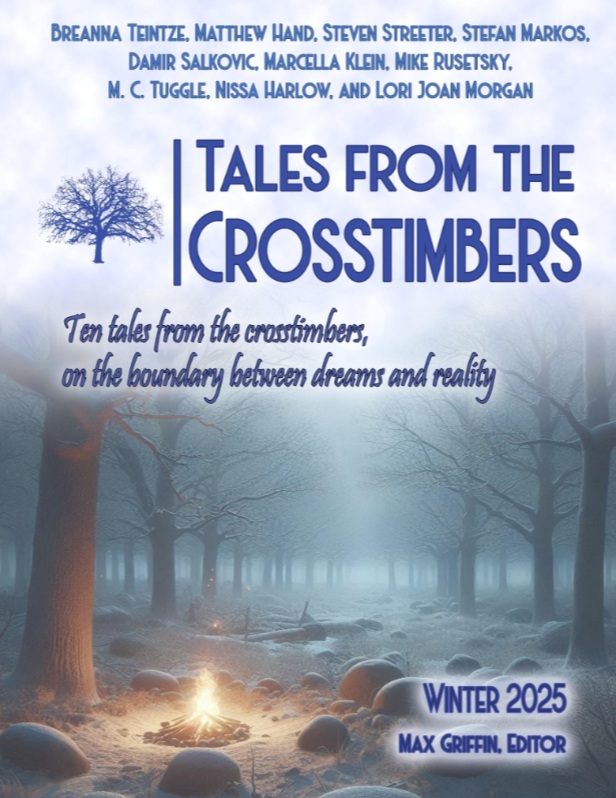
I’m pleased to announce that the winter issue of Tales from the Crosstimbers is now available on Amazon. It includes my story “At the Edge of the Crater.”
Jak, a newcomer to the mining colony on the asteroid 16 Psyche, ignores his partner’s warning not to travel alone into the asteroid’s Badlands. There’s a rich new vein of iridium to claim, and Jak wants first pick. All he has to do to win the race is to venture into a forbidding impact crater.
I wrote this tale as a futuristic version of “To Build a Fire” by Jack London. In “Crater,” the protagonist lets greed drown out the warnings of his more experienced partner. Space, like all of nature, often overwhelms us with its beauty and mystery but can also snuff out human life in an instant. To understand ourselves, and to grasp our place in the universe, we must realize we are mites compared to the limitless expanse of space. Survival is a struggle, one best waged with friends at our side.
Tales from the Crosstimbers features speculative tales “grounded in strong characters interacting with a gritty, realistic world.” So it’s the perfect venue for this story. I’m honored to be included with this line-up of authors.
I’m pleased to announce the latest issue of Tales from the Crosstimbers is now available on Amazon. It includes my story “A Rookie Mistake.”
Deputy Malcolm Lamb, the newest member of the marshal’s office on the rowdy mining asteroid Psyche, gets a chance to prove himself to the older deputies when he’s sent to find a stolen minebot. But when he finally catches up with the culprit, he’s forced to question where his duty lies. The choice he makes shows heroic action can spring from simple kindness, from our realization we are connected to others.
I’ve long imagined what mining would be like in the asteroid belt, a vast region rich with precious metals, yet forbidding and treacherous. To me, the combination of grizzled prospectors of the Old West and space exploration is endlessly fascinating. My first foray to the asteroid Psyche was “The Calculus of Karma,” the cover story in the June, 2020 issue of Mystery Weekly Magazine.
The return trip there was long overdue, and I’m thrilled with the result. Check it out! It’s available on Amazon as a Kindle or paperback.
Here’s a picture of me from 1975. I’m at the video board at WGHP TV in High Point, North Carolina. Weekends and summers in high school and college, I worked at the local TV station, running the projector and editing films. I got to see a lot of classic movies, especially the horror and science fiction films we featured on Shock Theater, which aired Saturday at midnight.
That first job makes a lasting impact, often in ways we don’t recognize. Like many truths about ourselves, it often takes an outsider to point that out. For example. I was pleasantly surprised by this review of Aztec Midnight, my first book:
“Tuggle skillfully ends most of his sections with hooks redolent of the weekly movie suspense serials that provided filler between Saturday matinee double features.” — Gordon Osmond, author of Slipping on Stardust
As soon as I read it I realized Osmond was right. I’d absorbed many of the tropes from the science fiction movies I’d edited, and as a kid, loved watching “B” serial films like Rocket Man.
Recreating the fun and adventure of those old classics remains my goal in the stories I write today. And if they get published? Why, that’s just icing on the cake.
Poe’s influence on world literature is profound and far reaching. He inspired many writers, including H. P. Lovecraft, Stephen King, and Ray Bradbury, and also defined modern horror, science fiction, and crime fiction.
It’s Edgar Allan Poe’s 215th birthday! In memory of this great writer of science fiction, fantasy, and mystery, I’m offering my observations about Poe’s creepiest tales, the ones that deal with the ultimate terror of human existence — being buried alive.
My tribute to Poe, “The Premature Burial,” is featured in the latest post at the DMR Books blog.
SPOCK: Incredible power. It can’t be a machine as we understand mechanics. KIRK: Then what is it? GUARDIAN: (The doughnut pulses bright in time with the words) A question. Since before your sun burned hot in space and before your race was born, I have awaited a question. KIRK: What are you? GUARDIAN: I am the Guardian of Forever. KIRK: Are you machine or being? GUARDIAN: I am both and neither. I am my own beginning, my own ending. SPOCK: I see no reason for answers to be couched in riddles. GUARDIAN: I answer as simply as your level of understanding makes possible.
From July 19th to August 10th, you can snag The Explore Sci-Fi Worlds Bundle, an outstanding selection of ebooks from independent and small press fantasy writers — and support war victims in Ukraine. This incredible offer includes my story A Tree Amid the Wood, as well as bonus volumes for donations of $20 or more, including:
We Dare – No Man’s Land edited by Jamie Ibson and Chris Kennedy
A Legacy of Stars by Danielle Ackley-McPhail
Androids & Aliens by J. Scott Coatsworth
Save the World edited by J. Scott Coatsworth
Daughters of Frankenstein edited by Steve Berman
Mirror Shards Vol. 2 edited by Thomas K. Carpenter
Tales of the Dissolutionverse by William C. Tracy
It’s a great opportunity to support a worthy cause and find new authors to love. Or rekindle your love for an old one. Remember, this offer ends August 10. Gift cards are available at Story Bundle.
“A 25-year science wager has come to an end. In 1998, neuroscientist Christof Koch bet philosopher David Chalmers that the mechanism by which the brain’s neurons produce consciousness would be discovered by 2023. Both scientists agreed publicly on 23 June, at the annual meeting of the Association for the Scientific Study of Consciousness (ASSC) in New York City, that it is an ongoing quest — and declared Chalmers the winner.”
Koch made the bet on his confidence that science would pinpoint the exact location in the brain that produced consciousness because of the advances in magnetic resonance imaging (MRI), which reveals changes in blood flow associated with brain activity. The wager, a case of wine, added incentive in addition to both bragging rights and the lure of discovery.
So the game was on!
As the Nature article concludes, the researchers confirmed “areas in the posterior cortex do contain information in a sustained manner,” and that “some aspects of consciousness, but not all of them, could be identified in the prefrontal cortex.” Koch admits his theories were not totally proven, and, being a scientist of his word, paid up.
Who says science isn’t entertaining?
What’s distressing, however, is how proponents of dualism are using this story as some kind of vindication. The notion that humans are unique assemblages of mind and matter and therefore outside of and superior to nature goes back to Plato, the Vedic writers, and that notorious rascal Rene Descartes. One commenter claimed Koch’s failure to prove his hypothesis as vindication that we are truly “ghosts in the machine.”
Interesting they used that term, which was coined by philosopher Gilbert Ryle in his argument against dualism. He deemed the position as a gigantic category mistake. I love his illustration: A visitor to a university may see classrooms, libraries, and other parts of the campus, but at the end of the tour, asks, “But where is the university?” not realizing the term refers to all of its components working as a unit. Similarly, the various sections of the brain handle their own functions, and we use the term “consciousness” to refer to all those functions working in harmony.
Why is this important? If our supposedly supernatural minds make us superior, all of nature is dumb matter good for nothing but exploitation. This not only imperils nature but alienates us from the world in which we live. The next step is contempt for our own bodies. A philosophy that leads to ecological ruin and rootlessness is an evil that must be exposed for what it is. And just as Koch and Chalmers could entertain and enlighten us with their little joust for science, we can enjoy stories that both inspire and force us to consider where we’re going and where we could end up.
Renowned fiction podcaster Tall Tale TV has published my short story “Winter Star.” Here’s what managing editor Chris Herron had to say: “Have just read your story. I loved it. It feels almost nostalgic in the way you wrote it. Like an 80’s sci-fi movie.“
I’m honored. I was aiming for a retro feel, something along the lines of Stand By Me, Close Encounters of the Third Kind, and Super 8.
It’s 1988. High school senior Trey Evans borrows his father’s pickup to haul a shortwave radio to the top of Winter Star Mountain, one of the highest peaks in the southern Appalachians. Trey and his friend Booney hope to intercept rare, elusive transmissions with the help of their high altitude monitoring post and a once-in-a-lifetime solar storm.
But their efforts attract unexpected attention from a mysterious visitor.
Tall Tale TV features sci-fi and fantasy authors from around the world. The site was a finalist for the now-discontinued Parsec Awards, which recognized outstanding science fiction podcasters.
This little story is my love letter to the glory days of shortwave radio. In its heyday, shortwave was the Wild West of the radio spectrum, where you might hear spies, drug smugglers, or NASA. There’s also a wistful nod to my camping expeditions of long ago to the dark, magnificent Appalachian Mountains.
Nostalgia, suspense, adventure — it’s all there. It’s also available on YouTube and Facebook.
In my story, biotech pioneer Franklin Pratt builds a living house that senses and responds to the needs of its owner. Franklin’s invention has the potential to reduce homelessness, pollution, and social isolation, but a stroke robs him of the ability to communicate. And worse — he fears and distrusts the only person who can help him.
Little Blue Marble publishes speculative fiction and articles aimed at raising awareness about the environment. I can’t tell you how proud I am to have my work included with so many fine authors.
My reverence for nature inspires both my fiction and blog posts about the wild places I’ve explored, from maritime forests to deserts. One of the themes I keep returning to in my writing is the mismatch between human needs and the unnatural straitjacket of modern life. Culture and nature should complement each other. Media analyst Arthur Asa Berger has observed that “culture” comes from the Latin “colere,” which means to tend to the earth and cultivate. Humans, like all other living things, need a nurturing environment. I believe the disconnect between human nature and creeping global homogeniety is at the root of modern neuroticism.
But don’t let the serious subject matter fool you — this book features well-crafted, entertaining stories. Little Blue Marble’s 2022 Anthologynot only promotes a vital cause but will make a great Christmas present.





 M.C. Tuggle, Writer