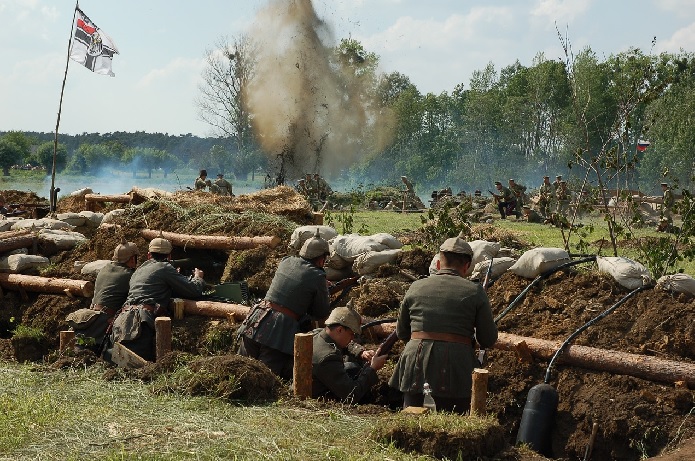
I just finished Aleksandr Solzhenitsyn’s August 1914. This work is stunning in its scope and insights. Imagine Tom Clancy’s Red Storm Rising and Tolstoy’s War and Peace rolled up into one challenging and exhilarating read. Like Tannenberg, the early WWI battle it’s based on, August 1914 inexorably pulls the reader headlong into a relentless, sweeping tragedy.
Next month will be the 109th anniversary of that world-shaking battle, and we’re still coping with its aftermath. Though Russia managed to surprise the Germans by putting 230,000 troops into the field versus the Germans’ 150,000, Russian forces were thoroughly routed. This was an early body-blow to Russia, which never fully recovered. The Russian people’s suffering eventually led to their desperate support of the one group that promised peace, the Bolsheviks, who, once in power, inflicted even more misery upon them.
Solzhenitsyn knew war, having fought as a captain in World War II, and was all too familiar with the colossal mistakes that petty men were capable of. It’s been said that while amateurs (me, for example) study battle strategy, experts study logistics, and Russian logistics officers were mind-numbingly clueless. When the beans and bullets fail to reach the boots on the ground, armies lose battles. Also, both Solzhenitsyn’s epic and the historical record tell us the Russian commanders did not bother to encode their radio communications, effectively broadcasting their plans to the attentive Germans.
Not only did Solzhenitsyn know war, he knew the human soul, which gives this work the depth missing from modern-day war novels. A recurring theme is the inadequacy of the human mind to grasp the complexities of large-scale operations. And while generals on both sides often made life and death decisions based on inadequate or completely false information, the actions they took would certainly lead to unforeseen death and suffering. They struggled with a double-edged curse – enormous power lay in their hands, but they did not know what to do with it.
At one point, the Russian commander, Alexander Samsonov, tries to steady his nerves as he assembles his battle plans:
“The fate of battalions, even whole regiments, might be affected by chance factors such as the lighting, the blink of an eye, the thickness of a finger, a blunt pencil, or whether one is standing or sitting at the table. Samsonov strove conscientiously and to the best of his ability to arrive at reasonable solution. Sweat dripped onto the map and Samsonov mopped his forehead with a handkerchief—perhaps because the hot, sultry day made it stuffy in the council chamber.” (p. 332)
Was it the heat of the day that made Samsonov sweat?
We grope our way through battles, never certain which choice will save or squander lives. That’s war – and that’s life.
 M.C. Tuggle, Writer
Your thinking is spot on, and your writing is excellent. Thank you for this book review, Mike. Great post!
LikeLiked by 1 person
Jennie,
That’s high praise coming from a teacher. Very nice of you.
LikeLiked by 1 person
Thanks so much for your kind words, Mike. Your writing and posts (and thinking) are terrific to read.
LikeLiked by 1 person
Sounds an interesting read Mike
LikeLiked by 2 people
June,
It’s one of those works you’re sad to finish.
LikeLike
I’ve never read Solzhenitsyn. It’s about time I did.
LikeLiked by 2 people
August 1914 is a great place to start. Or his lively prose poems, which are available online.
LikeLiked by 1 person