
One of the more colorful naval traditions Americans inherited from Mother England is the initiation of sailors and passengers the first time they cross the equator. Think of it as a baptism at sea.
My father, Clayton Tuggle, served on the USS Birmingham in World War II. Seriously battered and burned in the Battle of Okinawa, the Birmingham limped to Guam and later to Honolulu for extensive repairs. The sailors enjoyed their shore leave, but knew the ship was being prepared for the final invasion of Japan. However, Japan’s surrender on August 15 changed everything. The Birmingham’s new mission was to sail to Brisbane to serve as the flagship for the Commander of U. S. Naval Forces in Australia.
On September 15, 1945, as the Birmingham steamed toward Leyte Gulf, Captain R. H. Cruzen received an urgent request from King Neptune, the monarch of the sea. Neptune was greatly troubled that the ship was infested with Polywogs who had never before crossed the equator. Captain Cruzen graciously accepted the King and his consort, Salacia, the lovely goddess of the sea (in photo above).

The Polywogs were so numerous and so green that King Neptune summoned the Devil to oversee the purification process. The Devil enthusiastically administered the proper cure to the Polywogs, including immersion in seawater, crawling through kitchen refuse, and wearing women’s clothes.
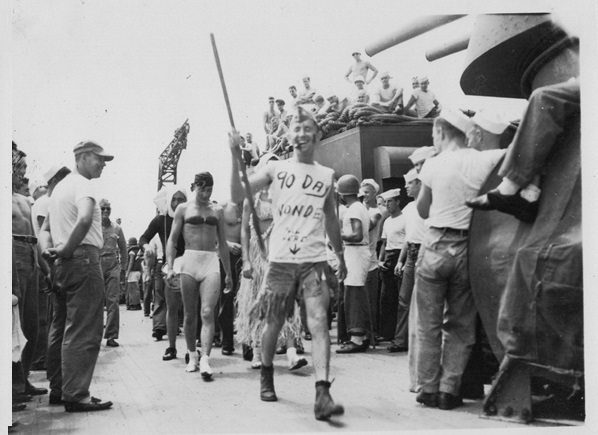
Officers were not spared. Above, a recent Midshipman School graduate (90-day wonder) marches cheerfully to his doom. Sailors who had previously been initiated – Shellbacks – look on approvingly.
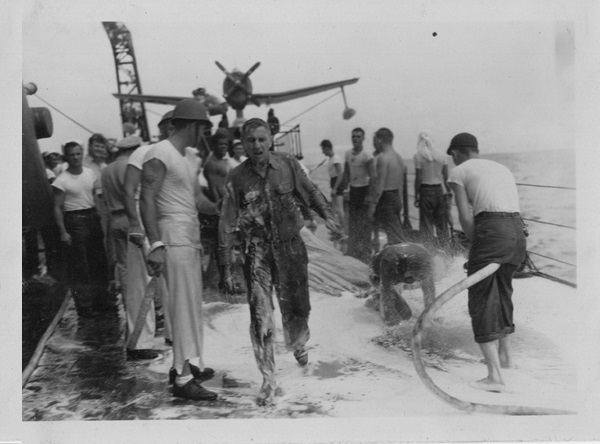
Not even the pilot of the Birmingham’s single seaplane was spared from the Devil’s not-so-tender mercies.
With their sins forgiven, their greenness thoroughly washed away, and their worthiness proven, the Polywogs graduated to the rank of experienced Shellbacks and were inducted into the Solemn Mysteries of the Ancient Order of the Deep. Sailors got to let off steam, and King Neptune acquired hundreds of loyal subjects.

 M.C. Tuggle, Writer