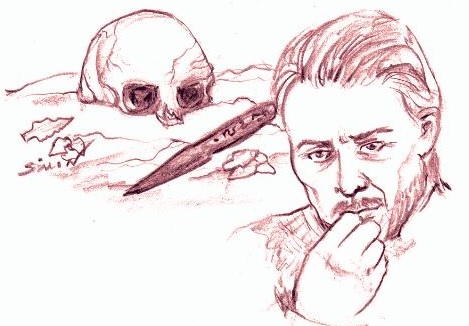
“The rejection slip is very hard to take on an empty stomach. There were times when I’d sit at that old wooden table and read one of those cold slips that had been attached to a story I had loved and worked on very hard and believed in, and I couldn’t help crying.”
– Ernest Hemingway
Category Archives: Hemingway
“If you’re a writer, declare yourself the best writer!”
Here’s an inspirational scene from one of my favorite movies, Midnight in Paris. Gil Pender, a young writer on vacation in Paris, climbs into a cab at the stroke of midnight, and when he gets out, he finds himself in 1920s Paris, where he encounters many literary and artistic legends. In the following clip, Gil gets to discuss writing with Ernest Hemingway. Gil can’t resist asking for a small favor:
Gil: Would you read it?
Ernest Hemingway: Your novel?
Gil: Yeah, it’s about 400 pages long, and I’m just looking for an opinion.
Ernest Hemingway: My opinion is I hate it.
Gil: Well you haven’t even read it yet.
Ernest Hemingway: If it’s bad, I’ll hate it because I hate bad writing, and if it’s good, I’ll be envious and hate it all the more. You don’t want the opinion of another writer.
Gil: You know what it is? I’m having a hard time getting somebody to evaluate it.
Ernest Hemingway: You’re too self-effacing; it’s not manly. If you’re a writer [slams table with his fist], declare yourself the best writer.
Ha! Yeah, that sounds like Ernie. And he’s right: It takes more than a little self-confidence to put your heart into a story and hit that “Send” key. You don’t know what the person judging your work is going to think. That’s scary — definitely not for the weak of heart.
Jami Gold recently addressed this in a great blog post titled “What Helps You BE a Writer?”:
Outside of any writing skill that we may or may not have, we also bring other aspects of ourselves to the writing-journey table. We might have personality traits that help us want to be a writer, such as a love of storytelling or a desire to entertain, educate, or inspire others.
Or we might have personality traits that help us stick with writing, even during the bad times. As Delilah mentioned in her post, stubbornness (tenacity, perseverance, determination, etc.) ranks high in many of the replies.
We might have enough of an ego that we think others are interested in what we have to say. Or we might have a desire to prove ourselves worthy of being listened to.
Jami and Ernie are on to something: If you’re going to write, go big. Go brazen. And keep going.
Best Fiction and Writing Blogs
The best fiction and writing blog posts from around the ‘net, with advice and inspiration guaranteed to make you a literary adventurer. Compiled by ernie.
Jeremy Anderberg – The Libraries of Famous Men: Ernest Hemingway
Krishan Coupland – How to Submit Your Writing
P. S. Hoffman – How I Learned to Stop Worrying and Love the Outline
J.C. Wolfe – 7 Ways I Find Writers’ Blogs
Jami Gold – What Does Your Genre’s Theme Promise to Readers?
Cathleen Townsend – Editor’s List of Common Mistakes
A. J. Humpage – The Art of Captivating First Lines
Hemingway’s Paris Memoir Flies Off Shelves in Show of Defiance
From Bloomberg Business:
Ernest Hemingway’s memoir about the time he spent lounging in cafes and bars in 1920s Paris has become an unlikely totem of defiance against the terrorist attacks that claimed 129 lives in the City of Light last Friday.
Hemingway’s ‘‘A Moveable Feast,’’ or “Paris est une Fete” in French, is flying off the shelves at bookstores across the French capital and is the fastest-selling biography and foreign-language book at online retailer Amazon.fr. Daily orders of the memoir, first published in 1964, three years after the American author’s death, have risen 50-fold to 500 since Monday, according to publisher Folio.
Copies have been laid among the flowers and tributes at the sites of the massacres, and people are reading the book in bars and cafes, Folio spokesman David Ducreux said Thursday. Orders surged after a BFM television interview on Monday with a 77-year-old woman called Danielle, who urged people to read the memoir as she laid flowers for the dead. The video was shared hundreds of times on social media.
I think this is a marvelous way to express solidarity with the people of Paris in the wake of last week’s horrific massacre. That said, the article’s description of A Moveable Feast as an account of the time Hemingway “spent lounging in cafes and bars in 1920s Paris” misses the mark. Yes, there are sensuous descriptions of how he and his friends “ate well and cheaply and drank well,” but the little masterpiece also reveals how Hemingway mastered the craft of fiction, including how he dealt with rejection letters. Hemingway’s vignettes of Ezra Pound, Gertrude Stein, and F. Scott Fitzgerald are not to be missed.
If you haven’t read it, pick up a copy at the library or book store. And let folks know you’re doing it for Paris.
Why Writers Run
Most folks think of writing as a monkish, abstract endeavor more akin to meditation than exertion. But there’s a vital connection between the discipline of putting one word after another and taking one stride after another, as Nick Ripatrazone explains in this must-read Atlantic article:
The steady, repetitive movement of distance running triggers one’s intellectual autopilot, freeing room for creative thought. Neuroscientists describe this experience as a feeling of timelessness, where attention drifts and imagination thrives. …
Since I’ve returned to distance running, I’ve changed the way I think about writing. Writing exists in that odd mental space between imagination and intellect, between the organic and the planned. Runners must learn to accept the same paradoxes, to realize that each individual run has its own narrative, with twists and turns and strains.
Writers and runners use the same phrase—“hit my stride”—to describe the moment when exertion and work become joy. Writers stuck on a sentence should lace their sneakers and go for a jog, knowing that when they return, they will be a bit sweatier, more tired, but often more charged to run with their words.
We know a sound mind in a healthy body is sharper and livelier because mind and body are not two separate entities. Each one affects the other. But Ripatrazone expands on this truth by proposing that running helps the mind harmonize with the rhythm and tempo of the body, stimulating the writer’s ability to “focus on a single, engrossing task and enter a new state of mind entirely—word after word, mile after mile.”
I fully agree, and would add that other physical activities also promote writing ability. I’ve found that weightlifting, a strenuous, repetitive, and somewhat dangerous activity, sharpens my focus and endurance, two qualities essential to getting words onto paper. Yukio Mishima even wrote a book, Sun and Steel, about the benign discipline lifting weights imposed on his writing. And Ernest Hemingway relied on boxing to help him break occasional writer’s block.
Best Fiction and Writing Blogs
The best fiction and writing blog posts from around the ‘net, all guaranteed to make you a literary adventurer. Compiled by ernie.
Jacqueline Seewald – Tips On Adding Symbolism In Fiction
Lori Rensink – Just Words And Just Music
Gary Gautier – The Architecture of Narrative
Assia Shahin – Uffizi Galore
Jay Dee Archer – Authors Answer 33 – The Writing Process
Timothy Pike – “Doing interesting stuff” inspires this tireless writer
Nihar Pradhan – Great Bloggers Are Great Thinkers
And as an extra bonus: Ancient Origins. This webzine is updated daily with fascinating articles about Science and Space, History and Archaeology, Evolution, and Strange Phenomena. A gold mine of writing ideas!
Best Fiction and Writing Blogs
The best fiction and writing blog posts from around the ‘net, all guaranteed to make you a literary adventurer. Compiled by ernie.
Sue Vincent- 10 Places to Find Ideas
Katie McCoach – What To Do After Writing The First Draft of Your Novel
Alice Osborn – How to Enjoy a Poem: Happy Poetry Month
Jack Sutter – Making Artful Choices
Alysha Kaye – On Teaching and Writing
E.K. Preston – Best Opening Lines of All Time
A.D. Martin – So, I Binge-watched Daredevil on Netflix
Jeff Wills – Changing Our Mind
Quote of the day
Why I Read

“Bret Lassiter,” by Marge Simon
I think writers are as necessary as doctors. Like a doctor, the writer performs the vital functions of diagnosing patients, advising them, and healing them.
Diagnosing: Through the generations, writers, like doctors, pretty much say the same things over and over, but in fresh, personal language. That’s because the human condition does not change. We must be told we are mortal, that we can and will get hurt, and that we should take better care of ourselves and loved ones.
Ernest Hemingway’s magnificent tale of war and loss in A Farewell To Arms remains one of the most powerful and vivid tales of the madness of World War I. Of course, its narrative is timeless because humanity is still being dazed and bloodied by conflict and loss. I still recall reading that book in high school, and how it shook me to the core the way it made the abstraction of death real. In the powerful final scene, the protagonist, Frederic Henry, makes the nurses leave the room where his wife has died in childbirth. He is determined to say goodbye. However, something is wrong:
But after I had got them out and shut the door and turned off the light it wasn’t any good. It was like saying good-bye to a statue. After a while I went out and left the hospital and walked back to the hotel in the rain.
Feel the lid of the coffin slamming down? The “statue” image chilled my marrow at age 17. An invaluable lesson.
Advising: Because death and suffering are real, the writer, like a good doctor, must caution readers about what they should and should not do. Sometimes we don’t listen, and need to be slapped in the face and reminded there are certain risks we’re taking without thinking about the possible consequences. Larry Niven’s “Bordered in Black” is one breathtaking example. I won’t give away the plot, but the story begins with Earth’s most famous astronaut destroying the first faster-than-light ship, from which he’s just explored the farthest reaches of space. Niven’s advice is this: Out there in the dark unknown, in alien places where the light from the nuclear fires we call stars cannot reach, there may have arisen Beings that are nothing like the cuddly ET. Nothing at all.
Something to think about before we broadcast more “Come on down!” messages from our radio telescopes.
Healing: And finally, no matter how well we take care of ourselves, pain and loss will find us. One story I enjoy re-reading is Yukio Mishima’s “Death in Midsummer,” which is about the accidental drowning of two children. The parents struggle to recover, and are finally able to return to the beach where their children died:
From beneath the clouds, the sea came toward them, far wider and more changeless than the land. The land never seems to take the sea, even its inlets. Particularly along a wide bow of coast, the sea sweeps in from everywhere.
The waves came up, broke, fell back. Their thunder was like the intense quiet of the summer sun, hardly a noise at all. Rather an earsplitting silence. A lyrical transformation of the waves, not waves, but rather ripples one might call the light derisive laughter of the waves at themselves – ripples came up to their feet and retreated again.
Those lines, I think, illustrate the surprising and timeless beauty that can emerge from harsh reality. By confronting our mortal condition, we appreciate more intently what it means to live. Finding that beauty is often difficult and fleeting, but it is possible, and literature helps us see it.
And those are the reasons I read. And write.
A Conversation with Adam Long of the Hemingway-Pfeiffer House
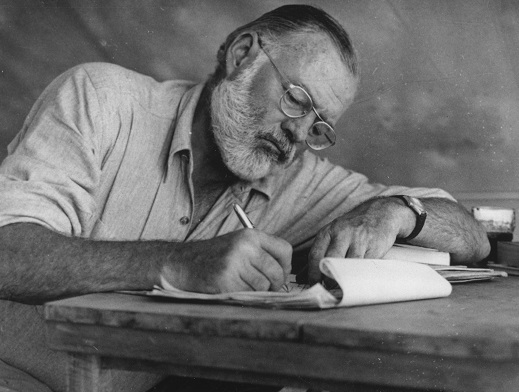
Here’s a little treasure for all of us Hemingway fans, an interview with Adam Long, the director of the Hemingway-Pfeiffer House. Mr. Long knows what he’s talking about. He comes to the job with a background in American modernism and a PhD in literature. Long shares his knowledge about the author’s time at his second wife’s family home, a period of Hemingway’s life many of us aren’t familiar with. Great insights into Hemingway’s writing habits and thought.
My only gripe with the interview is this prologue: “Hemingway once explained: ‘There’s nothing to writing. All you do is sit down at a typewriter and bleed.'”
It’s very unlikely Hemingway said that. That vivid quote probably came from Red Smith, a sportswriter. Hemingway’s weapon of choice was the pencil (See A Moveable Feast), and he wrote standing.