“For every Southern boy fourteen years old, not once but whenever he wants it, there is the instant when it’s still not yet two o’clock on that July afternoon in 1863, the brigades are in position behind the rail fence, the guns are laid and ready in the woods and the furled flags are already loosened to break out and Pickett himself with his long oiled ringlets and his hat in one hand probably and his sword in the other looking up the hill waiting for Longstreet to give the word and it’s all in the balance, it hasn’t happened yet.”
One of the more colorful naval traditions Americans inherited from Mother England is the initiation of sailors and passengers the first time they cross the equator. Think of it as a baptism at sea.
My father, Clayton Tuggle, served on the USS Birmingham in World War II. Seriously battered and burned in the Battle of Okinawa, the Birmingham limped to Guam and later to Honolulu for extensive repairs. The sailors enjoyed their shore leave, but knew the ship was being prepared for the final invasion of Japan. However, Japan’s surrender on August 15 changed everything. The Birmingham’s new mission was to sail to Brisbane to serve as the flagship for the Commander of U. S. Naval Forces in Australia.
On September 15, 1945, as the Birmingham steamed toward Leyte Gulf, Captain R. H. Cruzen received an urgent request from King Neptune, the monarch of the sea. Neptune was greatly troubled that the ship was infested with Polywogs who had never before crossed the equator. Captain Cruzen graciously accepted the King and his consort, Salacia, the lovely goddess of the sea (in photo above).
The Polywogs were so numerous and so green that King Neptune summoned the Devil to oversee the purification process. The Devil enthusiastically administered the proper cure to the Polywogs, including immersion in seawater, crawling through kitchen refuse, and wearing women’s clothes.
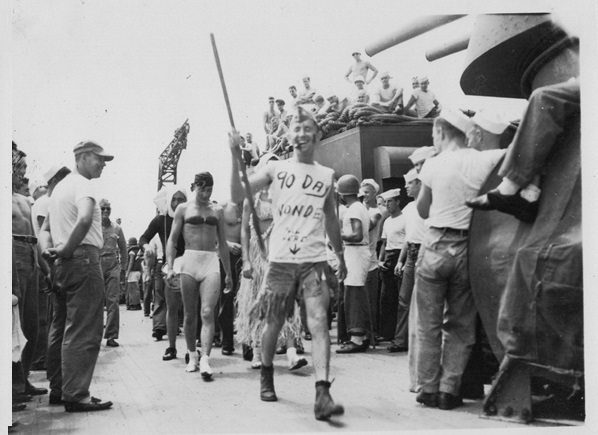
Officers were not spared. Above, a recent Midshipman School graduate (90-day wonder) marches cheerfully to his doom. Sailors who had previously been initiated – Shellbacks – look on approvingly.
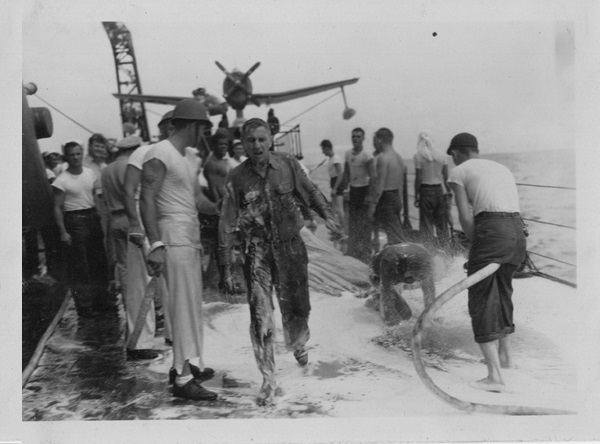
Not even the pilot of the Birmingham’s single seaplane was spared from the Devil’s not-so-tender mercies.
With their sins forgiven, their greenness thoroughly washed away, and their worthiness proven, the Polywogs graduated to the rank of experienced Shellbacks and were inducted into the Solemn Mysteries of the Ancient Order of the Deep. Sailors got to let off steam, and King Neptune acquired hundreds of loyal subjects.
“When you remember the past, you are not remembering it as it was. You are remembering it as it is. It is a vision or a dream, present with you in the present, alive with you in the only time you are alive.”
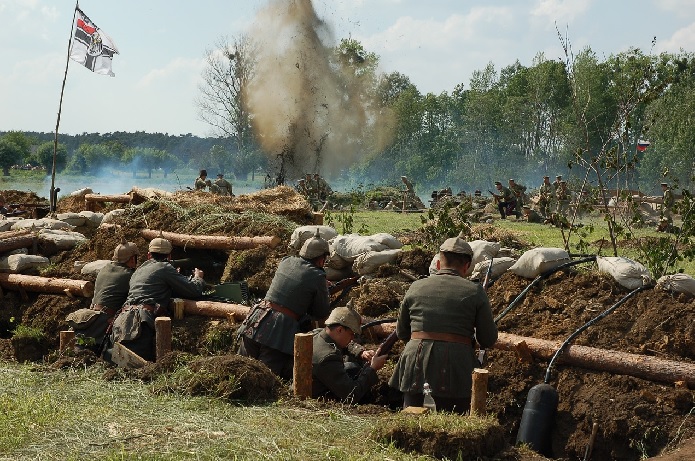
I just finished Aleksandr Solzhenitsyn’s August 1914. This work is stunning in its scope and insights. Imagine Tom Clancy’s Red Storm Rising and Tolstoy’s War and Peace rolled up into one challenging and exhilarating read. Like Tannenberg, the early WWI battle it’s based on, August 1914 inexorably pulls the reader headlong into a relentless, sweeping tragedy.
Next month will be the 109th anniversary of that world-shaking battle, and we’re still coping with its aftermath. Though Russia managed to surprise the Germans by putting 230,000 troops into the field versus the Germans’ 150,000, Russian forces were thoroughly routed. This was an early body-blow to Russia, which never fully recovered. The Russian people’s suffering eventually led to their desperate support of the one group that promised peace, the Bolsheviks, who, once in power, inflicted even more misery upon them.
Solzhenitsyn knew war, having fought as a captain in World War II, and was all too familiar with the colossal mistakes that petty men were capable of. It’s been said that while amateurs (me, for example) study battle strategy, experts study logistics, and Russian logistics officers were mind-numbingly clueless. When the beans and bullets fail to reach the boots on the ground, armies lose battles. Also, both Solzhenitsyn’s epic and the historical record tell us the Russian commanders did not bother to encode their radio communications, effectively broadcasting their plans to the attentive Germans.
Not only did Solzhenitsyn know war, he knew the human soul, which gives this work the depth missing from modern-day war novels. A recurring theme is the inadequacy of the human mind to grasp the complexities of large-scale operations. And while generals on both sides often made life and death decisions based on inadequate or completely false information, the actions they took would certainly lead to unforeseen death and suffering. They struggled with a double-edged curse – enormous power lay in their hands, but they did not know what to do with it.
At one point, the Russian commander, Alexander Samsonov, tries to steady his nerves as he assembles his battle plans:
“The fate of battalions, even whole regiments, might be affected by chance factors such as the lighting, the blink of an eye, the thickness of a finger, a blunt pencil, or whether one is standing or sitting at the table. Samsonov strove conscientiously and to the best of his ability to arrive at reasonable solution. Sweat dripped onto the map and Samsonov mopped his forehead with a handkerchief—perhaps because the hot, sultry day made it stuffy in the council chamber.” (p. 332)
Was it the heat of the day that made Samsonov sweat?
We grope our way through battles, never certain which choice will save or squander lives. That’s war – and that’s life.
“The act of writing this book made it clear to me that history, folklore and fiction are actually more similar than they are different. Each uses storytelling as a means of reckoning with the world, of processing trauma—both individually and collectively—and of finding one’s place. At the same time, these stories, whether fictional or factual, bind us to something greater, some shared understanding of where we have come from, of who we are, and of who we might become. “
It’s a steamy July in the summer I turn eleven. The hot sun is beating down on a broad field of sandy soil, where I tramp down a quarter-mile-long row of green tobacco plants, cutting off the secondary stems from each plant so the main leaves can grow.
There’s a cold watermelon waiting for the field workers at the end of the row. I plod toward it and continue to lop off the suckers, as we call the unwanted stems.
Then I see it, a thin, wedge-shaped piece of blue flint. An arrowhead. When I pick it up and wipe away the dried dirt, I can’t help but gaze in wonder at the craftsmanship, or to imagine its story. Who made it? Who used it?
Being the bookish sort, the relic means much more to me than just a neat-looking curiosity. At the first opportunity, I locate books on Indian artifacts at the High Point Public Library.
Many people think the Indian artifacts they stumble upon in farms, gardens, and construction sites are a few hundred years old. In fact, the Palmer point I found was over 8,000 years old, a testament to the enduring legacy of the first North American inhabitants.
Over the years, I continued to search for relics and accumulated a sizable collection. What began as an escape from drudgery turned into a lifetime hobby that not only taught me a lot of history, but also introduced me to primitive weapons. More important, it gave me an appreciation for both Native American culture and fine craftsmanship.
Disc scraper and Kirk Serrated point
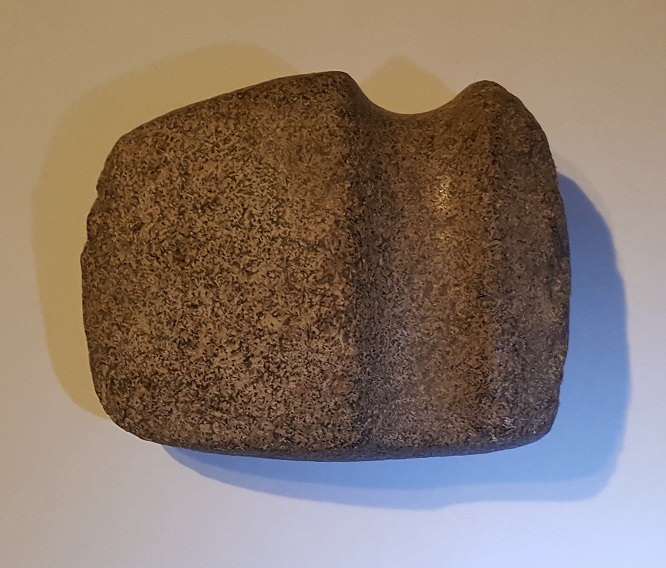
For example, the grooved ax in the first image was a formidable weapon and vital tool. The disc scraper shown immediately above required a great deal of pressure flaking from a skilled hand. The Kirk Serrated point beside it may have functioned as a saw. Running my finger over its barbs, I can’t help but appreciate its usefulness and beauty. It reveals the patient work of an experienced artisan, a product of a long tradition of craftsmanship.
Lesson learned: Every landscape conceals hidden wonders, not to mention forgotten stories waiting to be discovered.
“The point I would make is that the novelist and the historian are seeking the same thing: the truth — not a different truth: the same truth — only they reach it, or try to reach it, by different routes. Whether the event took place in a world now gone to dust, preserved by documents and evaluated by scholarship, or in the imagination, preserved by memory and distilled by the creative process, they both want to tell us how it was: to re-create it, by their separate methods, and make it live again in the world around them.” Shelby Foote, author and historian
“It has been said that if the protagonists of Hamlet and Othello were reversed, there would have been no tragedy: Hamlet would have seen through Iago in no time and Othello would not have hesitated to kill King Claudius.” – Barbara Tuchman, from The March of Folly, p. 231





 “The point I would make is that the novelist and the historian are seeking the same thing: the truth — not a different truth: the same truth — only they reach it, or try to reach it, by different routes. Whether the event took place in a world now gone to dust, preserved by documents and evaluated by scholarship, or in the imagination, preserved by memory and distilled by the creative process, they both want to tell us how it was: to re-create it, by their separate methods, and make it live again in the world around them.” Shelby Foote, author and historian
 “It has been said that if the protagonists of Hamlet and Othello were reversed, there would have been no tragedy: Hamlet would have seen through Iago in no time and Othello would not have hesitated to kill King Claudius.” – Barbara Tuchman, from The March of Folly, p. 231
 M.C. Tuggle, Writer