Category Archives: Science

No Shortcuts in Science!

Sometimes otherwise smart people don’t stay in their lane. Trouble begins when they imagine they’ve discovered earth-shaking truths in fields unimagined by people trained in those fields. It’s called epistemic trespassing.

Ezra Pound revolutionized modern poetry but turned into a crank spouting bizarre economic theories. Linus Pauling won a Nobel Prize in chemistry before taking up quack medicine. Here’s the latest: Theodore Beale is an accomplished fantasy author who claims he’s destroyed Charles Darwin and natural selection. Writing under the name Vox Day, he’s released a book titled Probability Zero: The Mathematical Impossibility of Evolution by Natural Selection.

Here’s the description of his book from Amazon: “By subjecting the big ideas of Darwin, Haldane, Mayr, Kimura, and Dawkins to the pitiless light of statistical and mathematical analysis, Day demonstrates that the Modern Synthesis isn’t just flawed—it is absolutely impossible.”

And that’s it. Vox Day has made no ground-breaking research, no new discoveries, and offers no evidence from any science. He thinks he’s bypassed all that by claiming natural selection is so statistically improbable, it can be dismissed as impossible.

In other words, he only recycles the creationist “Junkyard tornado” argument that no scientific evidence can overcome the odds against life arising and developing naturally.

Okay. What would happen if we decided probability trumps evidence when making inquiries? I can “prove” it’s impossible my wife and I could have ever met and married. But a better example comes to mind.

Remember the horrific murder of Iryna Zarutska in Charlotte last August ? A lawyer could use statistics alone to shoot down the prosecution’s case against DeCarlos Brown Jr., who is accused of stabbing Zarutska on a late-night train.

Consider: Of the 8.3 billion people in the world, Brown allegedly murdered a woman born in Ukraine, 5,200 miles away. Every day on Earth, only 120 people are killed by strangers. That means the probability of a homeless man in Charlotte killing a woman from Ukraine is 0.00000144578313253 %. And since only 1.5 % of Charlotte residents use the light rail, the odds of Brown encountering and killing Zarutska would be reduced to practically nothing.

Should a jury ignore the so-called DNA and eyewitness evidence and let Brown roam the streets of Charlotte again? Hopefully, when DeCarlos Brown Jr. gets his day in court, the jury will judge him based on the evidence, which tells us that despite the odds, Zarutska was on that train when Brown killed her.

The theory of evolution is also backed by evidence–abundant evidence from many branches of science.

But here’s the kicker–Day doesn’t deny the evidence for evolution. He even cites an example of human evolution:

“The primary European lactase persistence allele (LCT-13910*T) is estimated to have arisen approximately 7,500–10,000 years ago, coinciding with the advent of dairying in Neolithic Europe. This mutation confers a significant nutritional advantage in cultures that practice animal husbandry, as it allows adults to digest milk—a rich source of calories, protein, fat, and calcium that would otherwise cause gastrointestinal distress” (p. 110).

If you’re puzzled, re-read the book’s subtitle: “The Mathematical Impossibility of Evolution by Natural Selection.” Creationists will be disappointed thinking the book is a refutation of evolution. So what is Day arguing? In the book’s foreword, Frank Tipler, a professor of mathematics, spells out its purpose: “Mr. Day will demonstrate that, since evolution cannot have occurred by unintended means, evolution must have been directed.” In other words, Day accepts the overwhelming evidence for evolution, but claims natural selection is not the cause.

Even though he doesn’t use the term, Day is arguing for Intelligent Design, a pseudoscience cobbled together as a front for creationism. ID emerged after the bad publicity following Edwards v. Aguillard, in which the Supreme Court ruled that teaching creationism is an unconstitutional attempt to establish a particular religion. While creationism argues that scripture justifies the belief that life was created by a divine being, ID co-opts large chunks of science in an attempt to assert some mysterious, unknown intelligence — maybe aliens! — created life. Day calls his version “Intelligent Genetic Manipulation.”

Like the old creationists, however, Day argues for a “First Mover” and “Designer” as the hidden driver of evolution and specifically posits the Abrahamic God as its guiding force. Addressing the argument that structural defects — the eye’s blind spots, for example — disprove intelligent design, Day offers this totally scientific explanation:

“perhaps demons might manipulate genetics in opposition to it, or for purposes of their own that align with neither divine nor human interests. This could explain certain puzzling features of biological design: not mere suboptimality, but apparent malevolence. Why do parasites exist that can only reproduce by causing horrific suffering to their hosts? Perhaps because something wicked designed them” (pp 219-220).

This is not science. This is an attempt to smuggle religion into the schools and devolve our understanding of life and ourselves back to the Iron Age.

If you want a more technical yet imminently approachable critique, I recommend Dennis McCarthy’s excellent response, Why Probability Zero Is Wrong About Evolution. As McCarthy puts it, Vox Day’s “best-selling anti-evolution book misuses mathematics and spreads misinformation.”
The Barbarian and the Playwright

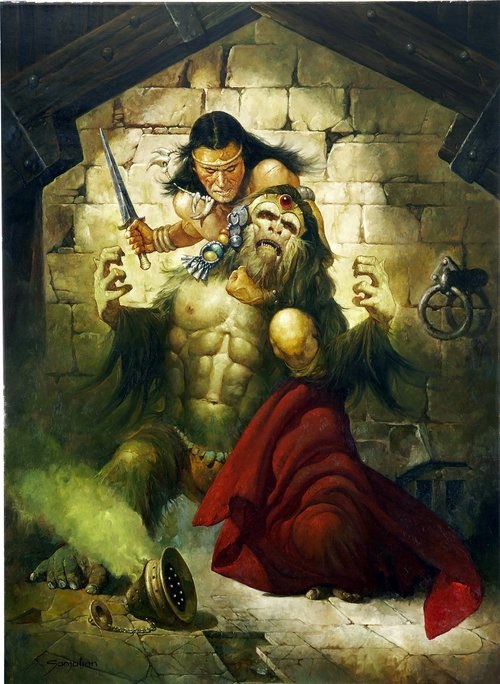
Fans of Robert E. Howard know the timeless appeal of his greatest creation, Conan the Barbarian. As David Smith puts it, Conan is “the natural man, ourselves begun again, reborn in a world as we secretly know our own world to be beneath its layers of hypocrisy and pretense.”

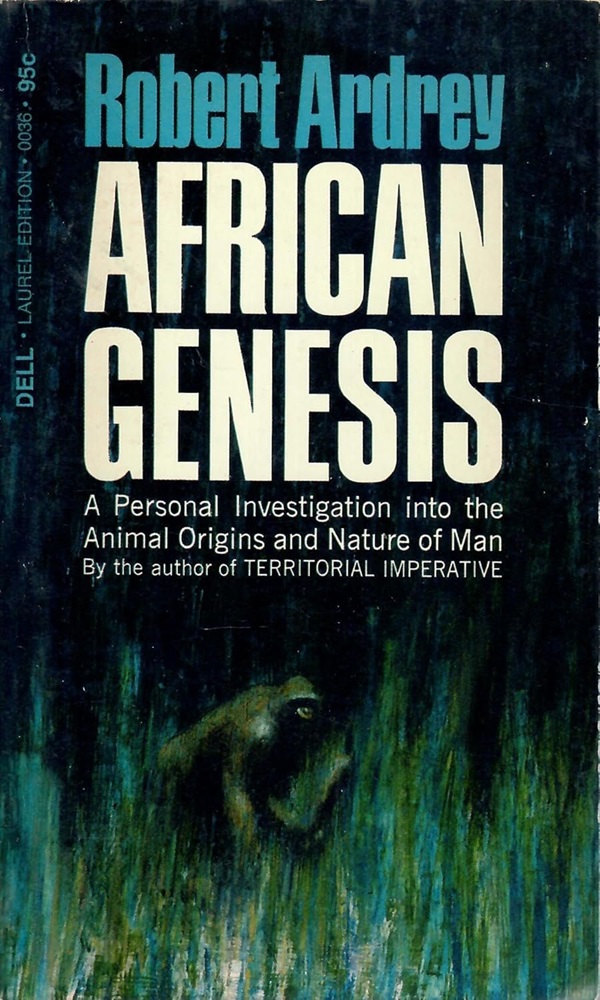
In my latest guest post at the DMR Books blog, I examine the parallels between recurring themes in the Conan stories and the works of dramatist and science writer Robert Ardrey.

In African Genesis and subsequent books, Ardrey examines the anthropological evidence for what “the natural man” actually is, as opposed to the myths we are told, or worse, tell ourselves. Ardrey’s works provide a deeper understanding of Howard’s tales celebrating the heroic, enduring qualities that make us human.

Quote of the day

“Science is not only compatible with spirituality; it is a profound source of spirituality. When we recognize our place in an immensity of light years and in the passage of ages, when we grasp the intricacy, beauty and subtlety of life, then that soaring feeling, that sense of elation and humility combined, is surely spiritual.”

Carl Sagan

WHY DO SO MANY PHYSICISTS WRITE CRIME NOVELS?

Mystery Weekly

Over at CrimeReads, Lee Randall has this to say about two interrelated realms many think have little in common:

“All complex narratives are networks,” writes Jane Alison in Meander, Spiral, Explode. “Any literary narrative of depth asks your brain to pull threads across the whole . . . your experience moving through them is never purely linear, but volumetric or spatial as your thoughts bounce across passages.”

That sounds like physics to me. This branch of science encompasses everything from mechanics, heat, light, radiation, sound, astronomy, atomic structure, electricity and magnetism. It demands elasticity of thought and an ability to think in metaphors. Physicists strive to describe the universe and understand the relationships between all its components.

That’s what novelists do, too!

(And short story writers!) There’s nothing like the feeling of linking together seemingly disparate elements into a unified whole. When it works, you feel it — and if you don’t feel it, neither will the reader. If plot arises from character, then the other elements of a story, including the objective, theme, scenes, twists, etc, should work in harmony to create a single, emotionally satisfying effect on the reader.

Nothing prepares you for such a challenge like reading widely and deeply. The resulting cross-pollination of ideas not only helps you see the interrelatedness of things, but keeps your sense of wonder alive. And that motivates you to create more stories.

My story “The Calculus of Karma” is a combination science fiction and mystery tale. A big chunk of the fun in writing it was creating a puzzle for the protagonist to solve. And what a puzzle — our rookie detective has a dead space miner on his hands, but no murder weapon, no suspects, and he has to solve the case before the death sparks an escalation between warring factions of miners. Inspiration finally arrives from Sir Isaac Newton and Al Capone.

That’s the challenge of science fiction — you have to create believable plot and character arcs, craft an entertaining story, produce flowing, sparkling prose, and — get the science right.

It’s a Dark World, After All …

Dark World

The Fermi Paradox asks a simple but unsettling question: With so many worlds spinning through space, each potentially breeding countless, unknown forms of life, why haven’t any of them paid us a visit? After all, the Drake equation predicts 20 civilizations in our neck of the cosmic woods. Yet the Active Search for Extra-Terrestrial Intelligence program has transmitted a number of “Y’all come!” messages into space without receiving one lousy response.

So where is everyone? If our neighbors are too busy to drop by, why don’t they at least text us?

One explanation is the Dark Forest theory. It speculates that any species capable of beaming messages through space could be both formidable and hungry, so the wise strategy is to do what John Krasinski and Emily Blunt did in A Quiet Place — don’t make a sound, and hope the monsters don’t hear you.

But wait! That could work both ways. We’ve been telegraphing our presence for over a hundred years with radio and TV communications, completely oblivious to who or what may be listening in the dark corners of outer space. Have we doomed ourselves by giving away our position to megapredators? If so, why haven’t they landed in the middle of the Super Bowl with their bibs and eating utensils?

Here’s my explanation: Any aliens who receive our transmissions of “I Love Lucy” and “Friends,” or find our naked pictures in their inboxes, will surely conclude that only the baddest of bad-ass species would be so brazen. After all, what is a lion proclaiming when he shakes the trees with his blood-curdling roar? He’s letting everything within earshot know that the king of beasts is on the move. Get in my way at your own risk.

Feel safe now? That happy thought is my Christmas present. You’re welcome.

Happy 230th Birthday, Enceladus, Our Solar System’s Greatest Hope For Life Beyond Earth

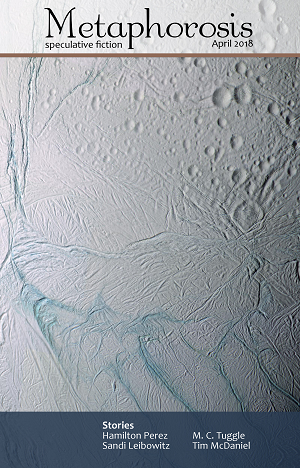
Metaphorosis April 2018 The latest issue of Forbes Magazine features this article commemorating the 230th anniversary of William Herschel’s discovery of Saturn’s most intriguing moon, Enceladus. Astrophysicist Ethan Siegel explains why this mysterious and beautiful body fascinates scientists:

Given that we know of 62 moons around Saturn, and that one of them (Titan) is enormous and has a thick atmosphere with liquid hydrocarbons on its surface, it hardly seems like Enceladus would be the place to look for life. It has no thick atmosphere like Titan; it has no lava-rich volcanoes like Io or cryovolcanoes like Triton. But still, Enceladus might be the most habitable place in our Solar System beyond Earth.

Its ultra-reflective, lifeless surface simply provides cover for a complex, possibly life-rich liquid ocean that begins just ~20 kilometers (12 miles) beneath the icy crust. A series of pale blue stripes cuts across its surface, telling the tale of deep fissures that go down into the interior of the world. But what’s perhaps most remarkable is that we can actually see water-ice being spewed from these fissures into space, extending upwards for hundreds of miles (or kilometers) with every eruption.

With water, energy, and organic molecules, some new, alien form of life could very well be waiting here to be discovered. And just to deepen the allure of this remarkable little moon, Siegel reminds us that we once believed the sunless bottom of our own oceans could not support life, and yet we now know creatures do indeed live around hydrothermal vents. And those vents, with their rich interplay of chemical and thermal processes, may well explain the origin of life itself.

Nature has frequently exploded our notions of the possibilities of life, a truth that inspires both science and science fiction. Enceladus reminds us just how vast, beautiful, and awe-inspiring the universe truly is.

UPDATE: From the comments section:

Great read as usual and one I will look into more. Curious? Is there any works of science-fiction that feature this Moon.

MCT: Oh, here’s one:

https://magazine.metaphorosis.com/story/2018/cathedra-m-c-tuggle/

Quote of the day

Spiritual science

“Science is not only compatible with spirituality, it is a profound source of spirituality. When we recognize our place in an immensity of light‐years and in the passage of ages, when we grasp the intricacy, beauty, and subtlety of life, then that soaring feeling, that sense of elation and humility combined, is surely spiritual.”

Carl Sagan

Where science and story meet

The spirit of C. P. Snow lives on. Robert A. Burton, a neurologist and novelist, shares his insights into just how closely science and literature dovetail in the human psyche:

Science is in the business of making up stories called hypotheses and testing them, then trying its best to make up better ones. Thought-experiments can be compared to storytelling exercises using well-known characters. What would Sherlock Holmes do if he found a body suspended in a tree with a note strapped to its ankle? What would a light ray being bounced between two mirrors look like to an observer sitting on a train? Once done with their story, scientists go to the lab to test it; writers call editors to see if they will buy it.

Of course. Both disciplines aim to shed light on some aspect of reality. And when we make connections between events that deepen our understanding of related events, we feel that sweet twinge of discovery, whether in the role of author or reader. In fact, science now informs us that when we successfully recognize patterns, we get a dopamine reward. And we really, really like our dopamine, so much, in fact, that we tend to cling to reassuring stories long after science has superseded them with better, more robust stories. As Dr. Burton explains:

People and science are like bread and butter. We are hardwired to need stories; science has storytelling buried deep in its nature. But there is also a problem. We can get our dopamine reward, and walk away with a story in hand, before science has finished testing it. This problem is exacerbated by the fact that the brain, hungry for its pattern-matching dopamine reward, overlooks contradictory or conflicting information whenever possible.

After all, what is religion other than the insightful blending of science and literature? As science uncovers more truths about ourselves and the universe, the storyteller’s job is to imagine new stories that make sense of new information, turning mere data into insight and wisdom.

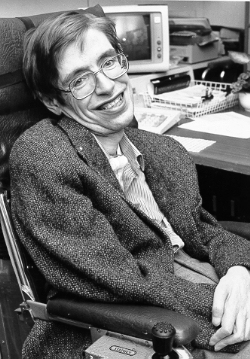
Stephen Hawking predicted race of ‘superhumans’

Here’s a troubling insight from one of history’s great scientists, via The Guardian:

The late physicist and author Prof Stephen Hawking has caused controversy by suggesting a new race of superhumans could develop from wealthy people choosing to edit their and their children’s DNA.

Hawking, the author of A Brief History of Time, who died in March, made the predictions in a collection of articles and essays.

The scientist presented the possibility that genetic engineering could create a new species of superhuman that could destroy the rest of humanity. The essays, published in the Sunday Times, were written in preparation for a book that will be published on Tuesday.

Can’t help but remember this episode from Star Trek TOS:

Who can forget this blistering exchange between Spock and McCoy:

SPOCK: Hull surface is pitted with meteor scars. However, scanners make out a name. SS Botany Bay.
KIRK: Then you can check the registry.
SPOCK: No such vessel listed. Records of that period are fragmentary, however. The mid=1990s was the era of your last so-called World War.
MCCOY: The Eugenics Wars.
SPOCK: Of course. Your attempt to improve the race through selective breeding.
MCCOY: Now, wait a minute. Not our attempt, Mister Spock. A group of ambitious scientists. I’m sure you know the type. Devoted to logic, completely unemotional

The problem with selective breeding, as Spock later points out, is that “superior ability breeds superior ambition.” Instead of Ghandis and Einsteins, you get Hitlers and Napoleons.

Indeed, that’s the problem with all utopian schemes, from eugenics to communism — those pesky unforeseen consequences. Our minds evolved to adapt and survive in small social groups facing a harsh, unforgiving environment. The complex processes underlying the universe are beyond our grasp, just as our muscles are incapable of tossing boulders into orbit. Our muscles and our minds are not only useful, but extraordinary, but each have their limitations. True wisdom is the recognition and acceptance of those limitations.

That’s why we should heed Hawking’s last words.