From July 19th to August 10th, you can snag The Explore Sci-Fi Worlds Bundle, an outstanding selection of ebooks from independent and small press fantasy writers — and support war victims in Ukraine. This incredible offer includes my story A Tree Amid the Wood, as well as bonus volumes for donations of $20 or more, including:
We Dare – No Man’s Land edited by Jamie Ibson and Chris Kennedy
A Legacy of Stars by Danielle Ackley-McPhail
Androids & Aliens by J. Scott Coatsworth
Save the World edited by J. Scott Coatsworth
Daughters of Frankenstein edited by Steve Berman
Mirror Shards Vol. 2 edited by Thomas K. Carpenter
Tales of the Dissolutionverse by William C. Tracy
It’s a great opportunity to support a worthy cause and find new authors to love. Or rekindle your love for an old one. Remember, this offer ends August 10. Gift cards are available at Story Bundle.
“A 25-year science wager has come to an end. In 1998, neuroscientist Christof Koch bet philosopher David Chalmers that the mechanism by which the brain’s neurons produce consciousness would be discovered by 2023. Both scientists agreed publicly on 23 June, at the annual meeting of the Association for the Scientific Study of Consciousness (ASSC) in New York City, that it is an ongoing quest — and declared Chalmers the winner.”
Koch made the bet on his confidence that science would pinpoint the exact location in the brain that produced consciousness because of the advances in magnetic resonance imaging (MRI), which reveals changes in blood flow associated with brain activity. The wager, a case of wine, added incentive in addition to both bragging rights and the lure of discovery.
So the game was on!
As the Nature article concludes, the researchers confirmed “areas in the posterior cortex do contain information in a sustained manner,” and that “some aspects of consciousness, but not all of them, could be identified in the prefrontal cortex.” Koch admits his theories were not totally proven, and, being a scientist of his word, paid up.
Who says science isn’t entertaining?
What’s distressing, however, is how proponents of dualism are using this story as some kind of vindication. The notion that humans are unique assemblages of mind and matter and therefore outside of and superior to nature goes back to Plato, the Vedic writers, and that notorious rascal Rene Descartes. One commenter claimed Koch’s failure to prove his hypothesis as vindication that we are truly “ghosts in the machine.”
Interesting they used that term, which was coined by philosopher Gilbert Ryle in his argument against dualism. He deemed the position as a gigantic category mistake. I love his illustration: A visitor to a university may see classrooms, libraries, and other parts of the campus, but at the end of the tour, asks, “But where is the university?” not realizing the term refers to all of its components working as a unit. Similarly, the various sections of the brain handle their own functions, and we use the term “consciousness” to refer to all those functions working in harmony.
Why is this important? If our supposedly supernatural minds make us superior, all of nature is dumb matter good for nothing but exploitation. This not only imperils nature but alienates us from the world in which we live. The next step is contempt for our own bodies. A philosophy that leads to ecological ruin and rootlessness is an evil that must be exposed for what it is. And just as Koch and Chalmers could entertain and enlighten us with their little joust for science, we can enjoy stories that both inspire and force us to consider where we’re going and where we could end up.
Renowned fiction podcaster Tall Tale TV has published my short story “Winter Star.” Here’s what managing editor Chris Herron had to say: “Have just read your story. I loved it. It feels almost nostalgic in the way you wrote it. Like an 80’s sci-fi movie.“
I’m honored. I was aiming for a retro feel, something along the lines of Stand By Me, Close Encounters of the Third Kind, and Super 8.
It’s 1988. High school senior Trey Evans borrows his father’s pickup to haul a shortwave radio to the top of Winter Star Mountain, one of the highest peaks in the southern Appalachians. Trey and his friend Booney hope to intercept rare, elusive transmissions with the help of their high altitude monitoring post and a once-in-a-lifetime solar storm.
But their efforts attract unexpected attention from a mysterious visitor.
Tall Tale TV features sci-fi and fantasy authors from around the world. The site was a finalist for the now-discontinued Parsec Awards, which recognized outstanding science fiction podcasters.
This little story is my love letter to the glory days of shortwave radio. In its heyday, shortwave was the Wild West of the radio spectrum, where you might hear spies, drug smugglers, or NASA. There’s also a wistful nod to my camping expeditions of long ago to the dark, magnificent Appalachian Mountains.
Nostalgia, suspense, adventure — it’s all there. It’s also available on YouTube and Facebook.
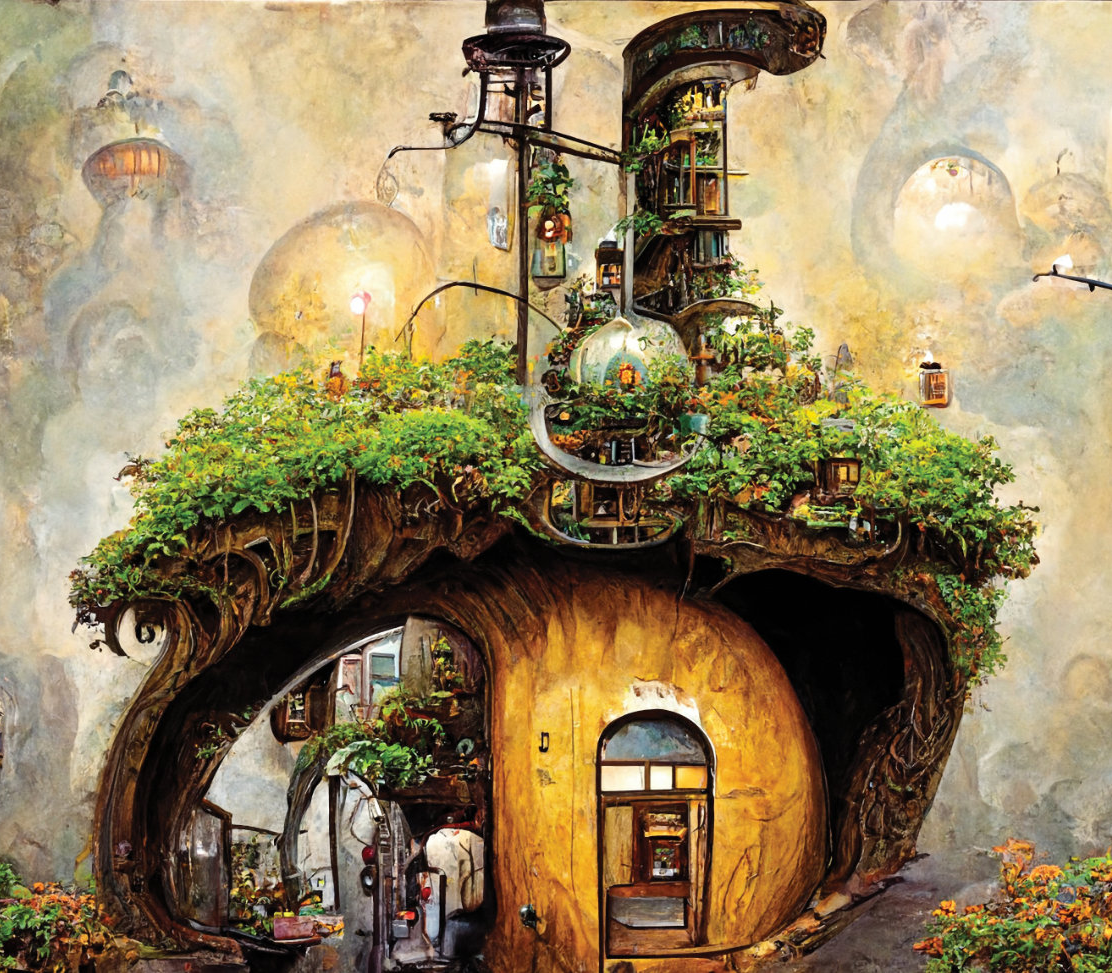
In my story, biotech pioneer Franklin Pratt builds a living house that senses and responds to the needs of its owner. Franklin’s invention has the potential to reduce homelessness, pollution, and social isolation, but a stroke robs him of the ability to communicate. And worse — he fears and distrusts the only person who can help him.
Little Blue Marble publishes speculative fiction and articles aimed at raising awareness about the environment. I can’t tell you how proud I am to have my work included with so many fine authors.
My reverence for nature inspires both my fiction and blog posts about the wild places I’ve explored, from maritime forests to deserts. One of the themes I keep returning to in my writing is the mismatch between human needs and the unnatural straitjacket of modern life. Culture and nature should complement each other. Media analyst Arthur Asa Berger has observed that “culture” comes from the Latin “colere,” which means to tend to the earth and cultivate. Humans, like all other living things, need a nurturing environment. I believe the disconnect between human nature and creeping global homogeniety is at the root of modern neuroticism.
But don’t let the serious subject matter fool you — this book features well-crafted, entertaining stories. Little Blue Marble’s 2022 Anthologynot only promotes a vital cause but will make a great Christmas present.
I was pleasantly surprised and honored when D.M. Ritzlin of DMR Books asked if he could interview me as part of his series of author profiles. We covered my writing background, the literary and philosophical influences on my fiction, and works in progress.
I am delighted to announce my story “A Tree Amid the Wood” is featured in the latest edition ofLittle Blue Marble, which publishes fiction, non-fiction, and poetry focusing on ecology.
Franklin Pratt lives in a special house of his own design. It is a living thing that senses and responds to its owner’s needs by growing rooms as needed and reflecting the owner’s emotional state with bioluminescent blossoms. Once it’s mass-produced, Franklin’s invention can provide housing for millions and help heal the environment.
But since his stroke, Franklin is unable to share his creation with the world. He feels he’s a prisoner in his own home and distrusts Carrie Masada, the woman who supervises his team of caretakers. Franklin fears she only wants to steal the secret of his house.
And he’s right. Carrie wants Franklin’s secret. But why?
My love and concern for nature has inspired a number of my postsand published stories, so while honored by this acceptance, I am especially pleased my story promotes a cause I believe in deeply. The title comes from one of Ezra Pound’s early poems, “The Tree“:
I stood still and was a tree amid the wood, Knowing the truth of things unseen before; Of Daphne and the laurel bough And that god-feasting couple old That grew elm-oak amid the wold. ‘Twas not until the gods had been Kindly entreated, and been brought within Unto the hearth of their heart’s home That they might do this wonder thing; Nathless I have been a tree amid the wood And many a new thing understood That was rank folly to my head before.
As in Pound’s lovely poem, my story explores how love of the natural world is the essential foundation for understanding, connecting, and caring — in other words, for becoming fully human.
Flash Fiction Magazine has published my story “Social Network.” This piece represents nearly three weeks of writing and re-writing. I’m quite pleased with how it turned out, and I have to thank editor Shanna Yetman for her guidance.
Most of my stories arise from an image I can’t get out of my head. The only relief is to transform that image into a story, and that process inevitably taps into deep-seated concerns. When I recently re-read H.P. Lovecraft’s classic Nyarlathotep, one vivid scene stuck in my imagination:
And where Nyarlathotep went, rest vanished; for the small hours were rent with the screams of nightmare. Never before had the screams of nightmare been such a public problem; now the wise men almost wished they could forbid sleep in the small hours, that the shrieks of cities might less horribly disturb the pale, pitying moon as it glimmered on green waters gliding under bridges, and old steeples crumbling against a sickly sky.
“Social Network“ imagines a malignant presence just as frightening as the one Lovecraft described, though in the form of a technological pandemic no vaccination can stop.
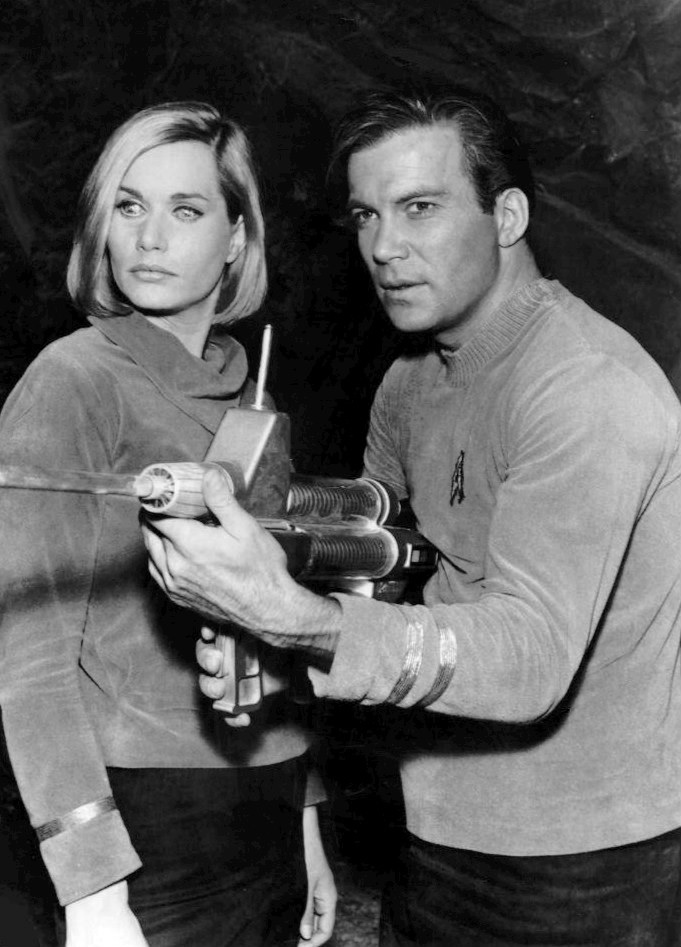
The recent death of Sally Kellerman got me to thinking about her role in the Star Trek episode “Where No Man Has Gone Before,” which was not only entertaining but thought-provoking.
Kellerman’s character, Dr. Elizabeth Dehner, and Gary Mitchell, the ship’s helmsman, acquire psychic powers when the Enterprise hits a mysterious force field in deep space. Mitchell, Captain Kirk’s close friend, gradually transforms into a god-like being who increasingly shows contempt for his crew mates, whom he now regards as weak creatures who only get in his way. Worse, Dr. Dehner begins a similar transformation.
It’s one of the original series’ best stories. The theme of how power corrupts was explored further in other Star Trek episodes. In “Plato’s Stepchildren,” Kirk & Co. confront humans who have acquired powerful telekinetic abilities. Their powers have turned them into sadistic bullies. At the story’s end, the chastised leader of the superhumans admits, “Uncontrolled, power will turn even saints into savages, and we can all be counted upon to live down to our lowest impulses.”
In “Patterns of Power,” the Enterprise finds a planet that’s transformed into Nazi Germany, complete with SS uniforms and calls for a “final solution” against its enemies. Turns out a Federation observer, determined to speed up progress on the planet, had introduced the population to National Socialism, thinking he could curb the movement’s nastier tendencies. But as Dr. McCoy observes, “A man who holds that much power, even with the best intentions, just can’t resist the urge to play God.”
Sounds like a timely message to me. In a confused and frightening time when both political parties threaten to bypass traditional constraints to get what they want, these old episodes have something to say.
The latest Rebel Wisdom features a thought-provoking interview with writer Damien Walter. Science fiction, says Walter, can replace “society’s central source of meaning,” which has traditionally been religion. As Walter puts it: “Science fiction is essentially the attempt of science… to create a mythos for itself. Because science damaged the previous mythos, the Christian mythos, for most of Western society.”
It’s a fascinating idea, one that every writer can relate to. I believe literature is inherently spiritual, exploring and ruminating on our connections to others and the universe. Anyone who wrestles their thoughts onto paper has a view of the world they yearn to share. Science alone, I realized long ago, is no substitute for a well-rounded world view. However, it can not only inspire great stories, but also deepen and broaden our perspective.
After all, ideas have consequences. A valid philosophy of life must begin with an accurate understanding of human nature. Look at the horrors spawned by the ideologies of the last century, all based on noble-sounding assumptions which turned out in practice to be false. Writers, I think, have a duty to diagnose, advise, and heal while we entertain.
The unspoken component of that duty is to constantly revise and strengthen our world view. As E. O. Wilson tells us, science can give the humanities “more solidly grounded answers” to life’s mysteries. And boy, does this society need grounding. That’s why I’ve long been fascinated by science fiction.
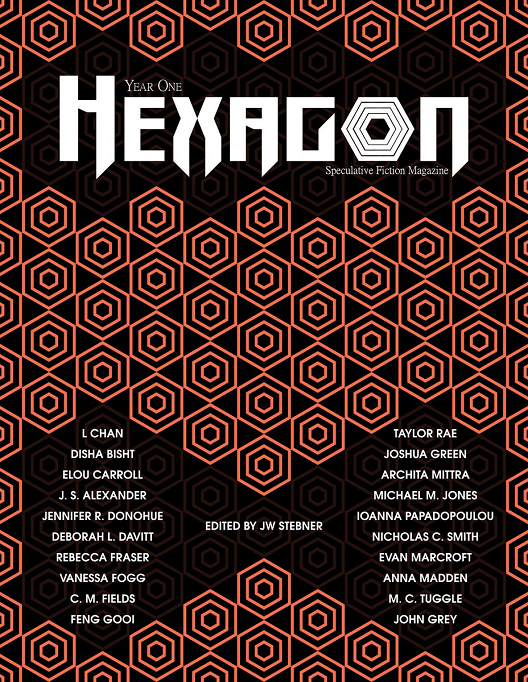
Now this is an unexpected surprise. TheYear One Anthology for Hexagon Speculative Fiction Magazine features all 20 pieces from Hexagon’s successful and groundbreaking first year. There are bonus pieces as well, such as author interviews and new cover concept art.
The anthology includes my flash fiction story Mirrors, which was published in the magazine’s premiere issue. I wrote it after re-reading Dr. Lewis Thomas’ book,The Lives of a Cell, which made me realize how an alien species would marvel at how cooperative humans are despite our aggressive tendencies. I was pleased atDidi Oviatt’s review: “Tuggle’s story of an insight about predatory creatures is a thought-provoking read.”




 M.C. Tuggle, Writer