Category Archives: Science fiction

Unbound II: Changed Worlds pre-release

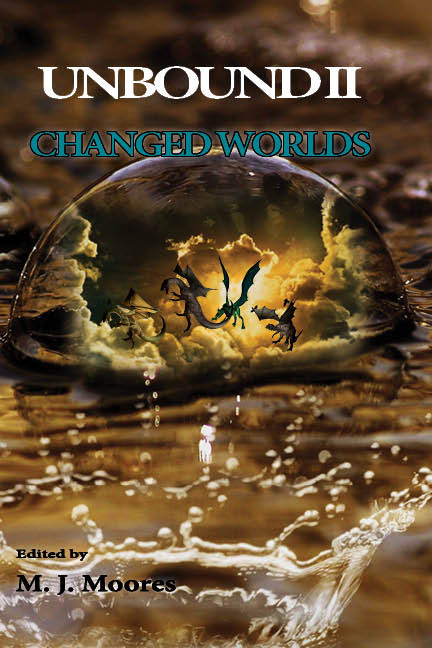
Unbound II

From Science Fiction and Fantasy Publications:

Unbound II: Changed Worlds

The Unbound Anthologies are a collection of themed short stories perfect for your reading pleasure. Every year we open a call to authors around the world challenging them to create never before created works of fiction, pick the best ones, and bundle them together for you.

This edition, our authors received the challenge of “Changed Worlds” in the Science Fiction and Fantasy genre. And now we are pleased to present to you:

Michael Healy’s “Hail Bruce”
Daniel Powell’s “Reclaiming the Elements”
Clint Spivey’s “The Barred Gates”
Lee Clark Zumpe’s “Book of Being”
Dale L. Sproule and Sally McBride’s “The Birthing Blades”
Barry Charman’s “The Knot”
Philip Bran Hall’s “The Hard Stuff”
M. M. Pryor’s “The Witch’s Intern”
M. C. Tuggle’s “Hunting Ground”
K. T. Wagner’s “Mountains to Cross”
M. J. Moores’ “The Reckoning”

While this publication’s release date is January 31st, you may either pre-order the ebook through online retailers or acquire your digital version now through our online store at:

Buy Unbound II – Changed Worlds

Print versions of this anthology will be available through all bookstores January 31st, 2017.

Best Fiction and Writing Blogs

jules-verne

The best fiction and writing blog posts from around the ‘net, all guaranteed to make you a literary legend. Compiled by jules.

Tina Ann Forkner5 Reasons You Should Still Pursue a Traditional Book Contract
M. L. KellerWhy Writing Advice is Ruining your Manuscript
Melissa TriplettFreelancing for Beginners and Old People
John FoleyThe Legacy of Hard Science Fiction
Christopher MorrisseyA Holiday Film Festival
Brett McKayWhy Every Man Should Read Jane Austen
Kim WinternheimerSubmission Strategies: Advice from a Literary Magazine Editor
Marc AngenotJules Verne and French Literary Criticism

Quote of the day

Margaret Atwood

“Why is it that when we grab for heaven — socialist or capitalist or even religious — we so often produce hell? I’m not sure, but so it is. Maybe it’s the lumpiness of human beings. What do you do with people who somehow just don’t or won’t fit into your grand scheme? All too often you stretch them on a Procrustean bed or dig a hole in the ground and shovel them into it.” – Margaret Atwood

The Great KOA Getaway

The Great KOA Getaway

There’s an energizing crispness in the October air – and that’s not all. Regional festivals celebrating local wine, apples, and barbecue lure excited crowds with sweet, smoky aromas and music from homegrown bands. The squawking from a wedge of geese overhead reminds us it’s hunting and camping season. And Halloween is just around the corner.

My latest work, “The Great KOA Getaway,” should get you in the mood. It’s a flash story about an unlucky/lucky ranger caught in the middle of a little misunderstanding at a remote campground. I’d describe it as a mash-up of Twilight Zone and National Lampoon’s Vacation, with just a touch of Lovecraft thrown in. It’s available free (!) at The Flash Fiction Press.

I’ve always enjoyed stories that tickle your goosebumps and funny bone at the same time. And isn’t that what makes Halloween so much fun?

I hope “The Great KOA Getaway” brings a shiver and a smile to your day.

New Words, New Worlds

sunrise

Novelist and teacher M. Thomas Gammarino experienced an epiphany when he taught two courses in the same semester, one on science fiction, and another in modernism. Gammarino expected the two genres to clash, but happily discovered they supplemented each other. The reason, he explains in this Omni article, is that all art aims to enable us to see the world more intently by presenting it in unfamiliar and challenging ways:

In his 1917 essay “Art as Device,” Russian formalist poet Viktor Shlovky gave us the term ostranenie to describe the primary function of art. The term is usually translated as “defamiliarization,” though it literally means “strange-making.” The job of art, in other words, is to renew our eyes by making the familiar appear strange. Other modernists had— or would— put forth variations on this idea, from Mallarmé’s “Donner un sens plus pur aux mots de la tribu” (purify the words of the tribe) to Ezra Pound’s “Make it new,” and modernist critics regularly invoke this idea to illuminate the sorts of linguistic experiments writers like Gertrude Stein and James Joyce were up to.

I heartily agree. Both fantasy and sci-fi renew one’s sense of wonder in ways literary fiction cannot. That’s not to say literary fiction is incapable of reawakening the awe we felt as a child discovering our shiny, new world. Energetic, evocative writing in any genre helps us re-imagine the world around us, forcing us to see it anew. But literary fiction tends to focus on the inner world, while fantasy and sci-fi direct us toward the outer world — or even toward new, imagined worlds. Speculative fiction always goes big, reminding us of our role in society, the world, and the universe itself.

That’s what makes fantasy and sci-fi such powerful springboards for the imagination.

Charlotte Observer Caption Contest

Caption contest

From the Charlotte Observer:

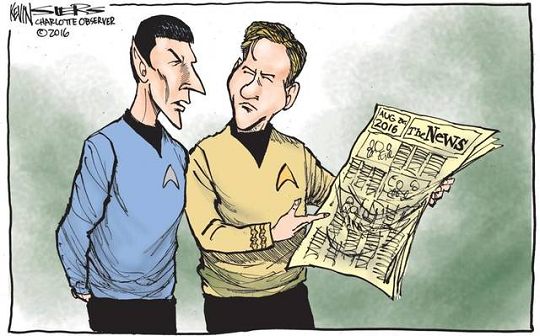
“It’s dead, Jim.”

The Winners: Mike Tuggle of Charlotte and Bill McLoughlin of Charlotte

Thanks for all your great entries. This is the first time in You Write the Caption history we’ve had a tie winner, but the judges couldn’t see anyway to avoid that this time. So congrats to great minds, Mike Tuggle and Bill McGloughlin.
———————————–
What can I say? Problem is, the winner is supposed to get the original cartoon. Who will it be? Looks to me like it’s Amok Time! Let the kal-if-fee for the prize begin!

A reader sent me this:

Congrats…….on your Cartoon Caption win! But I don’t get the “It’s Dead”! R—Sent from my iPhone

R—,

Hey, thanks!

If you aspire to becoming a certified Star Trek geek like me, you’ll have to learn the classic lines. In numerous scenes from the original series, a character would suffer some sort of unexpected calamity, and Kirk would shout, “What happened?” It was usually Dr. McCoy who’d examine the poor character and announce, “He’s dead, Jim!”

So in the Siers cartoon, Spock is informing Kirk of the fate of print journalism.

Unbound II: Changed Worlds Anthology

Unbound

Science Fiction and Fantasy Publications will publish Unbound II: Changed Worlds in August. This themed anthology includes my short story “Hunting Ground.” From their web site:

Our second in the groundbreaking collection of short stories with the underlying theme Changed Worlds. The Unbound Anthology series published by Science Fiction and Fantasy Publications started with more than 200 submissions. Carefully, we examined each story and finally ended with the best of the best for your enjoyment.

This collection covers both Science Fiction and Fantasy, taking you around the universe and into worlds beyond your imagination.

And here’s a suggestion for my fellow writers: if you’re looking for a great venue for your work, check out Science Fiction and Fantasy Publications. Editor M.J. Moores was a pleasure to work with, and I must say that her advice made my story stronger.

In other news, I still have five stories submitted to various publishers, all looking for a little slush pile love. Next week I’m meeting with my critique group to hear their ideas on a sixth story, which I’ll submit somewhere after I incorporate their suggestions. My goal this year was to always have at least three active submissions out, and I’ve held to it so far.

Wish me luck!

Black Ghost

Silver Blade

Silver Blade Magazine specializes in “Cutting-edge Science Fiction, Slipstream, and Fantasy.” The latest edition features my flash fiction piece “Black Ghost.”

The inspiration for this story came from a couple of things. My father, a veteran of World War II, was recently admitted to the “Memory Ward” at a nursing home. Seeing him alone in a wheelchair when I visit makes me wonder if people passing by have any idea what this quiet man, a veteran of the Battle of Okinawa, endured in that war. Short answer: They do not. Nor do most folks consider what they owe to that generation, a generation of heroes which slips away from us day by day.

The other spark for this story was a fascinating article in Ancient Origins about the once widespread practice of interring items in tombs the dead could use in the afterlife. These “parting gifts” weren’t cheap. Consider what archaeologists found in the tomb of Princess Ukok of Siberia:

Buried around her were six horses, saddled and bridled, her spiritual escorts to the next world, and a symbol of her evident status, perhaps more likely a revered folk tale narrator, a healer or a holy woman than an ice princess.

There, too, was a meal of sheep and horse meat and ornaments made from felt, wood, bronze and gold. And a small container of cannabis, say some accounts, along with a stone plate on which were the burned seeds of coriander.

Often, the living would supply the departed with the means to carry on their life’s work. The Ancient Origins article cited a study of tombs from pre-Roman Italy that revealed “indications of the commonality of military service since men’s tombs of the era routinely contained metal weaponry lying across or near the skeletal remains.”

That got me to thinking about the many deities and religions — not to mention nations — that have come and gone over the centuries, and how all of them arose because they met timeless human needs. The more I thought about it, the more intriguing the possibility a future society could adapt this ancient practice. Next thing I knew, I was outlining a story I’d already titled “Black Ghost.”

Stories provide much that religion offers. The tales we read, like the ones we encounter in worship, may not be factual but are nevertheless true and necessary. The cycles of nature, the challenge of growing up and leaving home, and one’s inevitable confrontation with life and death arouse fear and fascination within every human heart. Stories and myths have the power to startle, teach, and assure us on life’s journey. That’s why religion and storytelling have germinated in all cultures.

And whatever one’s views on religion, we can all appreciate the story’s secondary themes of the debt the living owe past generations, the heroism of ordinary people that make life possible, and the boundless potential — and petulance — within every 12-year-old. Enjoy.
Spring tidings

Aztec Midnight

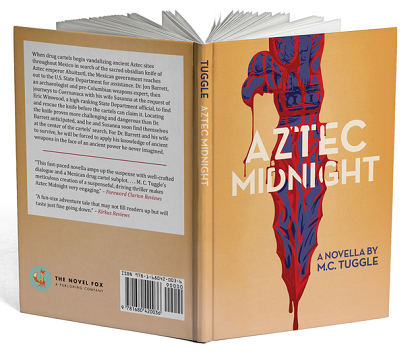
Yes, spring is here, and things are popping out all over. First this from my publisher, The Novel Fox:

Our favorite adventure novella, Aztec Midnight, is now literally a page-turner!

Aztec Midnight is available in both ebook and print. Purchase your paperback copy here

Yes, 2016 is off to a good start. So far, I’ve sold three sci-fi/fantasy short stories to three different publishers. One, The Clincher, came out in early March. A second is due in late May, and another will appear in a print anthology in September. I’ve completed the final edits and signed the contracts, so it looks like full steam ahead. Here’s to a productive 2016!

The Clincher

The Clincher

The Flash Fiction Press has published my story The Clincher, now available online.

The idea for this story came to me while reading William Lind’s introduction to Fourth Generation Warfare. Lind predicts that future battles will hinge on public perceptions of the combatants:

Fourth generation adversaries will be adept at manipulating the media to alter domestic and world opinion to the point where skillful use of psychological operations will sometimes preclude the commitment of combat forces. A major target will be the enemy population’s support of its government and the war.

Propaganda has long served as a “Fifth Column” for invading armies. During the 1968 Prague Spring uprisings against the Soviet Union, Czech communists assured their restless population that Soviet troops entering Prague weren’t really invading — they were just dropping by to preserve order and stop “counter-revolutionaries,” thereby ensuring Czechoslovakia’s peace and prosperity.

Prague Spring“We’re from Moscow, and we’re here to help.”

Lind argues that in future conflicts, warring groups will clash over narrative even more than over territory, making the control of public opinion “the dominant operational and strategic weapon.” It occurred to me that 4GW will weaponize the advertising industry. That made me think about Don Draper, Roger Sterling, and the other rapacious but fascinating characters from Mad Men. I wondered how they’d react if space aliens asked them to handle a PR campaign to prepare the Earth for invasion.

Yeah, they’d take that account.

Please leave comments at The Flash Fiction Press. Thanks!