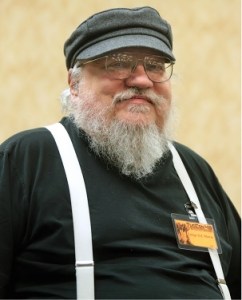
George RR Martin: ‘Science fiction has conquered the world’

This Irish Times article gives a little background into Martin’s life and what inspired him growing up. Raised in public housing, Martin found escape from his bleak surroundings in the soaring fiction of Robert Heinlein and other science fiction authors.

It would seem Martin’s fortunes have changed.

When asked about the near-fanatical devotion sci-fi readers feel about their favorite authors, Martin replies:

“Science fiction, for much of its history – and this goes back to before I was born – was not considered reputable,” says Martin. “It was seen as cheap gutter entertainment. I was a bright kid, but even I had teachers say to me, ‘Why do you read that science-fiction stuff? Why don’t you read real literature?’ You got that kind of snobbism.”

I remember one of my favorite English lit professors catching heat from his peers because he had us read Kurt Vonnegut’s Slaughterhouse Five, now considered a classic. And Vonnegut himself got zinged a few times in his career for writing sci-fi stories.

But as Martin says, times have changed.

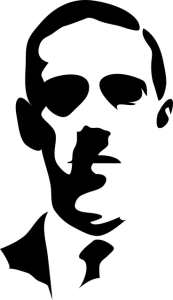
The Timeless Appeal of H. P. Lovecraft

Lovecraft

How is it possible that the feverish works of a writer who died in poverty and obscurity more than 80 years ago still matter?

And yet they do matter, and to a growing number of fans and admirers. Here are three recent takes on Lovecraft’s continuing popularity, all from vastly different points of view, though they agree Howard Phillips Lovecraft has something to say to modern audiences.

Cosmic Horror: A Study of the Unknowable, by B.K. Bass

Many modern authors have found inspiration in Lovecraft’s fiction. B.K. Bass, who writes science fiction, fantasy, and horror, acknowledges Lovecraft as a “primary influence.” What distinguishes Lovecraft’s “Cosmic Horror” from other genres, says Bass, is

that it plucks at the strings connected to two fears that arguably every person shares: fear of the unknown and fear of insignificance. Lovecraft himself may have said it best when he said that “it is hard to create a convincing picture of shattered natural law or cosmic alienage…without laying stress on the emotion of fear.”

The Emotional Rise of Cosmic Horror, by Mary Beth McAndrews

After giving due recognition to Lovecraft’s profound role in crafting and defining Cosmic Horror, Mary Beth McAndrews explores the best cinematic homages to the Cosmic Horror tradition. Her comments about Justin Benson and Aaron Moorhead’s 2017 film The Endless perfectly capture the existential possibilities of the genre. (Here’s my review of The Endless.) McAndrews argues the genre is not nihilistic, but instead opens our eyes to a world where we forge our own meaning and love in an unfeeling and severe universe.

Well put. I would add that like Albert Camus’ absurdist fiction, Lovecraft’s works proclaim that the terrors and uncertainties of this world require us to discover and hold tight to whatever ties and aspirations that give our lives meaning. As Lovecraft himself once wrote, “All one can logically do is to jog placidly and cynically on, according to the artificial standards and traditions with which heredity and environment have endowed him. He will get most satisfaction in the end by keeping faithful to these things.”

Toward a Theory of the New Weird, by Elvia Wilk

The enduring truth and vitality of an art form is reflected in how successive generations adapt it to their own experiences and worldviews. Elvia Wilk says this of Lovecraft’s all-too-relevant insights:

That discomforting implication of the limits of the human mind and the potential dissolution of the category Humanity makes Lovecraft’s fiction seem like a precursor to the contemporary awareness of the Anthropocene age. In an era defined by the planetary catastrophe of anthropogenic climate change, discussions of Lovecraft have come into prominence in philosophy, literature, and the arts. The horror of the archaic sea creature coming back to claim its due is a narrative (too) easy to map onto our current moment.

After all, it was Lovecraft who warned that the sciences, rather than ushering in Utopia, would open up “terrifying vistas of reality” upon us. Judging by our current predicament, I’d say he had a point.
Where science and story meet

The spirit of C. P. Snow lives on. Robert A. Burton, a neurologist and novelist, shares his insights into just how closely science and literature dovetail in the human psyche:

Science is in the business of making up stories called hypotheses and testing them, then trying its best to make up better ones. Thought-experiments can be compared to storytelling exercises using well-known characters. What would Sherlock Holmes do if he found a body suspended in a tree with a note strapped to its ankle? What would a light ray being bounced between two mirrors look like to an observer sitting on a train? Once done with their story, scientists go to the lab to test it; writers call editors to see if they will buy it.

Of course. Both disciplines aim to shed light on some aspect of reality. And when we make connections between events that deepen our understanding of related events, we feel that sweet twinge of discovery, whether in the role of author or reader. In fact, science now informs us that when we successfully recognize patterns, we get a dopamine reward. And we really, really like our dopamine, so much, in fact, that we tend to cling to reassuring stories long after science has superseded them with better, more robust stories. As Dr. Burton explains:

People and science are like bread and butter. We are hardwired to need stories; science has storytelling buried deep in its nature. But there is also a problem. We can get our dopamine reward, and walk away with a story in hand, before science has finished testing it. This problem is exacerbated by the fact that the brain, hungry for its pattern-matching dopamine reward, overlooks contradictory or conflicting information whenever possible.

After all, what is religion other than the insightful blending of science and literature? As science uncovers more truths about ourselves and the universe, the storyteller’s job is to imagine new stories that make sense of new information, turning mere data into insight and wisdom.

Do you have what it takes to be a good liar?

In other words, are you a good writer? *

Now, don’t feel insulted. Fact is, both accomplished writers and liars have the ability to recognize and accommodate other people’s point of view. If you aren’t sensitive to how others perceive your message, you can’t tell a believable story.

The above video illustrates how to determine a person’s lying ability in just a few seconds. (Hint: Have someone you trust watch the video and give YOU the test.)

And of course, there are the finer points of storytelling and lying to consider as well, such as knowing how to stimulate your audience’s imagination with just the right details that give your tale the appearance of reality. Achieving verisimilitude, like any other skill, takes practice.

There’s also a psychological element at work here. Both liars and writers enjoy being the center of attention. (Although you could argue that writers, who are introverts wrestling with extroverted cravings, really want an admiring audience kept at a safe distance.)

After all, the ability to lie is at the heart of what we do. Writers strive to craft an attractive and entertaining untruth. Isn’t that the definition of fiction? As Stephen King put it, “Fiction is the truth inside the lie.” The goal of fiction is to lure and enchant your audience so you can impart the larger meanings and deeper truths that originally inspired you to take up the challenge.

* Full disclosure: My wife gave me this test. Yeah, I passed.

H.P. Lovecraft: A Titan of Terror

This video is an excellent introduction to the life, work, and legacy of H. P. Lovecraft. As much as I’ve read about this tragic, talented man, it managed to surprise me with both biographical and career tidbits.

Here’s something I didn’t know: August Derleth, the editor chiefly responsible for publicizing Lovecraft after the writer’s death, had his stories translated and published overseas. Post-WWI French intellectuals, already admirers of Edgar Allan Poe, practically devoured everything Lovecraft had authored. That, of course, is how Michel Houellebecq “discovered” Lovecraft.

I’m definitely looking forward to future videos from Biographics. Confession: It’s the first YouTube channel I’ve subscribed to.

A Riddle Of Steel: The Definitive History of Conan the Barbarian

I’m really excited about FauxPop’s documentary on Robert E. Howard’s Conan the Barbarian. The people interviewed in this preview, including writer Roy Thomas and fantasy artists Boris Vallejo and Julie Bell, share fascinating insights about the continuing appeal of Howard’s legacy.

It’s unfortunate that so many still believe the Conan stories are nothing but escapist fantasy, but I believe A Riddle Of Steel will help change that.

The Conan plotline tells the story of a man determined to survive in a corrupt and dying society while holding true to his personal code of honor. (A theme even more timely in our present age.) Howard was not only a craftsman and entertainer whose dynamic style continues to inspire writers, but also a shrewd and perceptive commentator on the human condition. Here’s my take on the worldview underlying Howard’s most intriguing character.

A Riddle Of Steel is a hopeful sign the time is ripe for a more serious understanding of one of the greatest series in fantasy fiction.

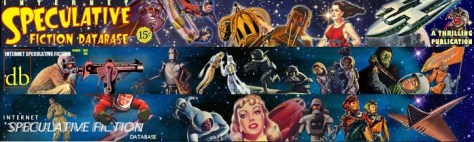
The Internet Speculative Fiction Database

I’ve recently been included in The Internet Speculative Fiction Database.

The ISFDB provides bibliographic information on past and present authors of science fiction, fantasy, and horror. Listings include author pseudonyms, series, awards, and cover art. The publication’s goal is to improve the coverage of speculative fiction to 100%, and they have earned a reputation for being fastidious about nailing down the facts. ISFDB won the 2005 Wooden Rocket Award for the Best Directory Site.

Cory Doctorow wrote in Science Fiction Age: “The best all-round guide to things science-fictional remains the Internet Speculative Fiction Database.”

I’m honored. My thanks to the ISFDB volunteers who included my works.

Quote of the day

“As a fiction writer, the act had an immediate, recognizable weight to it; the imagined reality Jay had created in the act felt like the embodiment of good fiction writing. I began to consider the connections between the two crafts of magic and fiction writing, wondering what might be gleaned about the process of creating living fictions. The suspension of disbelief required by both reader and audience member. The inherent tension between believability and deception. The materialization of something where there once was nothing.” – Gabriel Urza

Adventures and mishaps in science fiction, fantasy, and mystery