Terrorism, Hope, and Ebenezer Scrooge

Scrooge

I can’t help but think of what Christmas will be like for the 14 families who lost loved ones in the San Bernardino massacre last week, or for the families of the three who were gunned down at the Colorado Springs Planned Parenthood facilities last month.

Even for those of us who were not immediately affected, there is still that haunting reminder of the needless suffering we, as humans, inflict on each other.

And yet — and yet — we should not let ourselves give in to despair. Tempted as we may be to concede that evil appears entrenched in the human heart, we cannot surrender our hope that there is a spark of good in everyone, a spark worth noticing and perhaps even cultivating as best we can. As hard as it is to imagine, I believe the shooters in both tragedies thought they acted for worthy reasons.

Robert Dear, Jr., the Colorado Springs killer, ranted in court, “I’m guilty. There’s no trial. I’m a warrior for the babies.” Twisted? Yes. Egomaniacal? No doubt. But even this murderer believed he was protecting the innocent and helpless.

As for Farook and Malik, we can only speculate that they considered themselves warriors for their faith. Nevertheless, whatever was churning through their minds when they abandoned their six-month-old baby and drove to the San Bernardino County Department of Public Health with two .223-caliber semi-automatic rifles and pipe bombs, their actions certainly warranted the swift and decisive response the SWAT team meted out.

That said, we cannot ignore the powerful forces that work on terrorists such as Dear, Malik, and Farook. Modern alienation devastates the isolated individual, and many dedicate themselves to what appears as a last, desperate effort to accomplish something significant and worthwhile. In his article, The Psychological Sources of Islamic Terrorism, Dr. Michael J. Mazarr of Georgetown University writes:

Mass technological life tranquilizes people, drains us of our authenticity, of our will and strength to live a fully realized life. The result of this process is alienation, frustration, and anger. A few themes stand out from this broad concept.

One has to do with the burdens of freedom and choice. By breaking the chains of tradition and conformity, modern life offers a bewildering, paralyzing degree of choice about everything from career paths to marriage partners to fashion. When you can potentially be anything, the existentialists worry, you may in fact be nothing — and have no identity at all.

Alienation from tradition and from others is not freedom, but a curse. In our frantic pursuit of material gain, we lose sight of life’s true purpose. No one has better enunciated the antidote than the protagonist of A Christmas Carol, that classic fantasy tale of Christmas. After the three spirits teach him what Christmas means, Ebenezer Scrooge makes his famous vow:

“I will honour Christmas in my heart, and try to keep it all the year. I will live in the Past, the Present, and the Future. The Spirits of all Three shall strive within me. I will not shut out the lessons that they teach!” ― Charles Dickens, from his novella A Christmas Carol

Stubbornly seeking the spark of good that’s buried even in the heart of old Ebenezer Scrooge gives us hope, real hope, because very often we do indeed find that spark if we simply open our eyes to it. That insight into human nature makes for better fiction, too. The best literature can be a means to form and strengthen social ties because it helps us appreciate the hidden feelings of others. In my novella Aztec Midnight, the protagonist, Jon Barrett, must find and deliver an ancient Aztec relic to men who have kidnapped his wife. However, a local militia stands in his way — not because its members are evil, but because the relic will empower the drug cartels that terrorize them. Jon Barrett’s dilemma is one we can all appreciate.

Want to help make Christmas the season of hope it was meant to be? You can start by reading a good book. Or better yet – by giving one.
Balancing Creativity and Mental Illness

Medb

Where do writers get their ideas? Some say they spring from fevered minds. Those folks may have a point. There’s now scientific support for that view. From NewsMax:

Nancy Andreasen, a psychiatrist at the University of Iowa Carver College of Medicine, studied writers associated with the Iowa Writers’ Workshop and found that 80 percent suffered from depression, mania, or hypomania — compared to only 30 percent of non-writers.

Creative people tend to have adventuresome personalities and are likely to take risks. The high rate of mental illness in highly creative people could also be explained by a genetic predisposition to both creativity and madness.

Creativity involves combining new ideas in ways others have not considered. Sometimes when a person’s ideas seem too far off the norm, he or she doesn’t make sense and may seem mentally ill.

Hmm. A few names come to mind. Philip K. Dick. Robert E. Howard. Sylvia Plath. Troubled individuals all. And all talented writers.

But once again, science is just now discovering what astute observers have known for centuries. In A Midsummer Night’s Dream, King Theseus scoops Dr. Andreasen by some 400 years:

Lovers and madmen have such seething brains,
Such shaping fantasies, that apprehend
More than cool reason ever comprehends.
The lunatic, the lover and the poet
Are of imagination all compact:
One sees more devils than vast hell can hold,
That is, the madman: the lover, all as frantic,
Sees Helen’s beauty in a brow of Egypt:
The poet’s eye, in fine frenzy rolling,
Doth glance from heaven to earth, from earth to heaven;
And as imagination bodies forth
The forms of things unknown, the poet’s pen
Turns them to shapes and gives to airy nothing
A local habitation and a name.

Queen Hippolyta agrees with Theseus, adding that the “strange and admirable” often thrives within the grey and shifting border between madness and craft. I’d add that imagination is just part of what makes all art possible; it’s a skill — something that can be learned and honed — to make “airy nothing” into something concrete the reader can experience.

Quote of the day

Wendell Berry

The sense of the verb “to imagine” contains the full richness of the verb “to see.” To imagine is to see most clearly, familiarly, and understandingly with the eyes, but also to see inwardly, with “the mind’s eye.” It is to see, not passively, but with a force of vision and even with visionary force. To take it seriously we must give up at once any notion that imagination is disconnected from reality or truth or knowledge. It has nothing to do either with clever imitation of appearances or with “dreaming up.” It does not depend upon one’s attitude or point of view, but grasps securely the qualities of things seen or envisioned.Wendell Berry

Best Fiction And Writing Blogs

Kurt Vonnegut

The best fiction and writing blog posts from around the ‘net, with advice and inspiration guaranteed to make you a literary legend. Compiled by kurt.

Pippa GoldschmidtWhat’s more important, #editing or #first draft?
J.C. WolfeInner Writer vs. Inner Critic
SemperiteStop. Edit. Continue
Allison Maruska3 Steps To Writing An Effective PLOT TWIST
Donna HendersonOn Writing
J. S. MalpasPlanning Your Novel in Three Steps
Abbie LuTop Five Fiction Favorites
Mike FullerAnd My Shadow
Kurt Vonnegut8 Tips on How to Write a Good Short Story

Hemingway’s Paris Memoir Flies Off Shelves in Show of Defiance

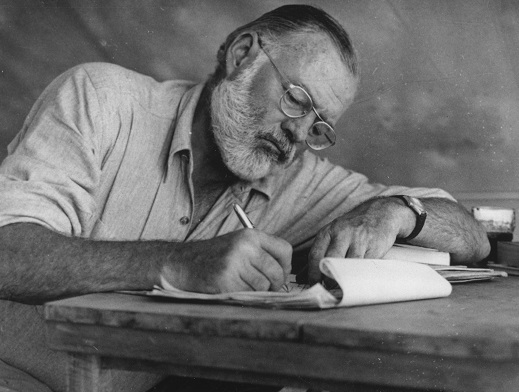
Hemingway Writing

From Bloomberg Business:

Ernest Hemingway’s memoir about the time he spent lounging in cafes and bars in 1920s Paris has become an unlikely totem of defiance against the terrorist attacks that claimed 129 lives in the City of Light last Friday.

Hemingway’s ‘‘A Moveable Feast,’’ or “Paris est une Fete” in French, is flying off the shelves at bookstores across the French capital and is the fastest-selling biography and foreign-language book at online retailer Amazon.fr. Daily orders of the memoir, first published in 1964, three years after the American author’s death, have risen 50-fold to 500 since Monday, according to publisher Folio.

Copies have been laid among the flowers and tributes at the sites of the massacres, and people are reading the book in bars and cafes, Folio spokesman David Ducreux said Thursday. Orders surged after a BFM television interview on Monday with a 77-year-old woman called Danielle, who urged people to read the memoir as she laid flowers for the dead. The video was shared hundreds of times on social media.

I think this is a marvelous way to express solidarity with the people of Paris in the wake of last week’s horrific massacre. That said, the article’s description of A Moveable Feast as an account of the time Hemingway “spent lounging in cafes and bars in 1920s Paris” misses the mark. Yes, there are sensuous descriptions of how he and his friends “ate well and cheaply and drank well,” but the little masterpiece also reveals how Hemingway mastered the craft of fiction, including how he dealt with rejection letters. Hemingway’s vignettes of Ezra Pound, Gertrude Stein, and F. Scott Fitzgerald are not to be missed.

If you haven’t read it, pick up a copy at the library or book store. And let folks know you’re doing it for Paris.

The Paris Massacre, Awareness, and Writing

Musashi

Like many others, the horrific massacre in Paris got me to thinking about how I would have reacted to a terror attack. A number of articles have popped up on the Internet stressing how situational awareness improves your odds of surviving acts of terrorism and similar emergencies. I couldn’t help but notice the ties between situational awareness and writing.

I’ve previously made the case that intense physical activity sharpens the mind and senses. Famed Japanese swordsman Miyamoto Musashi argued the same in his classic The Book of Five Rings. And now we have science that bolsters Musashi’s insights. From Psychology Today:

Musashi referred extensively to training vision and perception through martial arts, but now there is modern evidence in experimental psychology to support his assertions and show that visual abilities can be enhanced with such training. …

Writing in the journal “Attention and Perceptual Psychophysics,” Monica Muinos and Soledad Ballesteros from the Department of Basic Psychology in Madrid, Spain wanted to know if sports training that relied heavily on dynamic visual acuity could interfere with the normal decline in this ability. Using a tracking task where the participants had to rapidly determine the direction and characteristics of object motion, they studied young (less than 30 years) and older (more than 60 years) adults who either had no sporting background or who had training in judo or karate. Not surprisingly, martial arts athletes—both judo and karate—had better dynamic visual acuity scores than non-athletes. This result supports the idea that martial arts training may enhance dynamic visual acuity.

In the following clip, Matt Damon (as Jason Bourne) explains how attention to seemingly trivial details is essential to survival:

Awareness of the fine details others overlook is something every writer must develop. As Stephen King wrote in On Writing, “Skills in description, dialogue, and character development all boil down to seeing or hearing clearly and then transcribing what you see or hear with equal clarity.”

As I’ve said before, the act of reading and writing stories isn’t just a diversion from life, it is life itself.

Why Writers Run

Marathoon

Most folks think of writing as a monkish, abstract endeavor more akin to meditation than exertion. But there’s a vital connection between the discipline of putting one word after another and taking one stride after another, as Nick Ripatrazone explains in this must-read Atlantic article:

The steady, repetitive movement of distance running triggers one’s intellectual autopilot, freeing room for creative thought. Neuroscientists describe this experience as a feeling of timelessness, where attention drifts and imagination thrives. …

Since I’ve returned to distance running, I’ve changed the way I think about writing. Writing exists in that odd mental space between imagination and intellect, between the organic and the planned. Runners must learn to accept the same paradoxes, to realize that each individual run has its own narrative, with twists and turns and strains.

Writers and runners use the same phrase—“hit my stride”—to describe the moment when exertion and work become joy. Writers stuck on a sentence should lace their sneakers and go for a jog, knowing that when they return, they will be a bit sweatier, more tired, but often more charged to run with their words.

We know a sound mind in a healthy body is sharper and livelier because mind and body are not two separate entities. Each one affects the other. But Ripatrazone expands on this truth by proposing that running helps the mind harmonize with the rhythm and tempo of the body, stimulating the writer’s ability to “focus on a single, engrossing task and enter a new state of mind entirely—word after word, mile after mile.”

I fully agree, and would add that other physical activities also promote writing ability. I’ve found that weightlifting, a strenuous, repetitive, and somewhat dangerous activity, sharpens my focus and endurance, two qualities essential to getting words onto paper. Yukio Mishima even wrote a book, Sun and Steel, about the benign discipline lifting weights imposed on his writing. And Ernest Hemingway relied on boxing to help him break occasional writer’s block.

Adventures and mishaps in science fiction, fantasy, and mystery