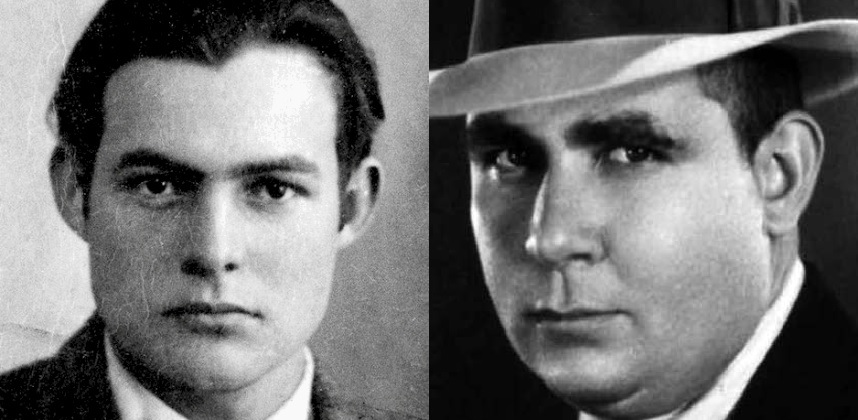
The Boxer

Ernest Hemingway and Robert E. Howard had a lot in common. Both were passionate outdoorsmen who relished food and drink and brawling. Though identified with different genres, both infused their fiction with athletic, vivid prose that still stirs the imaginations of appreciative readers. They have inspired countless writers, and decades after their deaths, their works are still in print.  

Both of them boxed, and wrote spirited, brawny stories about boxers. And each also wrote inspirational tales about heroes who refused to surrender despite overwhelming odds.

And yet, both committed suicide.

I’ve read excellent accounts of the lives and careers of both authors, and still puzzle over their final acts.

No doubt both men were tormented, and found some release – or at least, temporary escape – from their suffering in their writing. In a letter to F. Scott, Fitzgerald, Hemingway confided:

“Forget your personal tragedy. We are all bitched from the start and you especially have to hurt like hell before you can write seriously. But when you get the damned hurt use it—don’t cheat with it. Be as faithful to it as a scientist—but don’t think anything is of any importance because it happens to you or anyone belonging to you.”

In his poem “Musings,” Howard identifies writing as a weapon against the horrors and torments of a hostile world:

The mighty poets write in blood and tears
And agony that, flame-like, bites and sears.
They reach their mad blind hands into the night,
To plumb abysses dead to human sight;
To drag from gulfs where lunacy lies curled,
Mad, monstrous nightmare shapes to blast the world.

The intrepid protagonists that both writers brought to life still inspire. Garcia, the washed-up matador in Hemingway’s “The Undefeated,” must battle not just a formidable bull, but a predatory promoter and a fickle, unforgiving crowd. Like Santiago in “The Old Man and the Sea,” Garcia may be beaten at the end, but refuses to give up. Howard’s Conan tales still thrill readers with dazzling, evocative scenes of courage and muscle battling intrigue and sorcery.

How could artists who penned such timeless accounts of heroic tenacity raise their guns to their own heads?

One possible explanation is suggested by H.P. Lovecraft’s tribute to Howard shortly after Howard’s suicide:

“Scarcely anybody else in the pulp field had quite the driving zest and spontaneity of R. E. H. He put himself into everything he wrote—even when he made outward concessions to pulp standards…”

The same could be said of Hemingway. Both infused their stories with their own life-force. Like the determined heroes they conceived, they held on to their agency, though in a final, hard choice. Both found themselves with no other option. Hemingway could no longer write, and he was racked by concussions and a broken body. Howard was convinced both his relationship with Novalyne Price and his writing career were over, and was physically and emotionally wrecked by the demands of attending to his mother.

We can easily imagine Hemingway and Howard as the boxer Paul Simon wrote about:

In the clearing stands a boxer
And a fighter by his trade
And he carries the reminders
Of every glove that laid him down
Or cut him till he cried out
In his anger and his shame
“I am leaving, I am leaving”
But the fighter still remains

Pummeled and in devastating pain, the boxer chooses to leave. But the fighter still remains. As Hemingway once put it, “A man can be destroyed but not defeated.”
Little Blue Marble 2022 Anthology

I’m pleased to announce that Little Blue Marble has selected my short story “A Tree Amid the Wood” for its 2022 anthology.

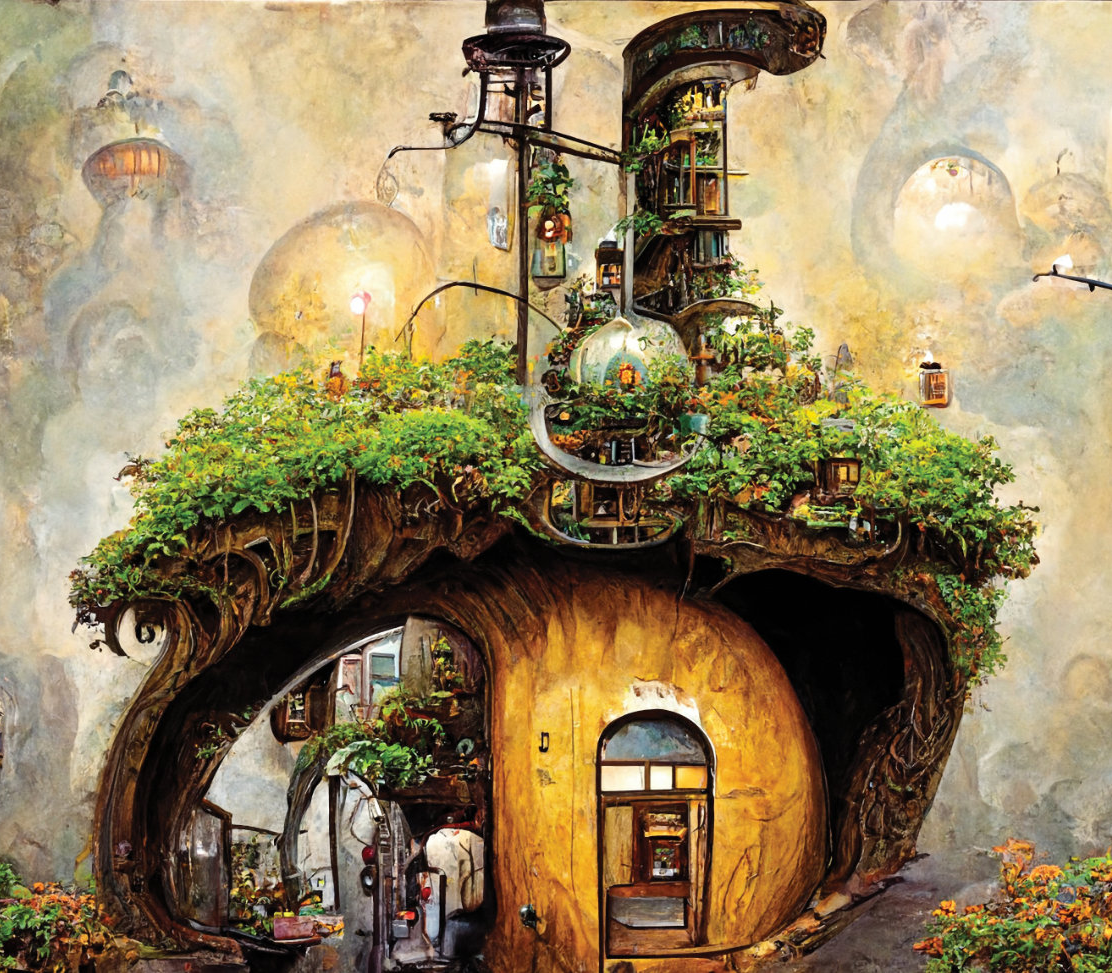
In my story, biotech pioneer Franklin Pratt builds a living house that senses and responds to the needs of its owner. Franklin’s invention has the potential to reduce homelessness, pollution, and social isolation, but a stroke robs him of the ability to communicate. And worse — he fears and distrusts the only person who can help him.

Little Blue Marble publishes speculative fiction and articles aimed at raising awareness about the environment. I can’t tell you how proud I am to have my work included with so many fine authors.

My reverence for nature inspires both my fiction and blog posts about the wild places I’ve explored, from maritime forests to deserts. One of the themes I keep returning to in my writing is the mismatch between human needs and the unnatural straitjacket of modern life. Culture and nature should complement each other. Media analyst Arthur Asa Berger has observed that “culture” comes from the Latin “colere,” which means to tend to the earth and cultivate. Humans, like all other living things, need a nurturing environment. I believe the disconnect between human nature and creeping global homogeniety is at the root of modern neuroticism.

But don’t let the serious subject matter fool you — this book features well-crafted, entertaining stories. Little Blue Marble’s 2022 Anthology not only promotes a vital cause but will make a great Christmas present.

Now available in print from Amazon.

The Art or the Artist?

“John Wayne was no actor.”

Yes, that’s what she said! While working a crossword puzzle, my wife had asked me about Academy Award winners from the ‘60s, and I’d suggested the Duke. My response was met with the above inflammatory statement. (John Wayne wasn’t the answer to the puzzle, but in fact, he did win an Oscar in 1969 for True Grit.)

But my wife’s comment got me to thinking. No doubt many would agree with her. After all, John Wayne pretty much played the same role in all of his movies. When he portrayed Genghis Khan in The Conqueror, he played the title character “as a gunfighter.” Does that mean Wayne wasn’t really an actor? How about George C. Scott? Both actors had millions of fans. People watched their movies to see how each actor adapted his latest role to his unique personality. Both had an electric presence that energized every character they portrayed.

But there are polar opposites that are equally enjoyable to watch. Consider Christian Bale, or Meryl Streep, or Dustin Hoffman. Their talent lies in adapting themselves to the role. These actors dissolve into the personality of the character they portray. While watching them, you see Batman, Sophie Zawistowski, or Benjamin Braddock. The character being portrayed is so vivid, you don’t see the actor.

The elegant Fred Astaire was said to have vanished into the fluidity of his dance moves. James Cagney, on the other hand, with his bouncy, stiff-legged leaps and sprints, brought a prizefighter’s moves to the dance floor. One made you see the dance, the other made you see him. And both pulled in large — and appreciative — audiences.

Certain writers display similar approaches to their craft. Whenever I read The Grapes of Wrath, or Tortilla Flat, I’m carried away by the story, the characterization, and the beauty of the language. Those are the things I feel when I read a John Steinbeck piece. However, when I read Robert E. Howard, I see his fiery personality illuminating the action, whether the story is about Conan, King Kull, or Solomon Kane. And the same goes for The Call of the Wild and The Sea-Wolf — you know you’re seeing Jack London, or aspects of him, on every page.

Piet Mondrian once declared that “The position of the artist is humble. He is essentially a channel.” There’s discipline in that approach, one that Meryl Streep, Fred Astaire, and John Steinbeck could agree on. The artist must get out of the way so the art can live.

But the other approach, that of George C. Scott, Robert E. Howard, and Jack London, also produces good art. John Lennon put it this way: “If being an egomaniac means I believe in what I do and in my art or music, then in that respect you can call me that… I believe in what I do, and I’ll say it.”

Writer and mystic Thomas Merton once suggested an intriguing compromise between the two extremes: “Art enables us to find ourselves and lose ourselves at the same time.” Yes.

The Magic of Place

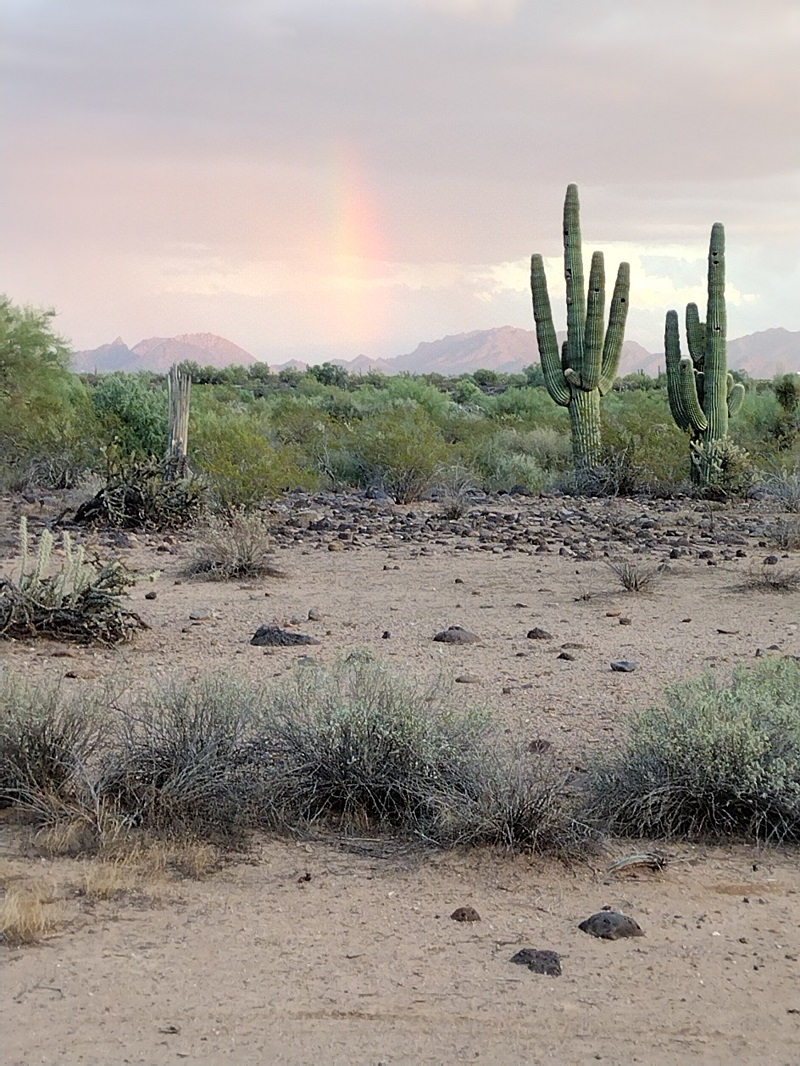
Earlier this month, Julie and I took a 15-mile e-bike journey across the Sonoran Desert north of Phoenix. Our guide knew the area well. He informed us that broken pottery littered the area. The Hohokom people who lived here for thousands of years believed shattering old pots would release the spirit of the departed artists who made them. While we searched for shards, our guide cautioned us to keep our eyes open for rattlesnakes, Sonoran toads, and spiny lizards. A pack of coyotes shadowed us for much of the journey, yipping to each other as they slinked just out of sight behind the brittle bush and ironwood trees.

A light rain dampened our little trek, but quickly blew east in time to catch the last rays of the setting sun and give us this little arc of a rainbow on the distant horizon. A line from H. R. Wakefield’s “He Cometh and He Passeth By” echoed in memory:

“Arizona is a moon-dim region, very lovely in its way, and stark and old, an ancient, lonely land. One is brought up against the vast enigmas of time and space and eternity.

I felt that.

My DMR Books blog interview

I was pleasantly surprised and honored when D.M. Ritzlin of DMR Books asked if he could interview me as part of his series of author profiles. We covered my writing background, the literary and philosophical influences on my fiction, and works in progress.

It’s now online at Independent Author Spotlight: M.C. Tuggle.

A Tree Amid the Wood

A Tree Amid the Wood

I am delighted to announce my story “A Tree Amid the Wood” is featured in the latest edition of Little Blue Marble, which publishes fiction, non-fiction, and poetry focusing on ecology.

Franklin Pratt lives in a special house of his own design. It is a living thing that senses and responds to its owner’s needs by growing rooms as needed and reflecting the owner’s emotional state with bioluminescent blossoms. Once it’s mass-produced, Franklin’s invention can provide housing for millions and help heal the environment.

But since his stroke, Franklin is unable to share his creation with the world. He feels he’s a prisoner in his own home and distrusts Carrie Masada, the woman who supervises his team of caretakers. Franklin fears she only wants to steal the secret of his house.

And he’s right. Carrie wants Franklin’s secret. But why?

My love and concern for nature has inspired a number of my posts and published stories, so while honored by this acceptance, I am especially pleased my story promotes a cause I believe in deeply. The title comes from one of Ezra Pound’s early poems, “The Tree“:

I stood still and was a tree amid the wood,
Knowing the truth of things unseen before;
Of Daphne and the laurel bough
And that god-feasting couple old
That grew elm-oak amid the wold.
‘Twas not until the gods had been
Kindly entreated, and been brought within
Unto the hearth of their heart’s home
That they might do this wonder thing;
Nathless I have been a tree amid the wood
And many a new thing understood
That was rank folly to my head before.

 As in Pound’s lovely poem, my story explores how love of the natural world is the essential foundation for understanding, connecting, and caring — in other words, for becoming fully human.

Creative Borrowing

In my post Writing with Creative Constraints, I confessed the following:

“In the past couple of months, I’ve broken through writer’s block by writing stories for themed anthologies or contests. In other words, I was out of ideas, so I followed the lead of someone else. “

Confession? Nothing to feel guilty about. After all, nothing new under the sun, right? Besides, since there are only seven basic stories, every work of fiction is only a variation or combination of them. So creative borrowing is simply what we writers do. Look at Star Wars. It’s just another space opera/fantasy/western/World War II/heroic quest tale.

Even the best look to other authors for inspiration. Take William Shakespeare, for example. The Cultural Tutor has compiled the source materials for all 38 of the Bard’s plays, from All’s Well That Ends Well to Titus Andronicus. So recycle those borrowed ideas with abandon, but don’t forget to infuse your creation with your own special style .

Adventures and mishaps in science fiction, fantasy, and mystery