“The great thing about growing up with science fiction is that you have an interest in everything.”
“The great thing about growing up with science fiction is that you have an interest in everything.”

The hard-working folks at The Internet Speculative Fiction Database have updated my bibliography to include my recent publications.
This is a fantastic resource for readers and writers of speculative fiction. It provides links to directories of authors and publishers, as well as a comprehensive magazine database. You’ll also find links to a gold mine of bibliographic research for all types of speculative fiction, including sci-fi, fantasy, and horror.
Each day, the home page features a listing of international authors born and deceased on that date. Great fodder for blog posts or Tweets!
“When I was a kid, I read Robert A. Heinlein, I read H.P. Lovecraft, I read Robert E. Howard, and then later Tolkien. Some of these would be classified as fantasy, some as horror and some as science fiction. To me, they were all stories, they were imaginative stories that took me to other worlds, other times, or other planets or dimensions or what have you, and I enjoyed the hell out of them. I didn’t see these as totally different things. I still don’t. I think these distinctions are largely false ones.”
George R. R. Martin
Over at CrimeReads, Lee Randall has this to say about two interrelated realms many think have little in common:
“All complex narratives are networks,” writes Jane Alison in Meander, Spiral, Explode. “Any literary narrative of depth asks your brain to pull threads across the whole . . . your experience moving through them is never purely linear, but volumetric or spatial as your thoughts bounce across passages.”
That sounds like physics to me. This branch of science encompasses everything from mechanics, heat, light, radiation, sound, astronomy, atomic structure, electricity and magnetism. It demands elasticity of thought and an ability to think in metaphors. Physicists strive to describe the universe and understand the relationships between all its components.
That’s what novelists do, too!
(And short story writers!) There’s nothing like the feeling of linking together seemingly disparate elements into a unified whole. When it works, you feel it — and if you don’t feel it, neither will the reader. If plot arises from character, then the other elements of a story, including the objective, theme, scenes, twists, etc, should work in harmony to create a single, emotionally satisfying effect on the reader.
Nothing prepares you for such a challenge like reading widely and deeply. The resulting cross-pollination of ideas not only helps you see the interrelatedness of things, but keeps your sense of wonder alive. And that motivates you to create more stories.
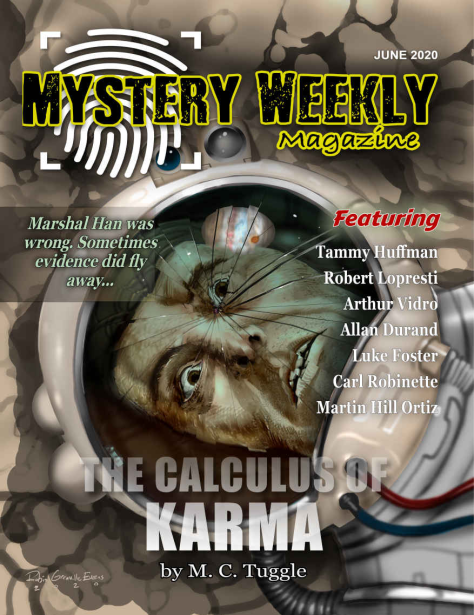
My story “The Calculus of Karma” is a combination science fiction and mystery tale. A big chunk of the fun in writing it was creating a puzzle for the protagonist to solve. And what a puzzle — our rookie detective has a dead space miner on his hands, but no murder weapon, no suspects, and he has to solve the case before the death sparks an escalation between warring factions of miners. Inspiration finally arrives from Sir Isaac Newton and Al Capone.
That’s the challenge of science fiction — you have to create believable plot and character arcs, craft an entertaining story, produce flowing, sparkling prose, and — get the science right.
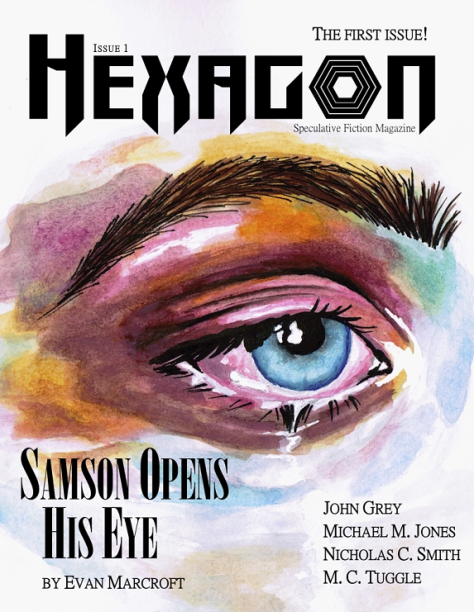
Didi Oviatt, the author of Justice For Belle, reviews the premiere issue of Hexagon Speculative Fiction Magazine:
In this 1st edition there are five quick science fiction reads by authors Mike Tuggle, Evan Marcroft, John Grey, Michael M. Jones, and Nicholas C. Smith. I’ve read work by Mike Tuggle before and really enjoyed his style, so I knew going in that this edition had potential. I wasn’t disappointed either.. Actually quite the opposite! These contributors really brought their A-game. Gore, action, aliens… it has it all!
Read the rest at Didi Oviatt.

The premiere issue of Hexagon Speculative Fiction Magazine is now available as a free download. It includes my flash fiction story “Mirrors.”
Alone on the remote moon Specula C-3, Dr. Annette Thatcher rescues the lone alien survivor of a wrecked spacecraft. Thatcher, a xenobiologist, is eager to learn about this strange being’s culture. But neither she nor the alien are prepared for what their chance encounter reveals about both species.
And that’s just one of five great pieces in Hexagon’s Summer 2020 issue, which also features stories and poetry by Evan Marcroft, Nicholas C. Smith, Michael M. Jones, and John Grey.
Hexagon is a Canadian publication whose mission is “to take our readers to fantastic worlds and to meet incredible characters.” Check it out!
Mystery Weekly Magazine has published my short story “The Calculus of Karma.” It’s a mashup of science fiction and detective fiction, two of my favorite genres. The gorgeous cover art by Robin Grenville Evans captures the story’s tone perfectly.
In the year 2454, Malcolm Lamb is a rookie deputy marshal assigned to a mining colony on the asteroid 16 Psyche. Lamb and his fellow deputies have to constantly break up clashes between Damani Corporation miners and wildcatters. Under its grim surface, Psyche hides a fortune in precious metals, and competition for it ignites raw passions.
When a dead miner is found in an alley behind a popular bar, Malcolm Lamb must find the killer to prevent an escalation in the deadly turf war between the corporate and wildcat miners. With no murder weapon, no suspect, and no clue how the miner was killed, Lamb has to interpret conflicting pieces of evidence before time runs out.
This story was a blast to research and write. A beta reader called it a Wild-West-inspired space adventure with a big chunk of Columbo thrown in. Malcolm Lamb is a bit of a departure from the kind of protagonist I usually write about, but he does embody an heroic principle I admire, best defined by Robert Penn Warren: “If poetry is the little myth we make, history is the big myth we live, and in our living, constantly remake.”
Mystery Weekly is a Mystery Writers of America approved publisher that features original short stories by the world’s best-known and emerging mystery writers. You can buy a Kindle or print copy through Amazon, or get a digital subscription to “the world’s most-read monthly mystery magazine” on Kindle Newstand.
Patreon subscribers to Hexagon Speculative Fiction Magazine now have early access to its premiere issue. It features my flash fiction story “Mirrors.”
While conducting a solo study of the fauna on Specula C3, Dr. Annette Thatcher witnesses the crash-landing of an alien spacecraft. She rescues Gregarin, the lone survivor of a ship from Etzi, a previously unknown planet. During the weeks Thatcher and Gregarin wait for an Earth rescue shuttle, they learn about each other’s language and culture — and surprising truths about themselves.
The idea for this story came to me while re-reading Dr. Lewis Thomas’ marvelous book, The Lives of a Cell, a beautifully written treasure chest of insights into the interconnectedness of all life. Thomas’ thoughts on collective societies that behave like single organisms got me to imagining how human society would appear to an alien species.
Hexagon Speculative Fiction is a new Canadian publication featuring poetry, fiction, and mixed media from all over the world. Its goal is to blend the fantastic, the absurd, the horrifying, and the humorous.
The debut issue also includes the work of Evan Marcroft, Nicholas C. Smith, Michael M. Jones, and John Grey.
“I find the short story much more intriguing because it encompasses, in a moment, everything that went before and supposes everything that will follow. It gives the reader the opportunity to exercise his or her chops in solving the mystery. It freezes up a moment in time, it freezes your imagination of a concept in a moment in time, and the short story has always seemed to be to me far more difficult and adroit and flexible than the novel. There are many great novels, and yet I see people writing trilogies and quatrologies and even five and six and eight volumes in a series, and I think, ‘Are they not re-chewing their cud?’ So I try to hit the gong the first time.” Harlan Ellison

Mention the term Southern fiction, and people typically think of the works of Flannery O’Connor, William Faulkner, Ron Rash, or Charles Frazier. The term evokes scenes of snowy-white cotton fields, simmering tension between characters sipping bourbon, or protagonists haunted by an aching nostalgia for a rural life long gone.
Most folks wouldn’t associate memory uploads, runaway AI systems, or megacorporations as proper subjects for Southern fiction. But maybe my article on cyberpunk author William Gibson might just change your mind. It’s the featured post over at the Abbeville Institute blog. Read it there, and comment on it here. Enjoy!
 M.C. Tuggle, Writer