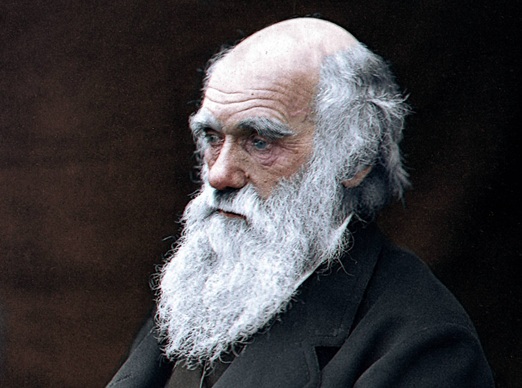
Charles Darwin’s landmark book On the Origin of Species was first published on this date in 1859.
We haven’t been the same since.
As E. O. Wilson tells us, science provides “more solidly grounded answers” to life’s mysteries. Not only has the theory of evolution transformed science, it has also given us a powerful lens for examining ourselves. Sadly, we remain blind to Darwin’s foundational message, that humans are not invaders but a part of nature. This continued isolation from the natural world has dire consequences, as this recent article from Science Daily warns us:
“A new study by evolutionary anthropologists Colin Shaw (University of Zurich) and Daniel Longman (Loughborough University) argues that the pace of modern living has moved faster than human evolution can follow. According to their work, many chronic stress problems and a wide range of contemporary health concerns may stem from a mismatch between biology shaped in natural settings and the highly industrialized world people occupy today.
That means the mismatch between our evolved physiology and modern conditions is unlikely to resolve itself naturally. Instead, the researchers argue, societies need to mitigate these effects by rethinking their relationship with nature and designing healthier, more sustainable environments.”
What to do? We must recognize our relationship with nature. The places we live must be reimagined and revamped so they resemble our hunter-gatherer past. More green spaces, more walkways, less dependence on cars, more opportunities to see nature maturing and blossoming before us.
But the first, most essential step is to open our eyes and see what we truly are.
 M.C. Tuggle, Writer
Mike, I’m glad that you bring this forward. And the truth is we are nature, we are plants that thrive according to the light we get, the nutrients we receive, and the environment we’re in. Unlike plants, we do need to move like the animals we also are to keep healthy.
LikeLiked by 1 person
And we ignore that truth at our peril.
LikeLiked by 1 person
Hi Mike, Thank you for that excellent article, it was most interesting and true. Being a nanogenarian (93) and a curious person by nature, I am indeed fortunate that only a few of my ‘lights’ have dimmed; especially so as I enjoy writing. ‘Life’ has ‘speeded up’ to a dizzying degree since I was a child in 1938. I can recall the peaceful level of most days. Walking to school and most other places where suitable: (Dad never drove so we didn’t own a car), he recommended walking or cycling, and it’s amazing what you notice about nature when your pace is slowed by habit.
At home, we were more involved in things than entertained by lots of gadgets. We played cards and word games and my brothers created interesting vehicles and aeroplanes from Meccano or plastic bricks, while I knitted or made- sometimes useful!- sewn articles. . And we all like drawing – to different levels: eldest brother the best, while the middle one well and truly caught up later, and I loitered but loved it. We didn’t have a telephone until the late 1950s, but prized our wireless. And I read anything with words on, while my brothers preferred comics.
Luckily, our parents were loving, intelligent souls who encouraged us “to do your best!” and we none of us (four) starved, kept the wolf from the door and have all had long and happy marriages, with plenty of adventures along the way. Although I’m not technical, I manage to use a computer, and have written ten books, many short stories and poetry.
They say that life is what you make it – but there are too many ‘ifs’ and ‘buts in that statement. . .but stretch your time with nature to the limit, be kind, smile more , listen to music, and have a good laugh when you ‘get your knickers in a twist.!’ Cheers. Sincerely
Joy Lennick
PS And limit your time with that dratted phone! . .
LikeLiked by 2 people
Joy,
Excellent advice! Andrew Nelson Lytle knew what he was saying when he said, “Throw out the radio and take down the fiddle from the wall.” I’d also toss ultra-processed food, TV dinners, and the TV.
LikeLike
Your last sentence is perfect.
LikeLiked by 1 person
Jennie,
That’s very kind of you.
LikeLiked by 1 person
You are welcome, Mike.
LikeLike
Yes. Thank you. Read Wilson and Darwin as an undergraduate.
LikeLiked by 1 person
PS- The anonymous is me. No thank you wordpress.
LikeLiked by 1 person
Sometimes these machines seem to have a mind of their own. An evil mind.
LikeLike
“… the pace of modern living has moved faster than human evolution can follow.” -Shaw and Longman
I lean toward 1970 Alvin Toffler often in this regard.
LikeLiked by 1 person
Indeed. I wonder how much more information overload we can take. Getting out into the wilds is a good respite.
LikeLike
” … societies need to mitigate these effects by rethinking their relationship with nature.” -Shaw and Longman
Yet it seems to me that “thinking” (reasoning) is what sets humankind apart from nature, not what brings us closer to being like the natural world. Maybe I am reading that word too literally.
Thanks for a post that stirs thinking.
LikeLiked by 1 person
I’d say we need to accept our ties to nature. Richard Weaver said it best: “Nature is not something to be fought, conquered and changed according to any human whims. To some extent, of course, it has to be used. But what man should seek in regard to nature is not a complete domination but a modus vivendi – that is, a manner of living together, a coming to terms with something that was here before our time and will be here after it.”
LikeLike
I agree that we are healthier when we see our ties to nature and turn off the blasted machines more often. As long as we remember that God is our creator.
LikeLike