All posts by Mike

Adventures and mishaps in science fiction, fantasy, and mystery

Can Literature Heal?

Fairie Queen

“If a nation’s literature declines, the nation atrophies and decays.”
Ezra Pound

Signs of atrophy and decay are inescapable these days. The coarseness of mass entertainment, the malignancy of political discourse, the creeping alienation affecting young and old alike which swells up and all too often releases itself in violence — all point to the realization that we have lost our way.

Before we can propose a way back, we have to figure out how we got lost.

I’m reminded of a flash of insight from one of my favorite nature writers, Charlene Spretnak. In The Resurgence of the Real, she noted that in our frenzy to reconstruct the world to cater to endless consumption and personal gratification, we have become our own Frankenstein monsters:

Ten years ago, I attended an all-day presentation by two of our finest writers on the natural world, Barry Lopez and Richard Nelson. A love of language and nature–and a humility before both–permeated their comments, but one observation in particular lodged vividly in my memory. After speaking about the ways in which wild animals are so acutely aware of minute events in their considerable range of attention that their consciousness extends far beyond their fur into the sensate forest, Lopez observed that a bear taken out of its habitat and put into a zoo is still a form of mammalian life, but it’s not a bear.

It’s not a bear.

It’s not a human if its felt connections with the unfolding story of the bioregion, the Earth community, and the cosmos are atrophied, denied, and replaced. It’s not a human if it can no longer experience awe and wonder at the beauty and mystery of life, seeing nothing but resources and restraints. It’s not a human if it is socialized to be oblivious to the unity of life, so lonely that it is vulnerable to all compensatory snares.

The destruction of community connections is not an accident. So-called “liberals” want to free the individual from social constraints, while so-called “libertarians” seek to free the individual from government constraints. But rather than feeling free, the individual is left psychologically isolated, aware of no obligations or duties, but insistent on his growing list of rights.

No wonder so many are resentful and distrustful of others. Meanwhile, the cultural ideal is individual differentiation as an end in itself. One who isn’t sufficiently differentiated is not authentic. Authenticity, however, is available on the retail level. We are what we buy.

So what can be done to break the barriers we’ve erected around ourselves? Literary critic Gary Saul Morson proposes a process that can be described as literary therapy:

It is really quite remarkable what happens when reading a great novel: By identifying with a character, you learn from within what it feels like to be someone else. The great realist novelists, from Jane Austen on, developed a technique for letting readers eavesdrop on the very process of a character’s thoughts and feelings as they are experienced. Readers watch heroes and heroines in the never-ending process of justifying themselves, deceiving themselves, arguing with themselves. That is something you cannot watch in real life, where we see others only from the outside and have to infer inner states from their behavior.

In other words, sharing a character’s joys, fears, and triumphs nurtures our natural impulse to empathize with others, thus breaking down the solipsistic illusion that none but the One True Self thinks, feels, and exists.

Is it possible to rediscover our humanity by freeing ourselves from our addiction to iPods, iPads, and shoot-’em-up video games, and instead spend our precious free time with good books? I think it’s worth a try.

Best Fiction and Writing Blogs

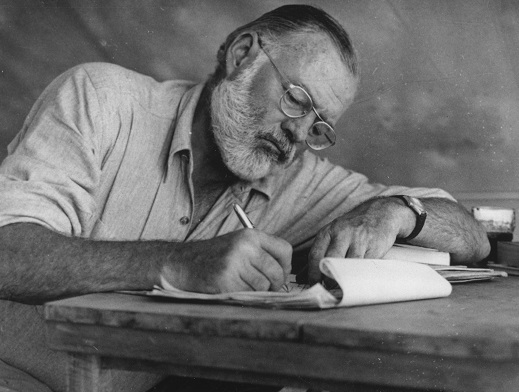
Hemingway Writing

The best fiction and writing blog posts from around the ‘net, with advice and inspiration guaranteed to make you a literary adventurer. Compiled by ernie.

Elizabeth StokkebyeLessons From Writing Boot Camp
Stratford CaldecottThe Provocative Imagination Behind Comic Books (A Tolkien scholar’s insights into comics)
Jacob EmetWriting
Shiva AcharyaCelebrating the Joy of Reading
Daedalus LexBest Sentence in English Lit
Jay Dee ArcherWorldbuilding
Nihar Pradhan – Writing Is Romancing With Self

re: the comic books article, I must admit I never recognized the archetypes represented by the Fantastic Four. Cool.

Therapeutic Superstition

Moonrise

Here is a heartbreaking — and, sadly, true — story of a man who was too much in tune with nature to be left alone and allowed to be happy. From First Things:

At any rate, the thing I want chiefly to emphasize about Reuben is that he was a remarkably happy man: harmless, kind, and always in good spirits. In fact, I do not think I have ever known anyone else who took such evident delight in the world. He told me he had felt himself surrounded at all times by friends, human and otherwise: A walk in the country for him was a visit to the companions of his childhood. He spoke of “creation” (he rarely used the word “nature,” it seems to me) as an essentially “amiable” reality if one approaches it correctly. He may have been one of the few truly happy souls I have known in my life.

Reuben’s fate reminds me of this little story.

Russell Kirk on Fantasy

Russell Kirk

Russell Kirk was a literary critic, historian, and political theorist. He passionately believed that literature was an essential part of one’s education, since it exposes students to “splendor and tragedy of the human condition, to constant moral insights, to the spectacle of human history, to love of community and country, to the achievements of right reason.”

Here are his reasons for reading and teaching fantasy, along with a few recommendations. From The Intellectual Conservative:

If young people are to begin to understand themselves, and to understand other people, and to know the laws which govern our nature, they ought to be encouraged to read allegory, fable, myth, and parable. All things begin and end in mystery. Out of tales of wonder comes awe—and the beginnings of philosophy. The images of fantasy move us lifelong. Sir Osbert Sitwell, when asked what lines of poetry had most moved him in all his life, replied candidly, “Froggie would a-wooing go, whether his mother would let him or no.”

So here are my fantastic recommendations—

John Bunyan, The Pilgrim’s Progress (1678-84)

William Shakespeare, A Midsummer Night’s Dream (1596-96)

Nathaniel Hawthorne, The House of the Seven Gables (1851) or (perhaps preferably) The Marble Faun (1860)

Robert Louis Stevenson, Kidnapped (1886) or one of his volumes of short stories

Ray Bradbury, Something Wicked This Way Comes (1962) or Dandelion Wine (1957) (Bradbury is something far better than an accomplished “science fiction writer;” he is a man of remarkable ethical insights and great power of style.)

Walter Scott, Old Mortality (1816) or The Heart of Midlothian (1818), (These are much more important romances than is Ivanhoe (1819), so commonly taught).

Select poems of Spenser, Burns, Coleridge, Wordsworth, Shelley, Tennyson, Whittier, Longfellow, Chesterton, Kipling, Masefield, Yeats, Frost, and others—selected with and eye to the marvelous and the mysterious.

Apollo 11

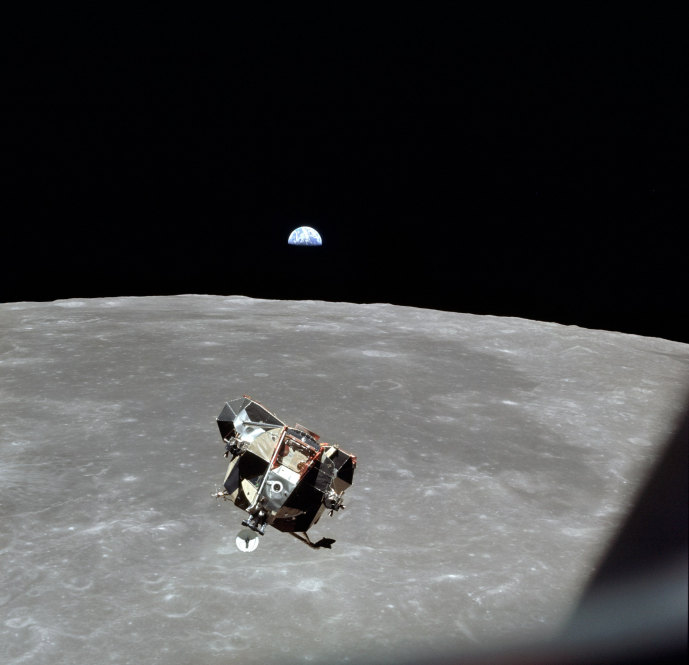
Apollo11

Where were you when Neil Armstrong set foot on the moon?

I remember that night well. I was in my second week working at my first job as a projectionist at WGHP-TV in High Point, North Carolina. Since we were on network feed all night, all I had to do was load our station ID slides and run a few commercials. In addition to me, there was the director and an engineer. That was the skeleton crew, and we were pretty well psyched all night. Nothing could have torn me away from the video monitor when Neil Armstrong stepped out of the lunar lander. The three of us stood motionless in that cramped control room full of racks of electronics and stared in total awe.

So — when’s the next bold adventure in space?

The Scots-Irish Rascals Who Made America

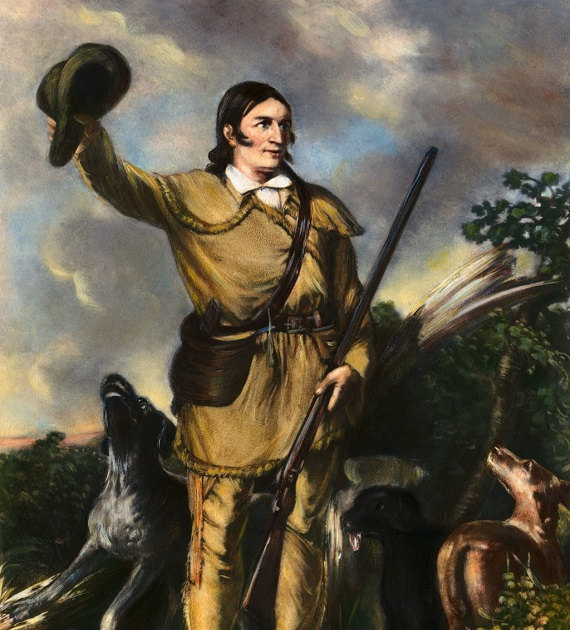
DavyCrockett

Here’s my review of Karen McCarthy’s The Other Irish, one of the books I read while researching my latest book. Who are “The Other Irish”? As McCarthy writes:

“They settled the frontier, intermarried with other migrants, imbued the national character with their own nature and values, and, arguably, became the most patriotic of all Americans. They provided American icons like Davy Crockett, literary giants from Mark Twain to Stephen King, American warriors from Sam Houston to George Patton. They invented NASCAR — the biggest spectator sport in America — and provided more than twenty presidents.”

My review is featured today at the Abbeville Institute.

Best Fiction and Writing Blogs

Hemingway2

The best fiction and writing blog posts from around the ‘net, all guaranteed to make you a literary adventurer. Compiled by ernie.

Jacqueline SeewaldTips On Adding Symbolism In Fiction
Lori RensinkJust Words And Just Music
Gary GautierThe Architecture of Narrative
Assia ShahinUffizi Galore
Jay Dee ArcherAuthors Answer 33 – The Writing Process
Timothy Pike“Doing interesting stuff” inspires this tireless writer
Nihar PradhanGreat Bloggers Are Great Thinkers

And as an extra bonus: Ancient Origins. This webzine is updated daily with fascinating articles about Science and Space, History and Archaeology, Evolution, and Strange Phenomena. A gold mine of writing ideas!

The Power of Body Language

Yojimbo2

Are you frustrated with your characters? Are they slowing down what should be a gripping, page-turning story? Maybe it’s time you got them off their rear ends and put them to work.

In my re-writes, I search the text for characters who THINK rather than ACT. When I spot a cerebral, lackluster character, I start re-staging the scene like a director, deciding how the characters should approach and look at one another. When I’ve done my job, every character will be in motion. His tone of voice, eye movements, expressions, and stance will reflect and amplify his emotions and attitudes. THEN each character can tell a compelling story.

Body language is one of the most powerful tools a writer can use. When we express our characters’ emotions and thoughts in concrete, physical terms, we pull the reader deeper into the story.

In my sci-fi short story Aquarius, the protag, Joni Lingg, leads a shadowy organization within NASA through intimidation and the power of her personality. But why TELL when it’s more fun and intriguing to SHOW:

I once saw her chew out an Air Force major. I was in the next room, and could hear nothing, but could see them clearly through a window. Joni, a short brunette with the face of a child, was enraged, jabbing her finger and thrusting her tiny chin at the major, her blue eyes blazing in fury. The major took it like a confused, whipped puppy.

In Aztec Midnight, I could have had the first-person narrator just say he hits his low point when he’s thrown into a Mexican jail and feels like giving up. But this is more emotionally engaging:

In the dark, drunks with slouching shoulders gave way to grim-faced men with dead eyes and scarred forearms. I found myself being swept along with the drunks. The lone bench in the back was filled with Cuernavaca’s meanest residents, and I didn’t feel like another fight. I leaned against the unyielding bars and shut my eyes. The pressure of the cold metal against my throbbing head and back barely registered. There was no fight left in me, no strength. I had no idea of the time or what I could do next.

Hazy minutes passed by while I propped myself up against the bars. There was no clock. I guessed I’d been in the hole at least two hours. My eyes burned when I shut them.

The reason body language is so evocative is because we are social beings. Long before the invention of language, our physical reactions communicated to others vital information about what we were experiencing. Facial expressions, gestures, and posture came long before the invention of language. The ability to “read” body language is more fundamental, and therefore more moving, than reading written language. So the more physical we can make the story, the more real it is to the reader.

Recent research in neuroscience tells us that when we think about an action, we activate the motor area of the mind that controls that action. Magnetic resonance imaging scanners show that when a subject reads about kicking, for example, the area of the brain that controls kicking “lights up.” There’s an exciting new theory of language called “Embodied Cognition,” which can be summed up as, “We understand language by simulating in our minds what it would be like to experience the things that the language describes.”

That’s why other researchers have found that the brains of those who read powerful stories are changed by those stories. Indeed, reading vivid stories actually creates “muscle memory” in the brain as if the reader had actually lived the events in the story.

No wonder my feet hurt after reading Tolkien’s The Fellowship of the Ring. That was quite a trek.

Psychology Today offers a useful introduction to body language. If you want to rev up your stories, learn the basics of body language and, like a stage director, guide your characters’ movements so they reinforce what your characters feel and think.