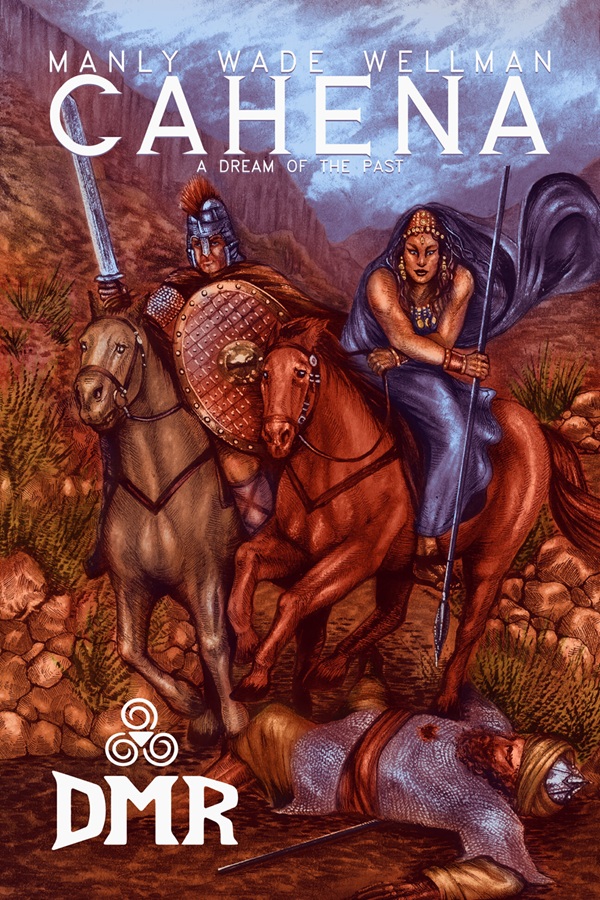
In his foreword to Cahena: A Dream of the Past, Manly Wade Wellman describes the last novel of his brilliant and prolific career as an historical novel. That’s mostly true. The book is rich in historical details, from the hardscrabble life of the Berbers to their preparations for battle, which are especially vivid and convincing. But this intriguing tale is also spiked with the sorcerous, including a demon that stalks the camps searching out doomed warriors, and a vampire.
The tale revolves around the military leader and enchantress known as the Cahena, who leads her people against invading Muslims from the east. The setting is north Africa around the beginning of the eighth century. The novel is told from the point of view of Wulf, a Saxon career soldier whose military prowess earns the Cahena’s trust, boosting him to the position of advisor and later her lover. The story moves smoothly and forcefully through military campaigns and romantic complications.
This book is a treasure to be enjoyed, from the gorgeous cover to the bittersweet conclusion. Brace yourself for realistic action, romance, betrayal, and heroism. History aficionados will especially appreciate the well-researched details of training and organizing an army. Call it historical fantasy, sword-and-sorcery, or historical romance, it delivers an entertaining, gripping tale.
Kudos to DMR Books for keeping Wellman’s legacy alive.
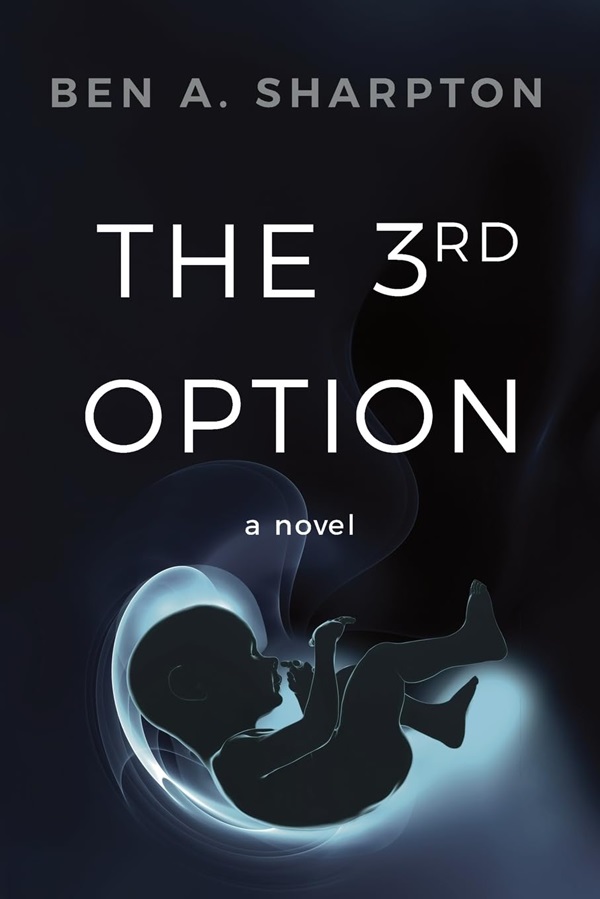
Allan Chappel arrives for a job interview primed for a second chance in life. Single, disillusioned, and stuck in a corporate cubicle, he’s an ex-cleric hoping to join an old college friend in a start-up business that, his friend has assured him, will “change the world.” But the moment he opens the door to his new venture, the building explodes.
In the hospital, Chappel is questioned by an aggressive police inspector. Troubled by the policeman’s insinuations, as well as the slow return of haunting images of the disaster, Chappel sneaks out of the hospital. But as soon as he returns home, he’s brutally attacked. Through desperation and dumb luck, he escapes his mysterious, would-be killer and takes to the streets and alleys of Atlanta. Aided by a scientist on the run, a despondent minister, and a psychic aunt, Allan Chappel must evade his pursuers while trying to discover why someone is determined to kill him.
The pursued quickly becomes both pursuer and sleuth. Chappel discovers the conspirators behind the bombing that killed his friend are powerful and politically connected. The deadly odyssey forced upon this innocent man harkens to such classics as “The Fugitive” and “North by Northwest.”
There’s more to this novel than your typical thriller. In between breathless dashes to hiding places, Chappel’s search for answers leads him into the tangled, emotion-filled conflict over abortion, an explosive issue that seems to have no resolution. As one character observes, “Everyone believes so passionately in their own side that they never seek an alternative, right?” To which Chappel responds, “How can there be an alternative? Either you’re pro-life or pro-choice.”
That’s the core of this intriguing novel. Despite the graphic action and language, this is a humane tale that explores alternatives to the win-lose scenarios we imagine prevent either discussion or compromise. Further, it seeks reconciliation and mutual understanding instead of revenge and the crushing of opponents. Well-written and timely, The 3rd Option is a voyage of hope.
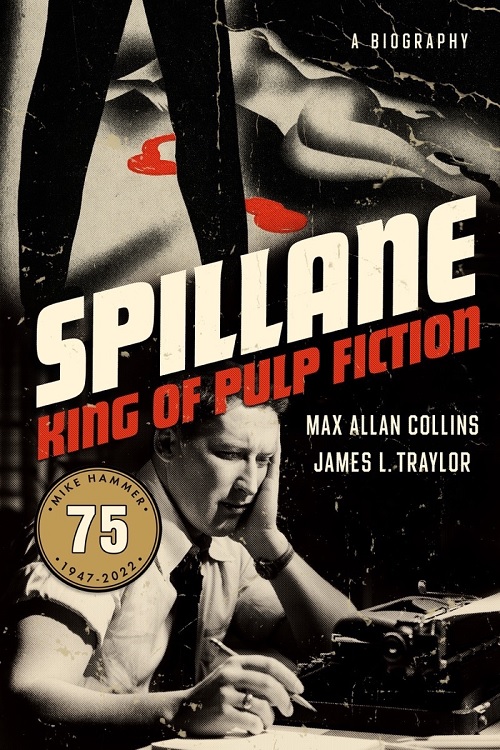
Everybody will get a kick out of this book. Those who are not fans of Mickey Spillane will discover a life story so vigorous and well-lived that most will not only enjoy the read but will convert to Mickey Spillane fandom. And we lucky souls who are already fans will have a fresh appreciation of the artistry, sheer energy, and creativity of one of the best-selling authors of all time.
Max Allan Collinsand James Traylor are mystery writers who’ve collaborated on previous books about Spillane. They wrote this biography in an easy-going, conversational style that perfectly suits their subject.
Why do they call Spillane the King of Pulp Fiction rather than the King of Crime Fiction? Because crime fiction is just one genre in the rowdy pulp universe, and Spillane left his fingerprints all over the cultural landscape.
An athletic young man who read voraciously, Mickey Spillane got his start writing comic books, and worked with many of the greats, including Stan Lee and Bill Everett. He penned storylines for Sub-Mariner, Captain America, and the Human Torch, just to name a few. Working with comics trained him to work fast, and that meant no holds barred on the imagination. Spillane later claimed his years writing comic books were the happiest years of his life. They certainly influenced his visual and physical writing style.
He foresaw that the soldiers and sailors returning home from WWII would appreciate action-packed, affordable books. After all, the 122 million Armed Forces Edition books distributed throughout the war had sharpened the appetite of the most literate generation America had ever seen. But Spillane also grasped that these veterans wanted more than entertainment. They had fought and bled to defend a country now plagued by widespread social disruption. Corruption, crime, and graft angered them, and many felt powerless and betrayed. Spillane intuited that these frustrated veterans yearned for quick, stern justice.
And so Mike Hammer was born.
I, The Jury, Spillane’s first novel, was a success, but some critics dismissed it as lurid, primitive, even vulgar. Others condemned both the writing and the writer. One critic denounced Spillane for authoring “a glorification of force, cruelty, and extra-legal methods that might be required reading in a Gestapo training school.” Botched attempts at putting Mike Hammer on the screen also bedeviled him.
But he kept on writing, running into some setbacks, but also much success. Success brought money and fame, which allowed him to live a life of adventure, including acting, boating, piloting planes, performing in the circus, roaming the backwoods with revenooers searching for illegal moonshine, and stock car racing. I couldn’t help but think of Yukio Mishima, another author who also lived a life of action.
The character of Mickey Spillane – as vivid and fascinating as any fictional character – was deeper and sharper than his critics realized. He’d trained fighter pilots during the war. Years later, when director William Wellman was stuck while re-editing a movie, Spillane suggested reversing two shots. Wellman considered the idea a moment before admitting, “Doggone it, he’s right.”
Writers will find some useful gems here. Spillane’s dedication to his craft belied his cavalier remarks about his work, such as the infamous, “Those big-shot writers could never dig the fact that there are more salted peanuts consumed than caviar.” In fact, Mickey Spillane cared deeply about writing, and kept honing his skill his entire life. Not to be missed is the short section “Mickey Spillane on Writing.” My favorite pointer: “When you’re writing a story, think of it like a joke. What’s a great punch line? Get the great ending then write up to it.”
Hippocampus Press sent me a copy of S. T. Joshi’s The Recognition of H. P. Lovecraft in return for an honest review. The pristine, shiny book with the magnificent cover they sent is now dog-eared with numerous underlined passages.
Which is my way of saying it is a book I will reread and refer to often.
The Lovecraft Riddle
When Howard Phillips Lovecraft died in March 1937, he was known to only a handful of readers, writers, and editors. He had published during his all-too-brief lifetime, but only in small-circulation magazines, notably, Weird Tales. Not one collection of his stories had been published in book form.
Today, Lovecraft’s tales are available world-wide in multiple languages. Famous writers and film makers acknowledge his profound influence. He even has an HBO series named after him.
What accounts for Lovecraft’s world-wide popularity? How did an author of fringe stories not only continue to be read, but win over new readers over the years and become a figure of pop culture? Only an ardent admirer and scholar of Lovecraft’s work such as S. T. Joshi could pull together an account of this unparalleled posthumous ascent to fame.
Lovecraft’s Long March
Lovecraft’s readers and fellow writers mourned and celebrated him after his death, including Clark Ashton Smith, Robert Bloch, and Kenneth Sterling. It fell to August Derleth to keep Lovecraft’s work in front of the reading public by printing or reprinting the late author’s greatest works in Weird Tales, some of which had been previously rejected. Later, Derleth founded Arkham House to put those stories and others into book form.
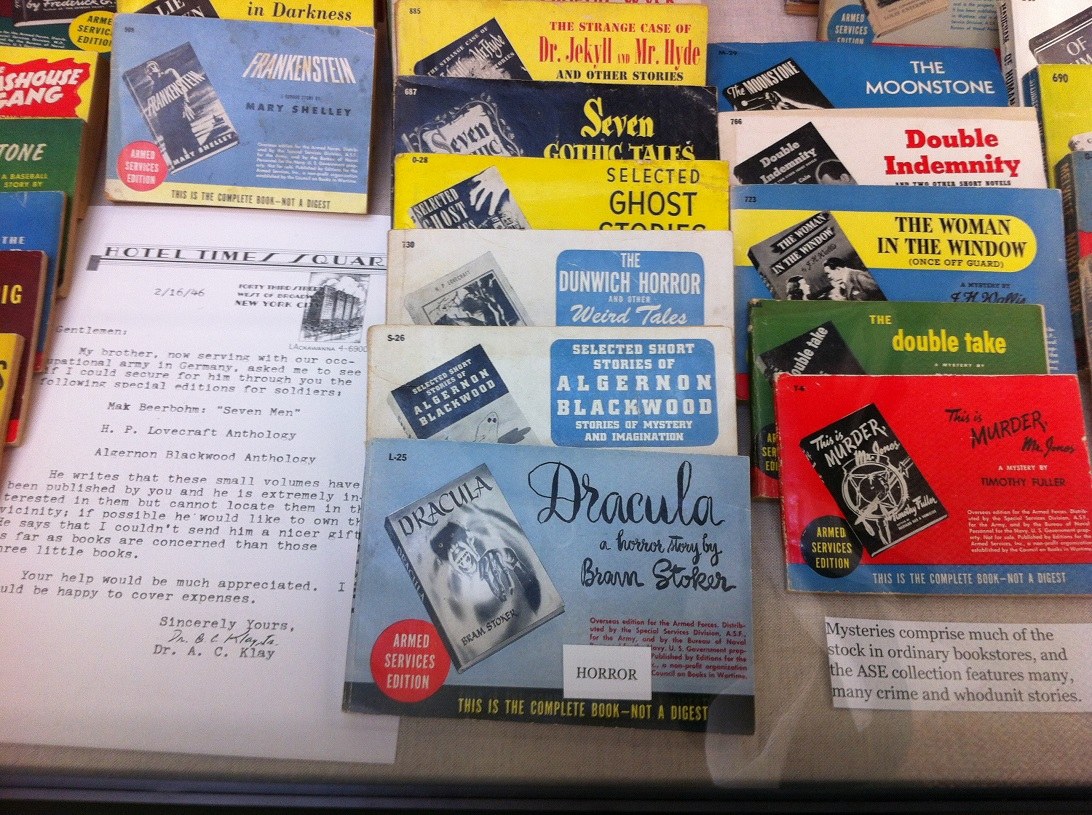
Derleth also had a hand in Lovecraft being featured in the 1945 Armed Forces Edition of paperback books. (It was his father’s copy of one of these books that introduced young Stephen King to Lovecraft.) Here’s a picture I took of some of those books, which includes The Dunwich Horror and a letter requesting more of Lovecraft’s works:
Other paperback editions including Lovecraft trickled out in the 1950s. By the 1960s, his stories made their way into attractive and beautifully illustrated volumes, such as 3 Tales of Horror in 1967. Lovecraft’s reputation was boosted by the roaring success of Rosemary’s Baby and The Exorcist. By this time, the obscure scribbler from Providence was regarded on many campuses as “a sort of counter-cultural figure, along the lines of Nietzsche, Camus, [and] Dalton Trumbo,” no doubt partly due to his appearance in textbooks.
Lovecraft-inspired films, including “Die, Monster, Die!” and “The Shuttered Room,” while not true to the original, nor of sterling quality, did keep the author’s legacy alive.
The Scholars Weigh In
The engine that slowly but inexorably propelled Lovecraft to global recognition was his artistry. Long denigrated as an interesting but flawed scribbler of scary stories, Lovecraft is now appreciated as a gifted craftsman. Shortly after his death, fan publications discussing his work popped up and flourished. As early as 1949, Lovecraft was getting serious scholarly treatment as a literary talent. Graduate-level theses emerged from Ivy League colleges and universities, and by the late 1990s were almost routine. In 2012, Graham Harman, a professor of philosophy at American University in Cairo, could proclaim that Lovecraft’s work “brushes against several of the most crucial philosophical themes of our time.”
His writing style, once considered turgid, even shrill (an opinion I will admit to having once believed) gradually won over critics. In Joshi’s view, Lovecraft’s work inspired other authors, filmmakers, and graphic artists because “there is such an abundance of striking visual effects and compelling dramatic action in some of Lovecraft’s scenarios that they can be manipulated into a wide array of media.”
The Final Word
Joshi’s passion for Lovecraft shines through on every page. That enthusiasm complements vast research to produce an enjoyable voyage of discovery for either the HPL fan or any lover of good writing. Unpretentious and straightforward, this overview of the world’s gradual recognition of an underappreciated talent is entertaining and enlightening. (Don’t miss chapter 9, “Dissemination and Controversy,” which includes Joshi’s thoughts on why a materialist like Lovecraft wrote about ghosts and demons.) That recognition will continue to grow, because, as Joshi concludes, “H. P. Lovecraft has proven himself a man and writer of the ages. His fame has expanded so far beyond what he could have imagined as itself to constitute a ‘weird tale’ of the most spectacularly bizarre sort.”
A secret that fans of Robert E. Howard and H. P. Lovecraft have known for years is that the works of these authors were much more than mere ghost and adventure stories. In the past couple of decades, a number of serious studies have confirmed that insightful and profound world views animated these tales, making them not only entertaining, but thought-provoking.
Jason Ray Carney is the latest scholar to analyze their enduring appeal. Carney, who teaches Literary Theory and Creative Writing at Christopher Newport University in Newport News, Virginia, also writes speculative fiction, and is the chair of the Pulp Studies section of the Popular Culture Association.
Weird Tales of Modernity examines Howard and Lovecraft, as well as the lesser-known Clark Ashton Smith, and considers their stories as critical reactions to modern art and the transience of life. While this study rewards the reader with a number of well-argued insights into the mindset and artistry of the three authors, it is not aimed at the general reading public. It is instead a highly technical analysis aimed at academics. While it lacks the conversational tone of Mark Finn’s Blood and Thunder, or the rollicking wit of Michel Houellebecq’s H. P. Lovecraft, it marches along with forceful logic and a careful mobilization of facts, backed by citations of numerous works from sixty-four notable authors and critics, including Jose Ortega y Gasset, W. B. Yeats, and T. S. Eliot.
Carney argues that Howard, Lovecraft, and Smith were united not only by their frequent appearance in the speculative fiction magazine Weird Tales, but also shared a common vision of art and life. A common theme in their stories was their rejection of modernism, and specifically, modern art, with its abandonment of traditional forms and the classical view of man. All three authors contemplated with disgust the creeping conformity that erased both individual and regional personalities. Robert E. Howard, for example, feared that “in a few generations all the United States will present one uniform pattern, modeled on the mechanized fabric of New York.” Such conformity, they warned, would not lead to global democracy, but to a dehumanized, soulless world.
Pulp fiction offered the “Weird Tales Three” a vehicle for expressing, and perhaps reclaiming, basic human experiences that modern life had taken from them. Howard, Lovecraft, and Smith crafted fiction that was, in Carney’s words, “sensational, often ineloquent or excessively ornate in style, and concerned with inciting raw emotions in readers – such as wonder, joy, excitement, and cosmic dread.”
Differing somewhat in style and theme, all three sought to rediscover those fundamental, ancient, and human emotions. Howard evoked them in his energetic tales of action and danger; Lovecraft showed us protagonists whose pursuit of esoteric knowledge forced them to confront inescapable cosmic horror; and Clark Aston Smith described characters desperately seeking lost joy, innocence, or love. All three conjured the frightening and the fantastic to focus the reader’s imagination on the ephemeral beauty and wonder that live in the ordinary.
Carney’s evaluation of Howard, Lovecraft, and Smith as a distinct subgroup provides an eye-opening and challenging appraisal that will help their readers to further appreciate their unique vision and artistry.
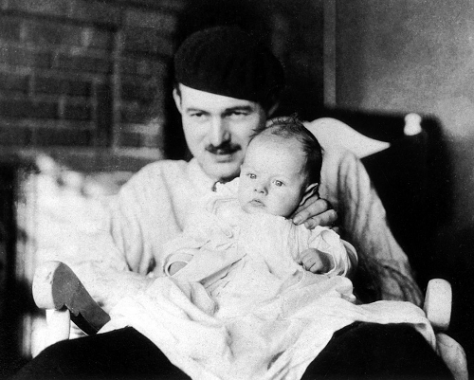
I’ve been busy during our global time-out. I’ve been reading new fiction, as well as re-reading old favorites, including Ernest Hemingway’s A Moveable Feast, a series of vignettes of Hemingway’s early days as an author while starting a family in 1920s Paris.
This little book cannot be drained; every time I read it, I discover more treasures. And if the honorable Mr. Leonard were alive, I could tell him Hemingway displays a wicked sense of humor in A Moveable Feast.
Let’s look at a few examples.
The metaphor that links the book’s poignant scenes together is the sumptuous food and drink of Paris. Here’s how Hemingway launches our little tour:
As I ate the oysters with their strong taste of the sea and their faint metallic taste that the cold white wine washed away, leaving only the sea taste and the succulent texture, and as I drank their cold liquid from each shell and washed it down with the crisp taste of the wine, I lost the empty feeling and began to be happy and to make plans.
That should whet any appetite. It certainly works for me.
Hemingway depicts Paris as a sprawling, lusty muse for all artists. In those days, he knew no greater joy than parking himself at a little café and setting a freshly sharpened pencil to his notebook. Pure writerly bliss. But every paradise has its snake, and for Hemingway, it’s the aggressive follower:
“Hi Hem. What are you trying to do? Write in a café?”
Your luck had run out and you shut the notebook.
Other artists, and especially writers, cannot evade Hemingway’s sharp, scrutinizing eye:
Wyndham Lewis wore a wide black hat, like a character in the quarter, and was dressed like someone out of La Boheme. He had a face that reminded me of a frog, not a bullfrog but just any frog, and Paris was too big a puddle for him.
F. Scott Fitzgerald and his melancholic wife Zelda get much scrutiny. Scott and Zelda had what you could call a rough and tumble, bittersweet relationship. When Zelda informs Scott she considers his, um, manhood inadequate, Scott looks to Hemingway for reassurance, which he kindly offers:
“You’re perfectly fine,” I said. “You are O.K. There’s nothing wrong with you. You look at yourself from above and you look foreshortened. Go over to the Louvre and look at the people in the statues and then go home and look at yourself in the mirror in profile.”
“Those statues may not be accurate.”
“They are pretty good. Most people would settle for them.”
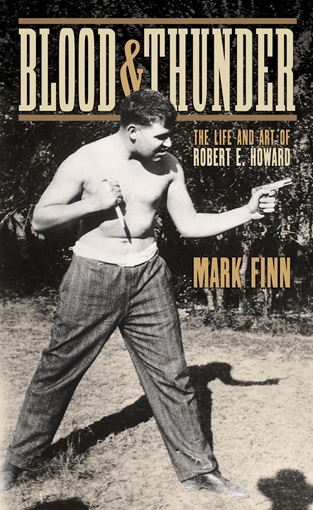
I’ve just finished Blood and Thunder, Mark Finn’s literary biography of Robert E. Howard. It’s one of those books I hated to see end. Blood & Thunder is an entertaining and inspired introduction to one of the greatest fantasy writers who ever lived.
Finn stresses throughout this biography that Texas was a life-long influence on Howard. Finn, also a native Texan, knows what he’s talking about.
Howard’s unique voice has been described as robust, vivid, and dark. The sizable Anglo-Celtic population throughout the South, including Texas, accounts for much of this. As Howard wrote in a letter to H. P. Lovecraft:
“But no Negro ghost-story ever gave me the horror as did the tales told by my grandmother. All the gloominess and dark mysticism of the Gaelic nature was hers, and there was no light and mirth in her. Her tales showed what a strange legion of folk-lore grew up in the Scotch-Irish settlements of the Southwest, where transplanted Celtic myths and fairy-tales met and mingled with a substratum of slave legends.”
Another major but often overlooked influence on the future writer was the Western tall tale. The young man listened intently to his father, a small town doctor, who spun entertaining yarns for patients, family members, and friends. The chapter dedicated to the fine Texan tradition of the tall tale is titled “Authentic Liars,” a perceptive acknowledgement of the writer’s most crucial talent, the ability to tell a believable lie the audience will happily swallow.
The Texas young Robert E. Howard grew up in was barely a generation removed from the Wild West, and the boy was spellbound by first-hand accounts of Comanche raids and attacks by the Mexican rebel Pancho Villa, undoubtedly the inspiration for the bandits, kozaki, and Picts who brawled and stormed throughout the Hyborian kingdoms. Even Texas-sized rattlesnakes found their way into Howard’s stories (“The Scarlet Citadel,” for example.) As Finn puts it, “Conan, then, is much closer to the American frontier tradition than epic fantasy.”
The Texas oil boom not only overturned the state’s once-agrarian economy, but jolted the culture, and not in a good way. In a letter to H. P. Lovecraft, Howard wrote:
“I’ve seen old farmers, bent with toil, and ignorant of the feel of ten dollars at a time, become millionaires in a week, by the way of oil gushers. And I’ve seen them blow in every cent of it and die paupers. I’ve seen whole towns debauched by an oil boom and boys and girls go to the devil whole-sale. I’ve seen promising youths turn from respectable citizens to dope-fiends, drunkards, gamblers, and gangsters in a matter of months.”
Howard’s recurring theme of civilizational rot and downfall were not abstract notions; he experienced these things first hand. Like his friend and fellow writer H. P. Lovecraft, Howard viewed industrialization as a destructive, de-humanizing force.
It’s impossible to discuss Robert E. Howard without considering H. P. Lovecraft. The two masters corresponded extensively, and clearly influenced each other’s work. Howard set Conan in a Lovecraftian universe, complete with a number of Cthulhu mythos deities. But it was a reciprocal – and beneficial – relationship. Finn points out how Howard’s action-oriented style inspired Lovecraft, whose fiction tended toward the psychological, to include the well-done nighttime chase scene in “The Shadow Over Innsmouth,” one of Lovecraft’s greatest tales.
I cannot agree with all of Finn’s conclusions. For example, I winced at his assertion that Yasmina from Howard’s novella “The People of the Black Circle” is a “more fully realized” character than Belit from “Queen of the Black Coast.” C’mon! I applaud Finn’s rejection of L. Sprague de Camp’s unfair and uninformed opinion that Howard was a suicidal paranoid with Oedipal tendencies. However, to rebut de Camp by asserting Howard had no choice but to commit suicide is simply ridiculous.
All in all, though, this is a well-researched, intelligent, and sympathetic evaluation of Robert E. Howard’s life and legacy, one I highly recommend for both newcomers and seasoned fans.
I am honored by this kind review from author K. D. Dowdall:
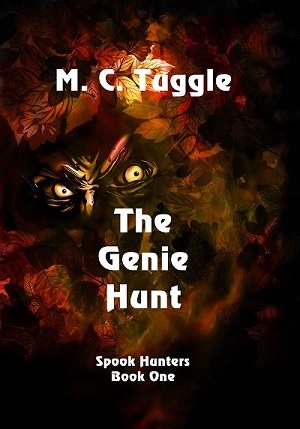
M. C. Tuggle’s The Genie Hunt is so engaging that I could not put it down. I continued reading it until the end, without stopping. It is not often that I want to reread a novel that I just finished reading. It is that good. It is a rather unique story about a lawyer, a reformed law-breaker, a kidnapped Genie, and a crime. It is a story about a friendship under duress, life-threatening danger, and a who-done-it mystery. The writing is superb, smooth transitions through scenes, characters that are so real that I was sure I knew them. It was the great dialogue, however, that moved the story along, including, strong pacing and time elements, that rang true.
I really like the main character, Buddy Vuncannon. … Buddy is placed in a situation where he’s forced to outsmart his opponents in law, as well as in crime, and the Genie. Through the struggle he thinks outside the box, and the way he is able to mentally navigate the situation at hand is genius. He’s very smart, always a step ahead.
I’m flattered! Be sure to pay Didi a visit, and read the rest of her review of The Genie Hunt.
The author does a great job at combining real-life scenarios with elements of fantasy. The novella reads like a combination of the television shows “Law & Order” and “Buffy the Vampire Slayer.” The writing and content made it so I never knew what to expect; with each turn of the page came a new surprise and boy, does that make for fun reading. It was not at all a “horror” book, but rather a suspenseful mystery with a healthy dose of the supernatural.
I also enjoyed how Tuggle maintains the strong friendship between Buddy and Coot, even though the events in their lives seem to keep going from bad to worse. Even though everything happening could tear them apart, their bond never breaks. They remain loyal to one another and even are able to joke around and make the best of what is surely a terrible situation. I found myself endeared by their friendship, and I was rooting for them the entire time.
This was not my first M.C. Tuggle book–I reviewed a novella of his called “Aztec Midnight” sometime last year–so I knew there was going to be more to the story than what initially met my eye, but even I was surprised at the extent of the uniqueness and creativity which flowed from the beginning of the book to the very last page. I can confidently say I have never read anything like “The Genie Hunt” before, and I am looking forward to what Tuggle comes up with next.


 M.C. Tuggle, Writer