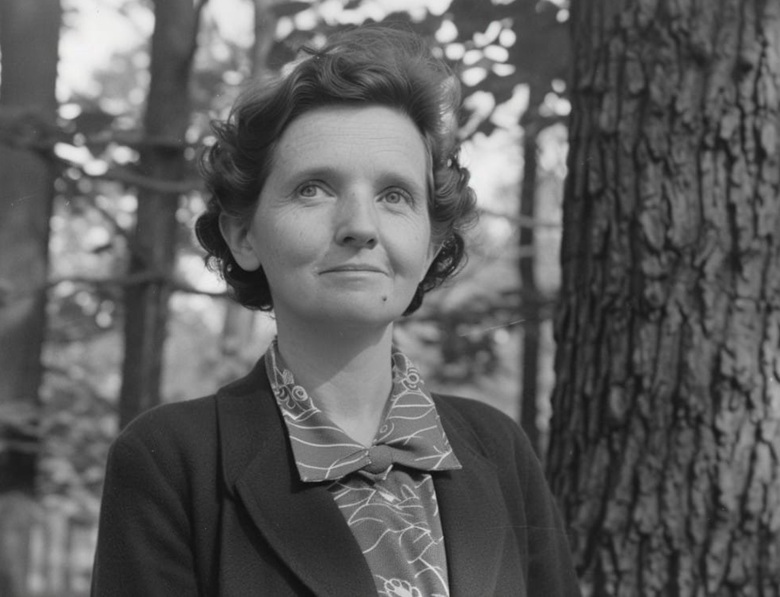
“The aim of science is to discover and illuminate truth. And that, I take it, is the aim of literature, whether biography or history.”
Rachel Carson
“The aim of science is to discover and illuminate truth. And that, I take it, is the aim of literature, whether biography or history.”
Rachel Carson
Sometimes otherwise smart people don’t stay in their lane. Trouble begins when they imagine they’ve discovered earth-shaking truths in fields unimagined by people trained in those fields. It’s called epistemic trespassing.
Ezra Pound revolutionized modern poetry but turned into a crank spouting bizarre economic theories. Linus Pauling won a Nobel Prize in chemistry before taking up quack medicine. Here’s the latest: Theodore Beale is an accomplished fantasy author who claims he’s destroyed Charles Darwin and natural selection. Writing under the name Vox Day, he’s released a book titled Probability Zero: The Mathematical Impossibility of Evolution by Natural Selection.
Here’s the description of his book from Amazon: “By subjecting the big ideas of Darwin, Haldane, Mayr, Kimura, and Dawkins to the pitiless light of statistical and mathematical analysis, Day demonstrates that the Modern Synthesis isn’t just flawed—it is absolutely impossible.”
And that’s it. Vox Day has made no ground-breaking research, no new discoveries, and offers no evidence from any science. He thinks he’s bypassed all that by claiming natural selection is so statistically improbable, it can be dismissed as impossible.
In other words, he only recycles the creationist “Junkyard tornado” argument that no scientific evidence can overcome the odds against life arising and developing naturally.
Okay. What would happen if we decided probability trumps evidence when making inquiries? I can “prove” it’s impossible my wife and I could have ever met and married. But a better example comes to mind.
Remember the horrific murder of Iryna Zarutska in Charlotte last August ? A lawyer could use statistics alone to shoot down the prosecution’s case against DeCarlos Brown Jr., who is accused of stabbing Zarutska on a late-night train.
Consider: Of the 8.3 billion people in the world, Brown allegedly murdered a woman born in Ukraine, 5,200 miles away. Every day on Earth, only 120 people are killed by strangers. That means the probability of a homeless man in Charlotte killing a woman from Ukraine is 0.00000144578313253 %. And since only 1.5 % of Charlotte residents use the light rail, the odds of Brown encountering and killing Zarutska would be reduced to practically nothing.
Should a jury ignore the so-called DNA and eyewitness evidence and let Brown roam the streets of Charlotte again? Hopefully, when DeCarlos Brown Jr. gets his day in court, the jury will judge him based on the evidence, which tells us that despite the odds, Zarutska was on that train when Brown killed her.
The theory of evolution is also backed by evidence–abundant evidence from many branches of science.
But here’s the kicker–Day doesn’t deny the evidence for evolution. He even cites an example of human evolution:
“The primary European lactase persistence allele (LCT-13910*T) is estimated to have arisen approximately 7,500–10,000 years ago, coinciding with the advent of dairying in Neolithic Europe. This mutation confers a significant nutritional advantage in cultures that practice animal husbandry, as it allows adults to digest milk—a rich source of calories, protein, fat, and calcium that would otherwise cause gastrointestinal distress” (p. 110).
If you’re puzzled, re-read the book’s subtitle: “The Mathematical Impossibility of Evolution by Natural Selection.” Creationists will be disappointed thinking the book is a refutation of evolution. So what is Day arguing? In the book’s foreword, Frank Tipler, a professor of mathematics, spells out its purpose: “Mr. Day will demonstrate that, since evolution cannot have occurred by unintended means, evolution must have been directed.” In other words, Day accepts the overwhelming evidence for evolution, but claims natural selection is not the cause.
Even though he doesn’t use the term, Day is arguing for Intelligent Design, a pseudoscience cobbled together as a front for creationism. ID emerged after the bad publicity following Edwards v. Aguillard, in which the Supreme Court ruled that teaching creationism is an unconstitutional attempt to establish a particular religion. While creationism argues that scripture justifies the belief that life was created by a divine being, ID co-opts large chunks of science in an attempt to assert some mysterious, unknown intelligence — maybe aliens! — created life. Day calls his version “Intelligent Genetic Manipulation.”
Like the old creationists, however, Day argues for a “First Mover” and “Designer” as the hidden driver of evolution and specifically posits the Abrahamic God as its guiding force. Addressing the argument that structural defects — the eye’s blind spots, for example — disprove intelligent design, Day offers this totally scientific explanation:
“perhaps demons might manipulate genetics in opposition to it, or for purposes of their own that align with neither divine nor human interests. This could explain certain puzzling features of biological design: not mere suboptimality, but apparent malevolence. Why do parasites exist that can only reproduce by causing horrific suffering to their hosts? Perhaps because something wicked designed them” (pp 219-220).
This is not science. This is an attempt to smuggle religion into the schools and devolve our understanding of life and ourselves back to the Iron Age.
If you want a more technical yet imminently approachable critique, I recommend Dennis McCarthy’s excellent response, Why Probability Zero Is Wrong About Evolution. As McCarthy puts it, Vox Day’s “best-selling anti-evolution book misuses mathematics and spreads misinformation.”
“Those who dwell among the beauties and mysteries of the earth are never alone or weary of life. Those who contemplate the beauty of the earth find reserves of strength that will endure as long as life lasts. The more clearly we can focus our attention on the wonders and realities of the universe, the less taste we shall have for destruction.”
Rachel Carson
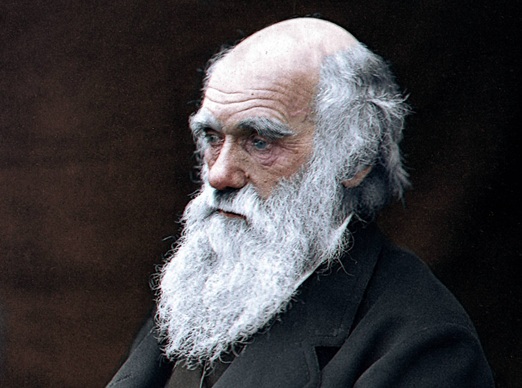
Charles Darwin’s landmark book On the Origin of Species was first published on this date in 1859.
We haven’t been the same since.
As E. O. Wilson tells us, science provides “more solidly grounded answers” to life’s mysteries. Not only has the theory of evolution transformed science, it has also given us a powerful lens for examining ourselves. Sadly, we remain blind to Darwin’s foundational message, that humans are not invaders but a part of nature. This continued isolation from the natural world has dire consequences, as this recent article from Science Daily warns us:
“A new study by evolutionary anthropologists Colin Shaw (University of Zurich) and Daniel Longman (Loughborough University) argues that the pace of modern living has moved faster than human evolution can follow. According to their work, many chronic stress problems and a wide range of contemporary health concerns may stem from a mismatch between biology shaped in natural settings and the highly industrialized world people occupy today.
That means the mismatch between our evolved physiology and modern conditions is unlikely to resolve itself naturally. Instead, the researchers argue, societies need to mitigate these effects by rethinking their relationship with nature and designing healthier, more sustainable environments.”
What to do? We must recognize our relationship with nature. The places we live must be reimagined and revamped so they resemble our hunter-gatherer past. More green spaces, more walkways, less dependence on cars, more opportunities to see nature maturing and blossoming before us.
But the first, most essential step is to open our eyes and see what we truly are.

“The kids say you gotta touch grass and that’s a real thing. I just came from the forest in Japan, and I’m in awe, like, ‘What are the birds doing? What is the little bug doing on the grass?’ It’s something that was here before us and will be here when we go away.”
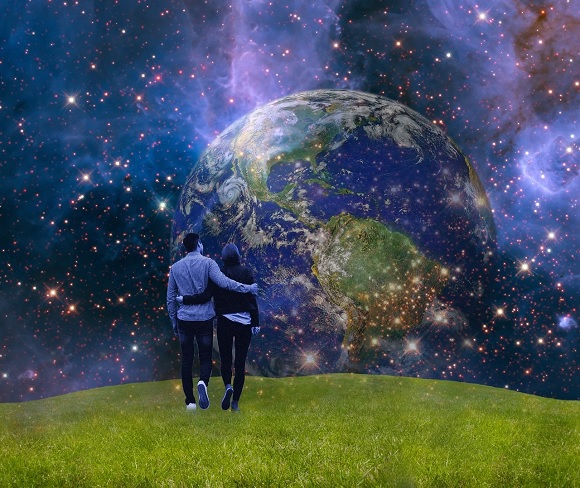
Earth Day reminds us there are responsibilities to being the apex predator. Many fool themselves into believing being on top means we have the right to gorge ourselves. It does not.
Others imagine we’re ghosts trapped in physical form who should dominate and use the Earth according to our will.
Those are delusions. Harmful delusions.
For one thing, Homo Sapiens’ self-serving narrative of being nature’s capstone is as fanciful as the name we gave ourselves. (Man the wise? Spare me.) Dinosaurs dominated the planet for 165 million years. Homo Sapiens has been around for about a quarter million years, and for most of that time, struggled to cling to a precarious existence.
Maybe a little prudence and humility are in order.
Instead of making choices based on other-worldly criteria –what should be, instead of what really is — maybe we should take the time to reevaluate our goals and choices so they contribute to long-term survival rather than short-term gain.
Here’s an article and some stories to spur that reevaluation:
The Barbarian and the Playwright – We’ve tried fooling ourselves about our true nature, and look where that brought us. In this essay, I suggest it’s time to look at ourselves realistically, with help from the unlikely team of Robert Ardrey and Robert E. Howard.
Hunting Ground – A fantasy tale exploring the dangers of fracking and the mindset that Earth exists to supply us with raw materials.
A Tree Amid the Wood – An inventor finds a way to meet human needs while protecting that which sustains us – if only he could remember it.
Notes from the Underground – A rock-music dystopian tale exploring what could happen to a species that fouls its own nest.
Mirrors – Earth Day shouldn’t be all doom and gloom – we as a species have some good qualities we can build on.
Happy Earth Day!

“Civilized man is in danger of losing all contact with the world of instinct — a danger that is still further increased by his living an urban existence in what seems to be a purely man-made environment. This loss of instinct is largely responsible for the pathological condition of contemporary culture.” Carl Jung
According to Norse mythology, all Nine Realms of the cosmos either hung from its branches, or else grew from its massive roots. As the source of cosmic structure, Yggdrasil commanded enormous respect. The Norse revered it as the giver and taker of life and order.
K.M. Weiland is one of my favorite writing coaches, and I never miss her posts. I learn something every time I check her blog. Her latest is on the craft of writing emotional fiction. She acknowledges it’s a difficult art, but there are good reasons for working to master it:
“The good news is that because fiction is an inherently emotional experience, it is well-suited to helping us access and process the very emotions we’re seeking to convey in our stories. … I recognize that my lifelong love of stories has certainly been influenced by their cathartic power to help me feel things in a safe container. For both readers and writers, stories offer the scientifically proven opportunity to expand the nervous system’s capacity to feel and process emotion—and, by extension, to experience life more expansively.”
That’s a worthy endeavor, one I’ve worked on for many years. But then came this:
“If you’re cut off from emotions, it’s because you’re cut off from your body. The act of vocally naming sensations helps promote a mind-body neural connection that makes it easier and easier to raise real-time emotional awareness.”
Absolutely. But why is this so?
The barrier to the emotional awareness that allows us to write honest, evocative fiction is the philosophical dualism that permeates the arts and sciences. Dualism asserts that mind and body are fundamentally different things unnaturally yoked together, with the rational mind trapped in an inferior, unintelligent body. That interpretation of human existence has been critiqued as “the ghost in the machine.” Charlene Spretnak, an ecowriter with compelling insights about the relationship between our bodies and the rest of nature, traces the development of dualism in her book The Resurgence of the Real:
“Rational thought could be exercised only if sealed off from ‘corrupting’ influences of the body (sensations, emotions, desires) and if properly isolated from ‘lowly’ nature. Plato felt that we, that is, our minds, are imprisoned in the dumb matter of our bodies.”
Plato believed the mind was a supernatural entity that made humans separate and above the rest of nature. Nature, according to dualism, is inherently inferior, worthy only of contempt and exploitation. Descartes cast this notion in concrete when he asserted that the mind defines humans. Sensations and emotions, rather than instant, crucial alerts from a knowing body, were regarded as confused, irrational reactions which should be ignored.
I examined the impact of dualism in my latest story, “Due Diligence.” Yes, it’s fantasy, but it gave me the freedom to explore what the unnatural separation of mind and body does to one’s ability to cope and find meaning.
The latest developments in neuroscience show us that thinking is grounded in the body. We now know much more about how neural networks in the brain store and retrieve memories. And if dualism were correct about the mind being fundamentally separate from the body, why are there so many studies confirming that physical exercise strengthens our ability to remember and solve problems?
The art of writing is more than a craft or a hobby, it’s a path toward making oneself and the world around us a little better. I love the way Weiland put it:
“Learning how to write emotional fiction is, at its core, a journey into the heart of our shared humanity. It is not just an artistic endeavor; it’s an exploration of the human experience.”
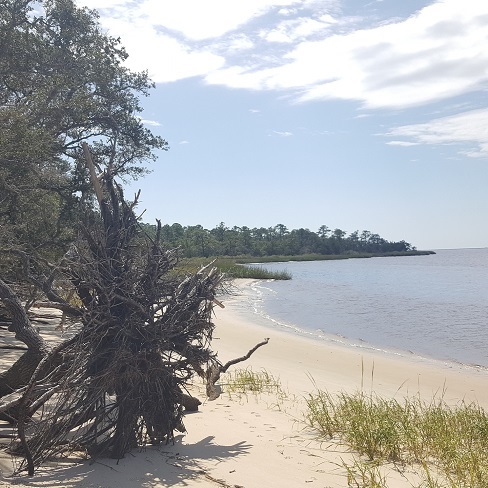
“Those who contemplate the beauty of the earth find reserves of strength that will endure as long as life lasts. There is symbolic as well as actual beauty in the migration of the birds, the ebb and flow of the tides, the folded bud ready for the spring. There is something infinitely healing in the repeated refrains of nature—the assurance that dawn comes after night, and spring after the winter.”
Rachel Carson, The Sense of Wonder
The change of seasons means something different at different ages. There comes the point where we recognize the things that endure despite many changes. The pagan Celts, my ancestors, celebrated the autumnal equinox, when the length of night and day are roughly equal, as Mabon. Not only was it a time for hunting and harvesting, but of appreciating the return of balance. Even today, it’s a time for reflecting on what’s gone by and what we hope for.
It’s been a fine year. The grandkids are growing, and I’ve had a little luck writing and publishing. One of my stories will be published before year’s end by a publisher I’ve long admired and aspired to, and I have four submissions looking for love in the slush piles at various venues.
And I’m working on new stories. The coming of fall is a good time to reassess and rededicate. I love getting out into the wild, taking a few chances, letting myself get a little lost. I need more of that. And when I’m not stomping around in the maritime forests or desert. I also love exploring the wild places in my head and heart. There’s no more productive and exciting means of doing that than the craft and discipline of writing. Here’s to a productive and energizing fall.
 M.C. Tuggle, Writer