Category Archives: Writing

Can AI replace writers?

I’m happy to see that more publishers won’t accept works created by AI. For the life of me, I can’t understand why someone would stick their name in the byline of something created by a computer program, but after all, plagiarism is nothing new. If people will take credit for something somebody else wrote, why not claim an AI product?

This issue isn’t going away. In Ray Kurzweil’s latest book, The Singularity is Nearer: When We Merge with AI, he claims AI will match and even surpass the writing of the best authors. These programs, he argues, will be “familiar with virtually every kind of human writing. Users could prompt it to answer questions about any given subject in a huge variety of styles — from scientific writing to children’s books, poetry, or sitcom scripts. It could even imitate specific writers, living or dead.”

Can it? I don’t think so. Ray Kurzweil is a transhumanist who advocates merging humans with AI as well as enhancing human ability with genetic engineering. Kurzweil believes we can upload our minds to a computer and live forever. Transhumanism despises the body, traditional culture, and humanity in general. Worse, it doesn’t understand any of the things it wants to replace.

First of all, human beings are not ghosts in a machine. The notion that our minds ride around in a meat robot that can be ditched without changing who we are is hopelessly simplistic. What we call the mind is the sum of the functions of the brain, which is a physical organ. And the brain interacts with the rest of the body. In fact, the field of Embodied Cognition tells us the body is central to our thought processes.

There’s solid research to back this view. Mirror neurons fire when we perform an action or when we observe someone else performing that action. Embodied Cognition also tells us that language is metaphor, and the building blocks of metaphor are physical sensations. Magnetic resonance imaging scanners reveal that when we read about a physical action, we activate the same areas of our brains as when we actually perform those actions. That’s the mirror neurons at work.

The bottom line is that disembodied machines cannot think, feel, or write the way humans do.  And never will.
The Way of Writing

K.M. Weiland is one of my favorite writing coaches, and I never miss her posts. I learn something every time I check her blog. Her latest is on the craft of writing emotional fiction. She acknowledges it’s a difficult art, but there are good reasons for working to master it:

“The good news is that because fiction is an inherently emotional experience, it is well-suited to helping us access and process the very emotions we’re seeking to convey in our stories. … I recognize that my lifelong love of stories has certainly been influenced by their cathartic power to help me feel things in a safe container. For both readers and writers, stories offer the scientifically proven opportunity to expand the nervous system’s capacity to feel and process emotion—and, by extension, to experience life more expansively.”

That’s a worthy endeavor, one I’ve worked on for many years. But then came this:

“If you’re cut off from emotions, it’s because you’re cut off from your body. The act of vocally naming sensations helps promote a mind-body neural connection that makes it easier and easier to raise real-time emotional awareness.”

Absolutely. But why is this so?

The barrier to the emotional awareness that allows us to write honest, evocative fiction is the philosophical dualism that permeates the arts and sciences. Dualism asserts that mind and body are fundamentally different things unnaturally yoked together, with the rational mind trapped in an inferior, unintelligent body. That interpretation of human existence has been critiqued as “the ghost in the machine.” Charlene Spretnak, an ecowriter with compelling insights about the relationship between our bodies and the rest of nature, traces the development of dualism in her book The Resurgence of the Real:

“Rational thought could be exercised only if sealed off from ‘corrupting’ influences of the body (sensations, emotions, desires) and if properly isolated from ‘lowly’ nature. Plato felt that we, that is, our minds, are imprisoned in the dumb matter of our bodies.”

Plato believed the mind was a supernatural entity that made humans separate and above the rest of nature. Nature, according to dualism, is inherently inferior, worthy only of contempt and exploitation. Descartes cast this notion in concrete when he asserted that the mind defines humans. Sensations and emotions, rather than instant, crucial alerts from a knowing body, were regarded as confused, irrational reactions which should be ignored.

I examined the impact of dualism in my latest story, “Due Diligence.” Yes, it’s fantasy, but it gave me the freedom to explore what the unnatural separation of mind and body does to one’s ability to cope and find meaning.  

The latest developments in neuroscience show us that thinking is grounded in the body. We now know much more about how neural networks in the brain store and retrieve memories. And if dualism were correct about the mind being fundamentally separate from the body, why are there so many studies confirming that physical exercise strengthens our ability to remember and solve problems?

The art of writing is more than a craft or a hobby, it’s a path toward making oneself and the world around us a little better. I love the way Weiland put it:

“Learning how to write emotional fiction is, at its core, a journey into the heart of our shared humanity. It is not just an artistic endeavor; it’s an exploration of the human experience.”

How Writing Makes Us Human

I was intrigued by this observation from author Walter Stephens:

Writing evolved to perform tasks that were difficult or impossible to accomplish without it; at some level, it is now essential for anything that human societies do, except in certain increasingly threatened cultures of hunter-gatherers. Without writing, modern civilization has amnesia; complex tasks need stable, reliable, long-term memory.

Think about the octopus. It’s a remarkably intelligent creature, but its short life span precludes it from creating an enduring civilization. Imagine a human child that had to discover for itself how to make fire, the wheel, or language. As Stephens puts it, “Writing enabled memory to outlast the human voice and transcend the individual person.” Tradition, our inheritance from countless forbears, is the infrastructure that makes us fully human. Without it, we’d be in the same boat as the octopus. Except we wouldn’t have boats.

As Stephens reminds us in his thought-provoking article, the written word is the most powerful tool — or weapon — we have yet created. No wonder we view language as a “wondrous, mystic art.”

Wondrous indeed. And surely an art. Early on, I was fascinated by stories, and still love reading and writing. Words enable us to connect with the past, the present, and the future, and allow the individual to pass on the things that enchant and delight us. I love describing the joys and terrors of life, from the roar of a storm on Onslow Bay, the smell of a wood campfire at a mountain camp, or the taste of a steamed oyster. And while passing our thoughts and feelings to others is an essential life skill, the art of writing is a life-long pursuit. As Hemingway once put it, “We are all apprentices in a craft where no one ever becomes a master.”

It’s a journey that will never end.

Happy Equinox!

The change of seasons means something different at different ages. There comes the point where we recognize the things that endure despite many changes. The pagan Celts, my ancestors, celebrated the autumnal equinox, when the length of night and day are roughly equal, as Mabon. Not only was it a time for hunting and harvesting, but of appreciating the return of balance. Even today, it’s a time for reflecting on what’s gone by and what we hope for.

It’s been a fine year. The grandkids are growing, and I’ve had a little luck writing and publishing. One of my stories will be published before year’s end by a publisher I’ve long admired and aspired to, and I have four submissions looking for love in the slush piles at various venues.

And I’m working on new stories. The coming of fall is a good time to reassess and rededicate. I love getting out into the wild, taking a few chances, letting myself get a little lost. I need more of that. And when I’m not stomping around in the maritime forests or desert. I also love exploring the wild places in my head and heart. There’s no more productive and exciting means of doing that than the craft and discipline of writing. Here’s to a productive and energizing fall.

Motivational tchotchkes

Not the Maltese Falcon

Garry Rodgers, a retired homicide detective and coroner who now writes mysteries, recently posted a picture of some of the inspirational mementos, or tchotchkes, he keeps in his writing studio. Rodgers borrowed tchotchke from the Slavic word for trinket. Among the objects in his office are a rotary phone, an Underwood No. 5 typewriter, and “a framed photo of some floozie who’s my idea of the perfect femme fatale,” which he says help fire his imagination when he’s stuck in a story.

That got me to thinking about the weird stuff I keep in my writing loft. The falcon above isn’t Maltese, but he’s regal and mysterious, just the attitude I need to spark new ideas.

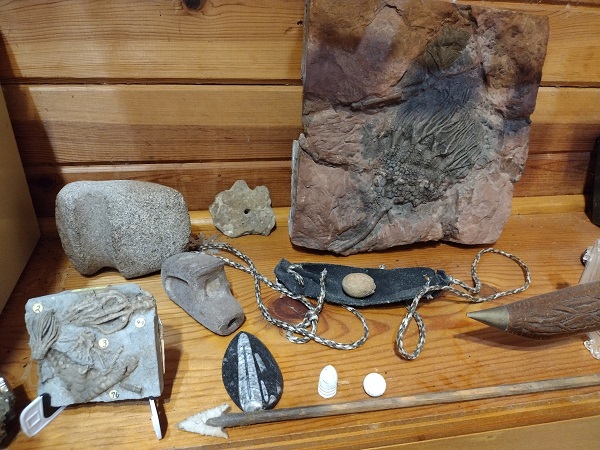
Here are some of the Native American artifacts from my collection, which includes a sandstone tobacco pipe in the shape of a frog, an ax, a (reconstructed) sling, and an arrow. The fossils add just the right amount of primeval ambience.

And here’s the shelf above my laptop. It’s easy to imagine various expressions in the contorted driftwood bookend. Depending on the slant of light, you can discover all sorts of shapes shifting around on the patina of the battered candlestick. On that candlestick is the key to an old German pie safe my wife bought. A few months ago, gazing at that key sparked the idea that it opened the door to a haunted house. Who would want that key? That little germ of an idea blossomed into my latest sale, which I expect to be published this summer.

What other story ideas lurk in these strange objects?

The Art or the Artist?

“John Wayne was no actor.”

Yes, that’s what she said! While working a crossword puzzle, my wife had asked me about Academy Award winners from the ‘60s, and I’d suggested the Duke. My response was met with the above inflammatory statement. (John Wayne wasn’t the answer to the puzzle, but in fact, he did win an Oscar in 1969 for True Grit.)

But my wife’s comment got me to thinking. No doubt many would agree with her. After all, John Wayne pretty much played the same role in all of his movies. When he portrayed Genghis Khan in The Conqueror, he played the title character “as a gunfighter.” Does that mean Wayne wasn’t really an actor? How about George C. Scott? Both actors had millions of fans. People watched their movies to see how each actor adapted his latest role to his unique personality. Both had an electric presence that energized every character they portrayed.

But there are polar opposites that are equally enjoyable to watch. Consider Christian Bale, or Meryl Streep, or Dustin Hoffman. Their talent lies in adapting themselves to the role. These actors dissolve into the personality of the character they portray. While watching them, you see Batman, Sophie Zawistowski, or Benjamin Braddock. The character being portrayed is so vivid, you don’t see the actor.

The elegant Fred Astaire was said to have vanished into the fluidity of his dance moves. James Cagney, on the other hand, with his bouncy, stiff-legged leaps and sprints, brought a prizefighter’s moves to the dance floor. One made you see the dance, the other made you see him. And both pulled in large — and appreciative — audiences.

Certain writers display similar approaches to their craft. Whenever I read The Grapes of Wrath, or Tortilla Flat, I’m carried away by the story, the characterization, and the beauty of the language. Those are the things I feel when I read a John Steinbeck piece. However, when I read Robert E. Howard, I see his fiery personality illuminating the action, whether the story is about Conan, King Kull, or Solomon Kane. And the same goes for The Call of the Wild and The Sea-Wolf — you know you’re seeing Jack London, or aspects of him, on every page.

Piet Mondrian once declared that “The position of the artist is humble. He is essentially a channel.” There’s discipline in that approach, one that Meryl Streep, Fred Astaire, and John Steinbeck could agree on. The artist must get out of the way so the art can live.

But the other approach, that of George C. Scott, Robert E. Howard, and Jack London, also produces good art. John Lennon put it this way: “If being an egomaniac means I believe in what I do and in my art or music, then in that respect you can call me that… I believe in what I do, and I’ll say it.”

Writer and mystic Thomas Merton once suggested an intriguing compromise between the two extremes: “Art enables us to find ourselves and lose ourselves at the same time.” Yes.

Creative Borrowing

In my post Writing with Creative Constraints, I confessed the following:

“In the past couple of months, I’ve broken through writer’s block by writing stories for themed anthologies or contests. In other words, I was out of ideas, so I followed the lead of someone else. “

Confession? Nothing to feel guilty about. After all, nothing new under the sun, right? Besides, since there are only seven basic stories, every work of fiction is only a variation or combination of them. So creative borrowing is simply what we writers do. Look at Star Wars. It’s just another space opera/fantasy/western/World War II/heroic quest tale.

Even the best look to other authors for inspiration. Take William Shakespeare, for example. The Cultural Tutor has compiled the source materials for all 38 of the Bard’s plays, from All’s Well That Ends Well to Titus Andronicus. So recycle those borrowed ideas with abandon, but don’t forget to infuse your creation with your own special style .