Category Archives: Writing

Best fiction and writing blogs

Lovecraft
The best fiction and writing blogs, compiled by lovecraft

A Vase of Wildflowers: Links for Readers and Writers [Good stuff here, folks!]
Writerish Ramblings: Critique Group
Captain’s Log: Notes on Money and Self-Publishing [Practical advice from a writer who’s walked the walk]
Kill Zone: Don’t Muddle Your Message [How to think like an editor]
Alice Osborn: 4 Tips for a Writing Mom to Stay Sane
Jacqueline Seewald: How to Increase Your Creativity and Productivity
Flavorwire: The 50 Sexiest Literary Villains
A Writer’s Path: Ten Quote Tuesday [Need inspiration? Ryan has it]

I resolve to be very bad this year

… and very good. It depends on what I’m aiming for at the moment.

Now that I’ve had a chance to digest all the advice and resolutions of various writers and writing coaches, I’ve decided what advice I intend to follow and what advice I will violate.

For starters, a number of well-meaning gurus counsel writers to finish what they’ve started. Only they say it like this: “Finish that manuscript! And eat your broccoli!”

No doubt they mean well. And there are times when you have to buck up and WORK at getting words onto the screen (or paper). But when a project just doesn’t work for you, there comes a time when you have to admit you took a wrong turn. Why keep on working to complete a piece that you know in your gut is a waste of time?

Another way I intend to be bad is to be more open to artistic expressions I once rejected or was afraid to approach. The “bad boys” (and girls!) of literature have something to say, and many of them say it damned well. For example, I just finished Charles Bukowski’s Ham on Rye, and loved it. He’s a writer who, from what I’d read ABOUT him, I just knew I’d despise. Boy, was I wrong. Ham on Rye is honest, gritty, vivid literature.

We all need a little crazy in our lives. In Act V, Scene 1 of my favorite Shakespeare play, A Midsummer Night’s Dream, Theseus offers these observations about the little spoonful of insanity that makes art come alive:

Lovers and madmen have such seething brains,
Such shaping fantasies, that apprehend
More than cool reason ever comprehends.
The lunatic, the lover and the poet
Are of imagination all compact:
One sees more devils than vast hell can hold,
That is, the madman: the lover, all as frantic,
Sees Helen’s beauty in a brow of Egypt:
The poet’s eye, in fine frenzy rolling,
Doth glance from heaven to earth, from earth to heaven;
And as imagination bodies forth
The forms of things unknown, the poet’s pen
Turns them to shapes and gives to airy nothing
A local habitation and a name.

As Hippolyta acknowledges, that interplay of madness and craft can yield “something of great constancy” that is both “strange and admirable.”

But fear not; I only intend to flirt with the dark side, not elope with it. I’ll be good, too, in the coming year — I’ll continue to set writing goals, blog often, and keep myself mentally and physically sharp by getting outdoors more often and exercising. It’s good to have both feet planted on the ground. However, the idea is not to stay planted, but to have a good foundation from which to explore and grow.

The Complex Sense of Place

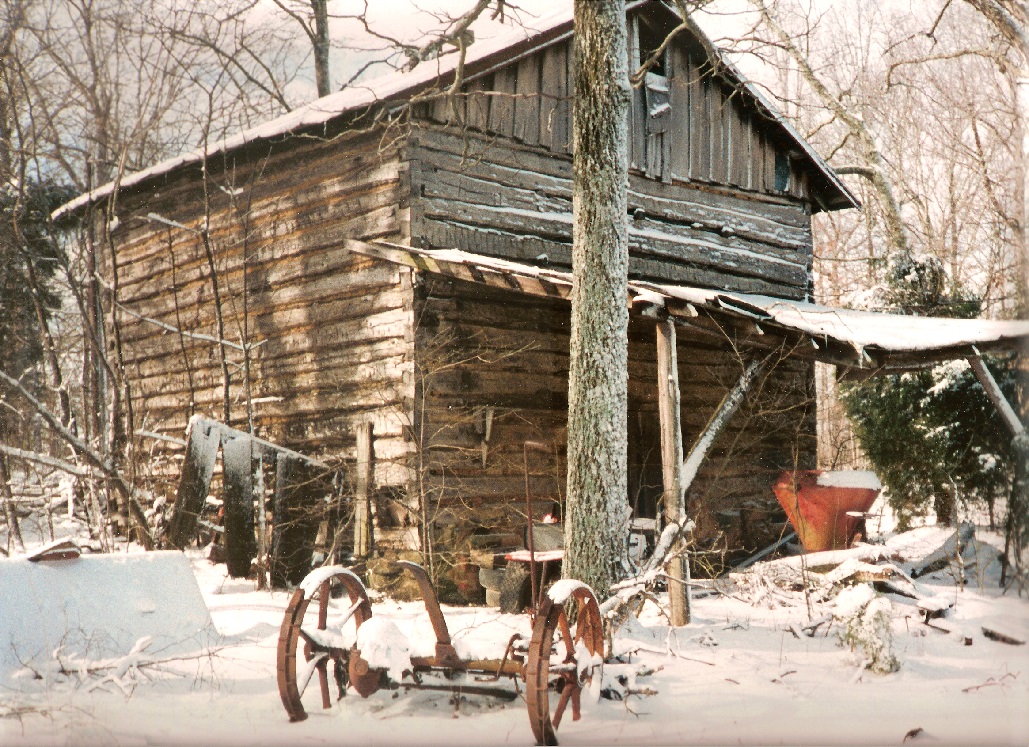
Tobacco Barn

“The deconstuctionist postmodern analysis asserts that we never actually know anything about our local patch of the biosphere because we can know only the concepts our particular society has invented … All this seems exceedingly odd–and more than a little pathological–to traditional native peoples, for instance. From an early age, they pay a great deal of attention to the dynamics of the natural world, both individually and collectively. They observe with great sensitivity the dramas, rhythms, and presence of place.” Charlene Spretnak, The Resurgence of the Real, p. 27.

Worthwhile writing, like any other product of a living culture, arises from a people’s strivings, tragedies, and victories as experienced in a particular place. This is an insight that animates the fiction of Tolkien, and I think he would agree that the sense of alienation that afflicts so many these days is the result of our loss of feeling for the dramas, rhythms, and presence of place. Tolkien certainly knew that a vivid setting could be as strong a character in a good story as the protagonist, and no one could create a living, dynamic backdrop like he could.

The Magic of the Everyday

Rosemary

“There is a rule for fantasy writers: the more truth you mix in with a lie, the stronger it gets.” – Diane Duane, via A Writer’s Path

Anne Leonard offers some great advice for fantasy writers in the current  io9 that echoes Diane Duane’s invaluable maxim:

I still really like epic fantasy, and especially the world-building part. What I’ve come to realize, though, is that for me world-building is necessary but not sufficient to suck me into the story; for the epic to be epic, it needs to be set against the mundane. By “mundane” I mean “worldly as opposed to spiritual,” rather than the more colloquial usage implying boredom and dullness. The anthropologist Clifford Geertz wrote about “exoticizing the domestic,” and I think that concept is what makes for really good fantasy and speculative fiction. The writer takes the ordinary and twists it, or puts it into a different context.

The term “exoticizing the domestic” brings to mind Rosemary’s Baby by Ira Levin, one of the greatest fantasy stories ever. The movie will rattle you, and the book will make your head explode. What makes it so relentlessly creepy is the way it piles on odd but apparently explainable details that, by themselves, appear ordinary, but add up to a tsunami of horror. In the opening, a helpful elderly man shows Rosemary and her husband Guy around the exclusive Bramford apartment building. He taps the elevator button, and Rosemary notices he’s missing part of his finger. They find a beautiful apartment where they stop and puzzle over a massive dresser blocking the door to a closet. When they manage to move the dresser and open the closet door, they find … nothing out of the ordinary. They take the apartment, and feel lucky to get it. After all, this is Manhattan.

Weeks later, at night, Rosemary hears the neighbors through the walls. She thinks they sound like they’re chanting … but Guy doesn’t believe her. And then … well, you know what happens next: a cultural phenomenon.

I rejected the idea of introducing the magical elements of Aztec Midnight in a prologue for just that reason. Not only would that have made the story less accessible, it would have been overkill. The interior of Mexico is a haunted, brooding place alive with tragic stories and populated by a stoic, courageous people. I wanted to capture the region’s dark magic, and the best way to do that was to show its effects without heavy-handed explanation.

Anne Leonard’s point is that a smart writer positions the ordinary into stories to lure the reader into a recognizable world. Once they’re in, the magic you unveil will be more believable.

Best fiction and writing blogs

Ezra

The best fiction and writing blogs, compiled by il miglior fabbro

It’s time to plan for the new year, so let’s focus on how to improve our writing. Here are the best resources I discovered in the past year. 2014 was a pretty good writing year for me. I hope these pointers will work for you, too. Enjoy!

Write on the River: 16 Thoughts for Authors/Publishing for 2015 [Wow! Don’t miss this]
Amina Gautier: Joy of Revision
A Writer’s Path: Writer’s Toolbox [More like the super-writer’s utility belt! See for yourself.}
Hugh Hart: 8 Tips For Creating Great Stories From George R.R. Martin
Jordan Dane: Five Key Ways to Make Your Characters Memorable
Jodie Renner: Get into Your Protagonist’s Head 
Chuck Palahniuk: Eliminate “Thought” from your writing! [The single best pointer of the year for me]
Steven James: Pump Up Your Creativity

The Writer’s First Commandment

Cameron

The Writer’s First Commandment is: Read. Write. Repeat. Read everything you can get your hands on, because you never know where story ideas will come from.

For example, one of Aesop’s fables provided the inspiration for my flash fiction piece Cameron Obscura:

AN ASTRONOMER used to go out at night to observe the stars. One evening, as he wandered through the suburbs with his whole attention fixed on the sky, he fell accidentally into a deep well. While he lamented and bewailed his sores and bruises, and cried loudly for help, a neighbor ran to the well, and learning what had happened said: “Hark ye, old fellow, why, in striving to pry into what is in heaven, do you not manage to see what is on earth?”

That got me to thinking about a TV news story I’d seen years earlier about two boys who had to be rescued from a well they got stuck in while trying to see stars during the day. They learned two valuable lessons: You can’t see stars from the bottom of a well when the sun’s shining. And it’s easier to get into a deep hole than to get out of it.

The character I imagined getting into such a situation was based on the brother of a college girlfriend. He was autistic, and took things very literally. It fascinated me how this very sweet, kind-hearted young man could tell you all about his impressive insect collection, but couldn’t fix a meal for himself.

The final element came from an article I’d recently read. I’ve always been a science buff, and faithfully keep up with Dr. Daniel Caton, an astronomer who writes a regular column for the Charlotte Observer. In that article, Caton counseled amateur astronomers not to regret their decision to pack up their equipment when bad weather interferes with their stargazing. Yes, the sky might clear up hours later, but it’s better to live with your choice and return later, fully rested.

These various elements came together nicely into my story, and Fabula Argentea accepted it. It occurred to me that I should let Dr. Caton know his column had inspired it. He was pleased to hear this:

Mike,

I loved the story! I’m glad that adding the “never look back” made the difference in getting it published. I liked the title, too–a clever play on words.

And, thanks for the kind words on my column. May I Tweet/FB the link to the story?

Dr. Daniel B. Caton, Ph.D.

He tweeted my story to his followers, and another astronomer re-tweeted it.

I think C.P. Snow would have approved.

Best fiction and writing blogs

Hemingway Writing

The best fiction and writing blogs, compiled by ernie

Quinn’s Books: INVISIBLE MONSTERS by Chuck Palahniuk
Write on the River: Ascension: This Aint Sharknado on #Syfy
Oscar Hokeah: Video on True Confessions through Coffee Cups
Storytime with John: Language Barrier
1SIGRIDSSON: GOOD MORNING AGAIN, PRETTY AUTUMN! [You have to see these images. They look like hidden fens and thickets from Lothlórien]
Daily Echo: Notes from a small dog… a letter to Santa
Elan Mudrrow: Short Sayings
Down The Hall On Your Left: To Boldly Go … [Now THIS is funny! Anyone over 50 will appreciate this]

Best fiction and writing blogs

DreamCreature

The best fiction and writing blogs, compiled by Treebeard

Sweating to Mordor: Creepy Boromir and Black Swans on the River
A Vase of Wildflowers: Artist Interview: John Holcroft
Ms. Toy Whisperer: Tested Faith
Fantasy Book Review: An interview with Patrick Rothfuss
The Silent Eye: Spokes on the wheel
Thoughts on Fantasy: The Special Effects You Don’t See (You’ve GOT to see the trailer!)
Ipuna Black: Life’s Little Moments
Confessions of a Readaholic: Ernest Hemingway’s reading list for all the Young Writers

Guns in Fiction With Larry Correia

A Writer’s Path is featuring a great interview with spec-fic author Larry Correia. Larry offers sound advice on traditional vs. self-publishing, the importance of marketing, and the absolute necessity of doing your homework so your readers are pulled in by the authenticity of your narrative. The focus of the interview is firearms, modern and antique, but Correia notes that “It isn’t just guns, but any topic where the reader is an expert and the author is clueless.”

So true. Here are some of the mistaken assumptions I’ve seen as an editor and while critiquing other writers:

– A pipsqueak, whether male or female, who’s secretly a “martial arts expert,” deftly pounds a muscle-bound bully into submission. Without getting a scratch. Yeah. Okay, I’ve been in both judo and karate tournaments, and trust me, sparring is ALWAYS strictly separated by sex, rank, and weight. Even among trained fighters, size matters.

– Same martial arts expert rams the bully’s nose bone into his brain, instantly killing him. Wrong. It can’t be done.

– Starting a fire by rubbing two loose sticks together. Please – step away from the computer, go outside – way outside – and spend the weekend camping. It’ll do you good, as well as teaching you a thing or two about life in the wild.

There are countless other pitfalls caused by relying on movies and TV for your research. Don’t do it. A writer needs a storehouse of experience to infuse his fiction with verisimilitude. When I was researching Cameron Obscura, I taught myself how to rappel down a wall. It was a blast, and it provided me with a gold mine of sensory details that made the story come alive.