The change of seasons means something different at different ages. There comes the point where we recognize the things that endure despite many changes. The pagan Celts, my ancestors, celebrated the autumnal equinox, when the length of night and day are roughly equal, as Mabon. Not only was it a time for hunting and harvesting, but of appreciating the return of balance. Even today, it’s a time for reflecting on what’s gone by and what we hope for.
It’s been a fine year. The grandkids are growing, and I’ve had a little luck writing and publishing. One of my stories will be published before year’s end by a publisher I’ve long admired and aspired to, and I have four submissions looking for love in the slush piles at various venues.
And I’m working on new stories. The coming of fall is a good time to reassess and rededicate. I love getting out into the wild, taking a few chances, letting myself get a little lost. I need more of that. And when I’m not stomping around in the maritime forests or desert. I also love exploring the wild places in my head and heart. There’s no more productive and exciting means of doing that than the craft and discipline of writing. Here’s to a productive and energizing fall.
“The mercy of the world is you don’t know what’s going to happen.” Wendell Berry
“The most merciful thing in the world, I think, is the inability of the human mind to correlate all its contents. We live on a placid island of ignorance in the midst of black seas of infinity, and it was not meant that we should voyage far.” H. P. Lovecraft
“Sadness is caused by intelligence, the more you understand certain things, the more you wish you didn’t understand them.” Charles Bukowski
“When you remember the past, you are not remembering it as it was. You are remembering it as it is. It is a vision or a dream, present with you in the present, alive with you in the only time you are alive.”
SPOCK: Incredible power. It can’t be a machine as we understand mechanics. KIRK: Then what is it? GUARDIAN: (The doughnut pulses bright in time with the words) A question. Since before your sun burned hot in space and before your race was born, I have awaited a question. KIRK: What are you? GUARDIAN: I am the Guardian of Forever. KIRK: Are you machine or being? GUARDIAN: I am both and neither. I am my own beginning, my own ending. SPOCK: I see no reason for answers to be couched in riddles. GUARDIAN: I answer as simply as your level of understanding makes possible.
My hometown paper, The Charlotte Observer, has fired Kevin Siers, its Pulitzer-Prize winning political cartoonist. Like many other papers, the Observer has been whittling itself away the past few years. They lost their palatial office building, quit printing a Saturday edition, and have bled off numerous positions over the last decade: business editor, book editor, social editor, and so on.
I didn’t agree with many of the Observer’s or Siers’ positions, but they were well presented and challenging. They used to host a limerick competition for St. Patrick’s Day and picked one of my limericks for publication. Kevin Siers picked my submission for his “Write that Caption” cartoon competition four times, and always awarded me with his original black-and-white drawing — except the last one, when he surprised me with the colorized version used for publication. (See above) It’s a cherished memento that now hangs framed in my office.
People tell me, “Just read the news online.” No. Trying to read online is not the same experience. Pop-up ads disrupt you. Worse, autoplay videos try to lure you away from the article, and videos aren’t as thought-provoking or enjoyable. Reading is an active and cooperative activity between reader and writer, while watching a video is passive and one-sided. Watching a video is like inserting electrodes into your brain and submissively absorbing the input.
From July 19th to August 10th, you can snag The Explore Sci-Fi Worlds Bundle, an outstanding selection of ebooks from independent and small press fantasy writers — and support war victims in Ukraine. This incredible offer includes my story A Tree Amid the Wood, as well as bonus volumes for donations of $20 or more, including:
We Dare – No Man’s Land edited by Jamie Ibson and Chris Kennedy
A Legacy of Stars by Danielle Ackley-McPhail
Androids & Aliens by J. Scott Coatsworth
Save the World edited by J. Scott Coatsworth
Daughters of Frankenstein edited by Steve Berman
Mirror Shards Vol. 2 edited by Thomas K. Carpenter
Tales of the Dissolutionverse by William C. Tracy
It’s a great opportunity to support a worthy cause and find new authors to love. Or rekindle your love for an old one. Remember, this offer ends August 10. Gift cards are available at Story Bundle.
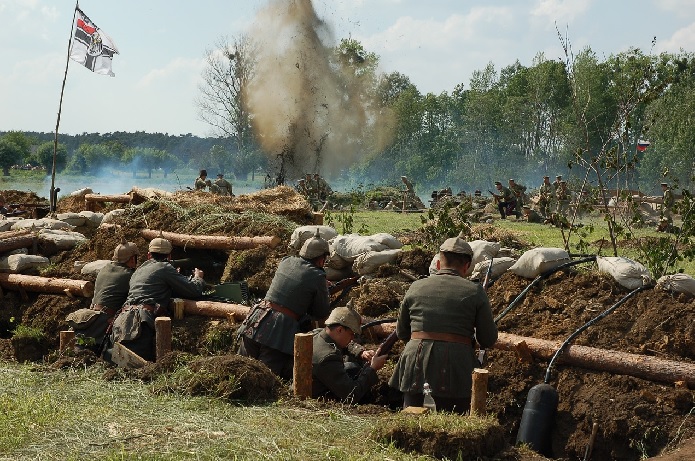
I just finished Aleksandr Solzhenitsyn’s August 1914. This work is stunning in its scope and insights. Imagine Tom Clancy’s Red Storm Rising and Tolstoy’s War and Peace rolled up into one challenging and exhilarating read. Like Tannenberg, the early WWI battle it’s based on, August 1914 inexorably pulls the reader headlong into a relentless, sweeping tragedy.
Next month will be the 109th anniversary of that world-shaking battle, and we’re still coping with its aftermath. Though Russia managed to surprise the Germans by putting 230,000 troops into the field versus the Germans’ 150,000, Russian forces were thoroughly routed. This was an early body-blow to Russia, which never fully recovered. The Russian people’s suffering eventually led to their desperate support of the one group that promised peace, the Bolsheviks, who, once in power, inflicted even more misery upon them.
Solzhenitsyn knew war, having fought as a captain in World War II, and was all too familiar with the colossal mistakes that petty men were capable of. It’s been said that while amateurs (me, for example) study battle strategy, experts study logistics, and Russian logistics officers were mind-numbingly clueless. When the beans and bullets fail to reach the boots on the ground, armies lose battles. Also, both Solzhenitsyn’s epic and the historical record tell us the Russian commanders did not bother to encode their radio communications, effectively broadcasting their plans to the attentive Germans.
Not only did Solzhenitsyn know war, he knew the human soul, which gives this work the depth missing from modern-day war novels. A recurring theme is the inadequacy of the human mind to grasp the complexities of large-scale operations. And while generals on both sides often made life and death decisions based on inadequate or completely false information, the actions they took would certainly lead to unforeseen death and suffering. They struggled with a double-edged curse – enormous power lay in their hands, but they did not know what to do with it.
At one point, the Russian commander, Alexander Samsonov, tries to steady his nerves as he assembles his battle plans:
“The fate of battalions, even whole regiments, might be affected by chance factors such as the lighting, the blink of an eye, the thickness of a finger, a blunt pencil, or whether one is standing or sitting at the table. Samsonov strove conscientiously and to the best of his ability to arrive at reasonable solution. Sweat dripped onto the map and Samsonov mopped his forehead with a handkerchief—perhaps because the hot, sultry day made it stuffy in the council chamber.” (p. 332)
Was it the heat of the day that made Samsonov sweat?
We grope our way through battles, never certain which choice will save or squander lives. That’s war – and that’s life.
“A 25-year science wager has come to an end. In 1998, neuroscientist Christof Koch bet philosopher David Chalmers that the mechanism by which the brain’s neurons produce consciousness would be discovered by 2023. Both scientists agreed publicly on 23 June, at the annual meeting of the Association for the Scientific Study of Consciousness (ASSC) in New York City, that it is an ongoing quest — and declared Chalmers the winner.”
Koch made the bet on his confidence that science would pinpoint the exact location in the brain that produced consciousness because of the advances in magnetic resonance imaging (MRI), which reveals changes in blood flow associated with brain activity. The wager, a case of wine, added incentive in addition to both bragging rights and the lure of discovery.
So the game was on!
As the Nature article concludes, the researchers confirmed “areas in the posterior cortex do contain information in a sustained manner,” and that “some aspects of consciousness, but not all of them, could be identified in the prefrontal cortex.” Koch admits his theories were not totally proven, and, being a scientist of his word, paid up.
Who says science isn’t entertaining?
What’s distressing, however, is how proponents of dualism are using this story as some kind of vindication. The notion that humans are unique assemblages of mind and matter and therefore outside of and superior to nature goes back to Plato, the Vedic writers, and that notorious rascal Rene Descartes. One commenter claimed Koch’s failure to prove his hypothesis as vindication that we are truly “ghosts in the machine.”
Interesting they used that term, which was coined by philosopher Gilbert Ryle in his argument against dualism. He deemed the position as a gigantic category mistake. I love his illustration: A visitor to a university may see classrooms, libraries, and other parts of the campus, but at the end of the tour, asks, “But where is the university?” not realizing the term refers to all of its components working as a unit. Similarly, the various sections of the brain handle their own functions, and we use the term “consciousness” to refer to all those functions working in harmony.
Why is this important? If our supposedly supernatural minds make us superior, all of nature is dumb matter good for nothing but exploitation. This not only imperils nature but alienates us from the world in which we live. The next step is contempt for our own bodies. A philosophy that leads to ecological ruin and rootlessness is an evil that must be exposed for what it is. And just as Koch and Chalmers could entertain and enlighten us with their little joust for science, we can enjoy stories that both inspire and force us to consider where we’re going and where we could end up.
“Write a lot. And finish what you write. Don’t join writer’s clubs and go sit around having coffee reading pieces of your manuscript to people. Write it. Finish it. I set those rules up years ago, and nothing’s changed.”
Garry Rodgers, a retired homicide detective and coroner who now writes mysteries, recently posted a picture of some of the inspirational mementos, or tchotchkes, he keeps in his writing studio. Rodgers borrowed tchotchke from the Slavic word for trinket. Among the objects in his office are a rotary phone, an Underwood No. 5 typewriter, and “a framed photo of some floozie who’s my idea of the perfect femme fatale,” which he says help fire his imagination when he’s stuck in a story.
That got me to thinking about the weird stuff I keep in my writing loft. The falcon above isn’t Maltese, but he’s regal and mysterious, just the attitude I need to spark new ideas.
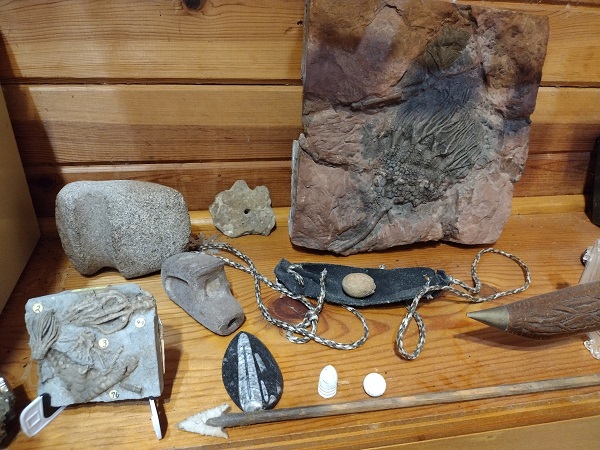
Here are some of the Native American artifacts from my collection, which includes a sandstone tobacco pipe in the shape of a frog, an ax, a (reconstructed) sling, and an arrow. The fossils add just the right amount of primeval ambience.
And here’s the shelf above my laptop. It’s easy to imagine various expressions in the contorted driftwood bookend. Depending on the slant of light, you can discover all sorts of shapes shifting around on the patina of the battered candlestick. On that candlestick is the key to an old German pie safe my wife bought. A few months ago, gazing at that key sparked the idea that it opened the door to a haunted house. Who would want that key? That little germ of an idea blossomed into my latest sale, which I expect to be published this summer.
What other story ideas lurk in these strange objects?







 M.C. Tuggle, Writer