Tag Archives: language

Reading for life

Story

The latest findings on American literacy are troubling, and not just for educators and authors:

The number of Americans who read for pleasure has fallen by 40%, according to a new study.

Researchers at the University of Florida and University College London have found that between 2003 and 2023, daily reading for reasons other than work and study fell by about 3% each year.

Many causes contribute to this unsettling trend. More “how to” advice is presented in the form of videos rather than text. Often, when you’re trying to read a news story online, pop-up videos vie for your attention. Video games, with their numbing sound effects and over-the-top visuals, offer seductive, but mindless, distraction. How are books to compete?

And again, the effects are far-reaching. Written language is the bedrock of an advanced civilization. The wisdom of past generations boosts the available information to the present generation, freeing us from having to re-invent the wheel.

Just as important, language binds us to one another, helping us see ourselves in context. Reading stories opens our eyes, letting us see we’re not alone facing problems.

Finally, each of us is a story, a cohesive narrative that makes sense of our memories, good and bad, as well as our aspirations. Lacking that narrative, we fall apart. Little wonder so many people feel isolated, disconnected, not just from others, but from themselves. When children agonize about being born in the wrong body, they’re yearning for a cohesive identity, which helps define purpose.

A culture that actively promotes atomizing society into disjointed, isolated individuals needs medical attention. The humanizing power of language is just what the doctor ordered.

The Magic of Words

Years ago, the opening scene of A Wizard of Earthsea captured my imagination and hooked me into this little classic. All who appreciate the power and beauty of words can’t help but feel the wonder Duny experiences as his gift for magic expands with his mastery of language. When his aunt, a witch, tells Duny the “true name” of falcons, he discovers this gives him control over them. This whets his appetite for more:

“When he found that the wild falcons stooped down to him from the wind when he summoned them by name, lighting with a thunder of wings on his wrist like the hunting-birds of a prince, then he hungered to know more such names. … To earn the words of power he did all the witch asked of him and learned of her all she taught, though not all of it was pleasant.” p. 5

Ordinary mortals feel the same rush when they learn the names of things. My eyes always tear up when I watch the water scene from The Miracle Worker. Anyone who isn’t moved when young Helen Keller learns that words represent reality has a heart of stone. Leicester Hemingway wrote that by the time his brother Ernest was eight, he “knew the names of all the birds, all the trees, flowers, fish, and animals found in the Middle West.” Knowing the names of things connects you to them. It elevates and empowers you.

As beautiful as this truth is, it isn’t romanticism, but hard practicality. Faithful communication was our distant ancestors’ most important adaptation to a harsh environment, as Robert Ardrey illustrated in The Social Contract:

“The bipolar nature of hominid society … became the cradle of language as we know it. Things had to be told. A hunter was injured, a child was sick. Hunters returning empty-handed had to tell apologetically of the big one that got away. Leopards menacing the home-place had to be described by the women, numbered, placed on the map if the group was to be defended.” p. 327

That’s why telling the truth evolved into an ancient virtue. Lying not only disrupted social bonds, but also threatened survival. Accurate, truthful communication alerted one’s family and neighbors to both dangers and opportunities.

Modernity hasn’t changed this basic fact. Writers offer the world an ideal of precise transmission of ideas and emotions. That’s what Ernest Hemingway meant when he reminded himself that he had to write “the truest sentence that you know.” In other words, a writer must discipline himself to express his truth with conviction and stand by his words.

Clear, honest communication remains a goal for the individual and society. Ezra Pound once declared that “Good art cannot be immoral. By good art I mean art that bears true witness, I mean the art that is most precise.” Asked what he would do if he were governor, Pound’s mentor Confucius vowed to “rectify the names.” By “rectify,” he meant to restore, to purify, to correct, so that words would correspond to reality. That’s a discipline, an art, and a calling.

Words – just words

Words just words

One of my coping mechanisms when stuck on a manuscript is to read outstanding posts on writing I’ve saved over the years. This morning, I revisited this advice from K.M. Weiland:

One of the best rules of thumb for showing instead of telling is to never name an emotion. Love, hate, happiness, sadness, frustration, grief—they all might be easily recognizable emotions. They might even all be emotions that will immediately get a point across to a reader. But by themselves the words lack the ability to make a reader feel what we are trying to convey.

This insight shook the mental cobwebs that had been holding me back. Weiland’s right — the most stirring and uplifting prose succeeds obliquely, rousing the reader to silent awe or trembling fear. A few examples:

“Some nights in the midst of this loneliness I swung among the scattered stars at the end of the thin thread of faith alone.”Wendell Berry

“The trees were full of silver-white sunlight and the meanest of them sparkled.”Flannery O’Connor

“I sat up straight and as I did so something inside my head moved like the weights on a doll’s eyes and it hit me inside in back of my eyeballs. My legs felt warm and wet and my shoes were wet and warm inside. I knew that I was hit and leaned over and put my hand on my knee. My knee wasn’t there.”Ernest Hemingway

Not only do these examples evoke intense reactions, they do so indirectly. As Weiland advises, the best writing shows rather than tells. Emily Dickinson was on the same track when she proposed that we tell the truth, but tell it slant.

I believe these passages soar for us because they appeal to more than just our logical selves. The neocortex, that is, the rational brain, processes language, but it connects to other parts of the brain as well. The limbic system interprets facts as emotions, and triggers the reptilian brain, which in turn shoots reactions to the body. So if you read Stephen King alone at midnight, you start peeking outside the window and maybe sweat a little. That’s the three parts working together. And we love it.

Good writing, then, achieves unity of mind and body, a sorely needed experience in an age that fractures and alienates.

Getting the words right

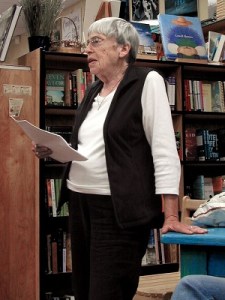
Ursula K. Le Guin
By Gorthian – Own work, CC BY-SA 3.0, https://commons.wikimedia.org/w/index.php?curid=31670340
Writers, whether new or seasoned, know well the central struggle of the craft, which is, as Ernest Hemingway put it, “Getting the words right.”

When you nail it, there’s nothing like it. The scene that sizzles, the story that moves readers — that’s what we live and work for as writers.

To me, no other fictional work has better captured the promise — and risk — of language than Ursula K. Le Guin’s classic, “A Wizard of Earthsea,” which tells the story of a boy learning the art of wizardry. The boy’s aunt, a dabbler in spell-making, introduces young Duny to the mystical relationship between the entities of our world and the names by which we know and influence them:

She praised him, and told him she might teach him rhymes he would like better, such as the word that makes a snail look out of its shell, or the name that calls a falcon down from the sky.

“Aye, teach me that name!” he said, being clear over the fright the goats had given him, and puffed up with her praise of his cleverness. …

When he found that the wild falcons stooped down to him from the wind when he summoned them by name, lighting with a thunder of wings on his wrist like the hunting-birds of a prince, then he hungered to know more such names and came to his aunt begging to learn the name of the sparrowhawk and the osprey and the eagle. To earn the words of power he did all the witch asked of him and learned of her all she taught, though not all of it was pleasant to do or know. pp. 4-5

Young Duny (later to be known as Ged) learns that the purpose of developing his power is to enhance and protect life. One of the themes of Le Guin’s riveting tale is the danger that a wizard can misuse that power if it is wielded carelessly.

The point, of course, is that the power of language is not only real, but necessary for a full life as a human being in society and the world. When used thoughtfully, language connects and anchors us. I like the way Joe Moran of Liverpool John Moores University expresses the process in this Literary Hub article:

For the American writing teacher Francis Christensen, learning to write was also about learning to live. He believed that teaching his students how to write a really great long sentence could teach them to “look at life with more alertness.” It should not just be about ensuring that the sentence is grammatically correct, or even clear. The one true aim, he wrote, was “to enhance life—to give the self (the soul) body by wedding it to the world, to give the world life by wedding it to the self.” He wanted his students to become “sentence acrobats” who could “dazzle by their syntactic dexterity.”

“To give the world life by wedding it to the self.” Beautiful. Such moments make the rejections and rewrites worth it.

Bright Star

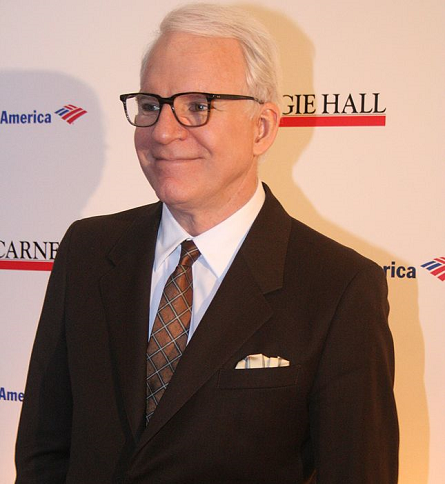
Steve Martin

My wife and I saw “Bright Star” yesterday. We loved it. You will too, and I’ll tell you why.

On the surface, it’s a typical musical, bustling with subplots about young love, the pains and joys of family relations, and Southern gothic melodrama, all peppered with timely comic relief. But it’s really about writing, editing, and language itself. Steve Martin (yes, that Steve Martin) wrote the book, and in addition to his accomplishments as an actor, director, and musician, is a gifted writer. He knows what it’s like to be rejected, to hang in there, and finally get that first manuscript published.

Billy Cane, just returned to Zebulon, North Carolina after serving in WWII, has a bad case of the writing bug. It’s so bad, he’s willing to leave his beloved home town and move to Asheville to endure the rigors of pleasing a demanding editor and her good cop/bad cop assistants. All writers will appreciate young Billy’s exchanges with his editor, who’s brutally honest with what she sees as a promising talent. At one point, she shoves a manuscript back at him as if it’s toxic, then lets another dangle in her fingers and says, “This may be acceptable if you delete 300 words.” Poor Billy scans a few pages, scratches his head, and replies, “Could you tell me WHICH 300?”

There are many references to the Southern writing tradition. Steve Martin, who was born in Texas, knows a thing or two about language’s ability to uplift, to wound, and to connect with others, familiar and rich themes often explored in Southern literature. This musical is a celebration of faith in one’s family, in one’s ability to persevere, and to hope. If you get the chance, don’t miss this one. It’s a winner.

The Linguist as piñata

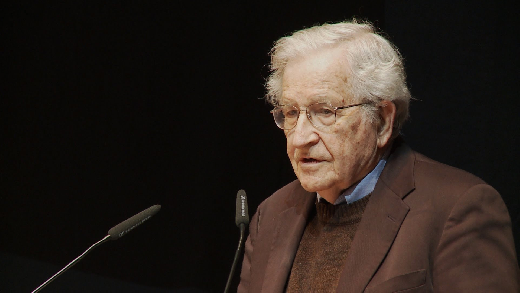
Noam Chomsky

From Scientific American:

Noam Chomsky’s political views attract so much attention that it’s easy to forget he’s a scientist, one of the most influential who ever lived. Beginning in the 1950s, Chomsky contended that all humans possess an innate capacity for language, activated in infancy by minimal environmental stimuli. He has elaborated and revised his theory of language acquisition ever since.

It’s a great article, and includes an interview with another accomplished linguist, Steven Pinker. Pinker concludes that even after decades of brutal examination and criticism, Chomsky’s famous thesis best explains how children master language. The alternatives boil down to arguing that language is an artificial construct of the rational mind that children, starting from a blank slate, must learn.

This vindication of Chomsky’s universal grammar theory is interesting on two counts, and both impact my writing. First, I’m fascinated by language. More important, scientific support of language as an inborn capability bolsters the view that people are naturally social, as opposed to the atomistic, rationalistic view of humanity pushed by both Hobbesians and Marxists.

We’re not plopped on this planet to enrich ourselves and consume; we are born to experience the world and find ourselves in it. That’s the worldview that animates everything I write.

Tolkien, Trees, and Tradition

TreeRoots

Joseph Pearce explores Tolkien’s reverence for language and heritage:

This deep understanding of language is analogous to an understanding of history. If we want to understand where we are now and where we are going, we have to understand where we have been. And what is true of history in the broader sense is equally true of the history of words. In order to really speak well, write well, or think clearly, we need to use words correctly. We need to know linguistic tradition. We need to be linguistic traditionalists. We have to be in touch with the language, its roots, and its heritage. We need to become linguistic tree-huggers! We do not necessarily have to speak very quickly; we have to speak well. We have to speak accurately, with a precision of meaning. Contrary to Peter Jackson’s tragically abusive presentation of the Ents in his film version of Tolkien’s epic, in which they appear to be dim-wits who are outwitted by the smartness of the hobbits, we know that when Tolkien’s Ents come to a decision it will be the right one, because they have been absolutely precise in the way they have used their words. They think and speak definitely, in accordance with precise definition. They define their terms and they know their meanings. They are the opposite of postmoderns and nihilists who see no meaningful roots to the cosmos because they see no meaningful roots to words.

Modernism, argues Pearce, is vandalism that fancies itself to be liberation from a constraining  past. Indeed, it celebrates the murder of authenticity, as it demands that all heritage chains down the individual. Of course, what actually happens is not a glorious jail-break from nature and history, but alienation from those things Charlene Spretnak has identified as the prime Modernist targets: “the knowing body, the creative cosmos, and the complex sense of place.” If we lose those things, then we are unshielded from today’s manipulators of language and value who profit by convincing us that our identity is discretionary, and can be as sleek and desirable as the Gap jeans and Zappo shoes they urge us to buy.