Tag Archives: Southern Fiction

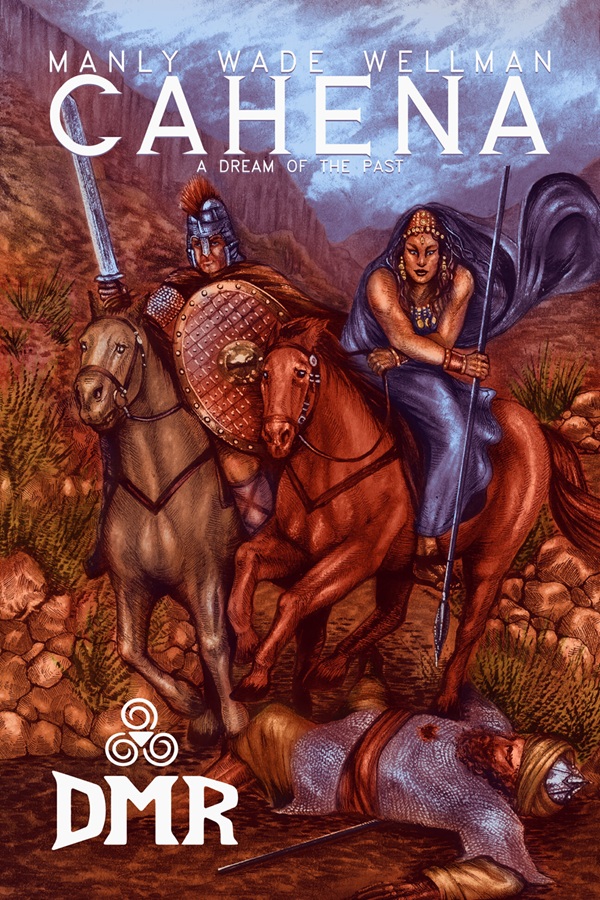
Cahena

In his foreword to Cahena: A Dream of the Past, Manly Wade Wellman describes the last novel of his brilliant and prolific career as an historical novel. That’s mostly true. The book is rich in historical details, from the hardscrabble life of the Berbers to their preparations for battle, which are especially vivid and convincing. But this intriguing tale is also spiked with the sorcerous, including a demon that stalks the camps searching out doomed warriors, and a vampire.

The tale revolves around the military leader and enchantress known as the Cahena, who leads her people against invading Muslims from the east. The setting is north Africa around the beginning of the eighth century. The novel is told from the point of view of Wulf, a Saxon career soldier whose military prowess earns the Cahena’s trust, boosting him to the position of advisor and later her lover. The story moves smoothly and forcefully through military campaigns and romantic complications.

This book is a treasure to be enjoyed, from the gorgeous cover to the bittersweet conclusion. Brace yourself for realistic action, romance, betrayal, and heroism. History aficionados will especially appreciate the well-researched details of training and organizing an army. Call it historical fantasy, sword-and-sorcery, or historical romance, it delivers an entertaining, gripping tale.

Kudos to DMR Books for keeping Wellman’s legacy alive.

July 3, 1863

“For every Southern boy fourteen years old, not once but whenever he wants it, there is the instant when it’s still not yet two o’clock on that July afternoon in 1863, the brigades are in position behind the rail fence, the guns are laid and ready in the woods and the furled flags are already loosened to break out and Pickett himself with his long oiled ringlets and his hat in one hand probably and his sword in the other looking up the hill waiting for Longstreet to give the word and it’s all in the balance, it hasn’t happened yet.”

William Faulkner, Intruder in the Dust

Happy 216th Birthday, Edgar Allan Poe!

Edgar Allan Poe

Poe’s influence on world literature is profound and far reaching. He inspired many writers, including H. P. Lovecraft, Stephen King, and Ray Bradbury, and also defined modern horror, science fiction, and crime fiction.

Here’s my birthday tribute to a great teller of tales, Edgar Allan Poe’s “The Premature Burial.”

Ron Rash named to North Carolina Literary Hall of Fame

Ron Rash, the Parris Distinguished Professor in Appalachian Cultural Studies at Western Carolina University (my alma mater), has been recognized once again for his outstanding contributions to Southern fiction. From Western Carolina Stories:

“We are thrilled that Ron Rash is being inducted in the NC Literary Hall of Fame, a well-deserved honor,” said David Kinner, dean of WCU’s College of Arts and Sciences. “Like WCU, Ron’s work is tied to our region, its history and its people, and through his writing, he has entertained us, moved us and made us think. Ron is a prolific author, an integral part of our community and our students benefit from being able to learn from him.”

Rash said he was grateful to be placed among authors who impacted his journey as a writer.

“What makes this honor so meaningful is that previous inductees, especially Thomas Wolfe, Fred Chappell, Lee Smith and Robert Morgan, are writers who have inspired and influenced my own work,” Rash said.

The books I’ve read by Rash include The Cove and Serena, haunting, lyrical works that will certainly contribute to the legacy of Southern fiction.

Quote of the day

“The South is a very alluring and otherworldly place. It’s very easy to feel completely surrounded by an invisible presence down there, for lack of a better word. Everything is very rich. The air is very heavy. The trees feel like they’re descending on you. It really permeates your physical being while you’re down there, it does.” J. Nicole Jones

I know that presence well, having grown up here. Which is why I set so many of my stories in the South. MT

Quote of the day

“Place in fiction is the named, identified, concrete, exact and exacting, and therefore credible, gathering spot of all that has been felt, is about to be experienced, in the novel’s progress. Every story would be another story, and unrecognizable as art, if it took up its characters and plot and happened somewhere else.”

Eudora Welty

William Gibson, Cyber Rebel

Mention the term Southern fiction, and people typically think of the works of Flannery O’Connor, William Faulkner, Ron Rash, or Charles Frazier. The term evokes scenes of snowy-white cotton fields, simmering tension between characters sipping bourbon, or protagonists haunted by an aching nostalgia for a rural life long gone.

Most folks wouldn’t associate memory uploads, runaway AI systems, or megacorporations as proper subjects for Southern fiction. But maybe my article on cyberpunk author William Gibson might just change your mind. It’s the featured post over at the Abbeville Institute blog. Read it there, and comment on it here. Enjoy!

What Is a Southern Writer, Anyway?

Writing in the New York Times, Margaret Renkl grapples with the nature and resilience of the Southern literary tradition. Not only does Southern literature claim such past greats as William Faulkner, Flannery O’Connor, and Eudora Welty, but modern-day Southern writers, such as Wendell Berry, Ron Rash, and Ann Patchett, who continue to build on that tradition. How can this be, Renkl asks, in a region that is undergoing such profound changes? Her conclusion is worth considering:

It has all made me wonder: What if being a Southern writer has nothing to do with rural tropes or lyrical prose or a lush landscape or humid heat so thick it’s hard to breathe? What if being a Southern writer is foremost a matter of growing up in a deeply troubled place and yet finding it somehow impossible to leave? Of seeing clearly the failings of home and nevertheless refusing to flee? … Maybe being a Southern writer is only a matter of loving a damaged and damaging place, of loving its flawed and beautiful people, so much that you have to stay there, observing and recording and believing, against all odds, that one day it will finally live up to the promise of its own good heart.

Much has been said about how art often arises from pain, something the South has known all too well. Sometimes, suffering can lead to insights not obvious to those who have evaded bad times. In addition to such recurring themes as the joys and anguish of family, history, and nature, Southern literature often questions the triumphalism and confidence in progress seen in the works of Northern writers. And yet, Southerners love their heroes, characters who press on despite the odds, as well as tales of glory and derring-do. Robert E. Howard’s stories are well-known for both their pessimism about progress and their celebration of courage in desperate situations.

I’d argue that the chief attraction of Southern writing is the genre’s celebration of the human ability to stagger to one’s feet after disaster and relish the beauty and mystery of life despite it all. As William Faulkner wrote in The Sound and The Fury, “Wonder. Go on and wonder.” Good advice.

Bright Star

Steve Martin

My wife and I saw “Bright Star” yesterday. We loved it. You will too, and I’ll tell you why.

On the surface, it’s a typical musical, bustling with subplots about young love, the pains and joys of family relations, and Southern gothic melodrama, all peppered with timely comic relief. But it’s really about writing, editing, and language itself. Steve Martin (yes, that Steve Martin) wrote the book, and in addition to his accomplishments as an actor, director, and musician, is a gifted writer. He knows what it’s like to be rejected, to hang in there, and finally get that first manuscript published.

Billy Cane, just returned to Zebulon, North Carolina after serving in WWII, has a bad case of the writing bug. It’s so bad, he’s willing to leave his beloved home town and move to Asheville to endure the rigors of pleasing a demanding editor and her good cop/bad cop assistants. All writers will appreciate young Billy’s exchanges with his editor, who’s brutally honest with what she sees as a promising talent. At one point, she shoves a manuscript back at him as if it’s toxic, then lets another dangle in her fingers and says, “This may be acceptable if you delete 300 words.” Poor Billy scans a few pages, scratches his head, and replies, “Could you tell me WHICH 300?”

There are many references to the Southern writing tradition. Steve Martin, who was born in Texas, knows a thing or two about language’s ability to uplift, to wound, and to connect with others, familiar and rich themes often explored in Southern literature. This musical is a celebration of faith in one’s family, in one’s ability to persevere, and to hope. If you get the chance, don’t miss this one. It’s a winner.

Manly Wade Wellman: The Voice of the Mountains

Manly Wade Wellman

My article on Manly Wade Wellman, once known as “the dean of fantasy writers,” is featured on the Abbeville Institute’s blog:

Manly Wade Wellman never penned an autobiography, despite the fact he published 500 stories and articles, won the World Fantasy Award and Edgar Allan Poe Award, and even edged out William Faulkner to win the Ellery Queen Mystery Magazine Award in 1946.

Yet, in one of his most famous short stories, Wellman did reveal how he must have seen himself throughout his career, from a crime reporter for The Wichita Eagle, to Assistant Director of the WPA’s Folklore Project in New York City, and finally as “the dean of fantasy writers.” In “The Desrick on Yandro,” the protagonist, John the Balladeer, has to sing for his supper to a group of “ladies and men in costly clothes.” Confident and entertaining despite his modest attire and outsider ways, John charms the crowd with forgotten classics, including “Rebel Soldier.” Like John the Balladeer, Manly Wade Wellman was a rustic but worldly singer of old ballads, as well as a walking, talking ambassador and promoter of traditional Southern culture wherever he went.

Read the rest at the Abbeville Institute, and Like here.