Category Archives: Modern life

On the origin of species

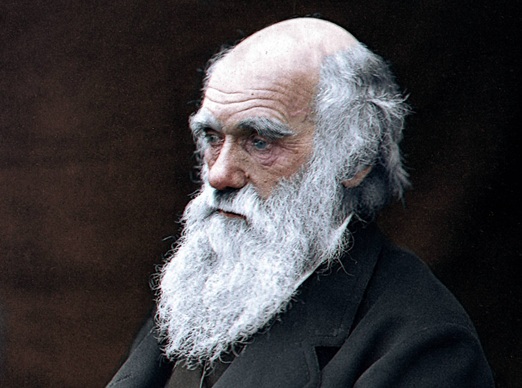
Charles Darwin’s landmark book On the Origin of Species was first published on this date in 1859.

We haven’t been the same since.

As E. O. Wilson tells us, science provides “more solidly grounded answers” to life’s mysteries. Not only has the theory of evolution transformed science, it has also given us a powerful lens for examining ourselves. Sadly, we remain blind to Darwin’s foundational message, that humans are not invaders but a part of nature. This continued isolation from the natural world has dire consequences, as this recent article from Science Daily warns us:

“A new study by evolutionary anthropologists Colin Shaw (University of Zurich) and Daniel Longman (Loughborough University) argues that the pace of modern living has moved faster than human evolution can follow. According to their work, many chronic stress problems and a wide range of contemporary health concerns may stem from a mismatch between biology shaped in natural settings and the highly industrialized world people occupy today.

That means the mismatch between our evolved physiology and modern conditions is unlikely to resolve itself naturally. Instead, the researchers argue, societies need to mitigate these effects by rethinking their relationship with nature and designing healthier, more sustainable environments.”

What to do? We must recognize our relationship with nature. The places we live must be reimagined and revamped so they resemble our hunter-gatherer past. More green spaces, more walkways, less dependence on cars, more opportunities to see nature maturing and blossoming before us.

But the first, most essential step is to open our eyes and see what we truly are.

Can AI replace writers?

I’m happy to see that more publishers won’t accept works created by AI. For the life of me, I can’t understand why someone would stick their name in the byline of something created by a computer program, but after all, plagiarism is nothing new. If people will take credit for something somebody else wrote, why not claim an AI product?

This issue isn’t going away. In Ray Kurzweil’s latest book, The Singularity is Nearer: When We Merge with AI, he claims AI will match and even surpass the writing of the best authors. These programs, he argues, will be “familiar with virtually every kind of human writing. Users could prompt it to answer questions about any given subject in a huge variety of styles — from scientific writing to children’s books, poetry, or sitcom scripts. It could even imitate specific writers, living or dead.”

Can it? I don’t think so. Ray Kurzweil is a transhumanist who advocates merging humans with AI as well as enhancing human ability with genetic engineering. Kurzweil believes we can upload our minds to a computer and live forever. Transhumanism despises the body, traditional culture, and humanity in general. Worse, it doesn’t understand any of the things it wants to replace.

First of all, human beings are not ghosts in a machine. The notion that our minds ride around in a meat robot that can be ditched without changing who we are is hopelessly simplistic. What we call the mind is the sum of the functions of the brain, which is a physical organ. And the brain interacts with the rest of the body. In fact, the field of Embodied Cognition tells us the body is central to our thought processes.

There’s solid research to back this view. Mirror neurons fire when we perform an action or when we observe someone else performing that action. Embodied Cognition also tells us that language is metaphor, and the building blocks of metaphor are physical sensations. Magnetic resonance imaging scanners reveal that when we read about a physical action, we activate the same areas of our brains as when we actually perform those actions. That’s the mirror neurons at work.

The bottom line is that disembodied machines cannot think, feel, or write the way humans do.  And never will.

The Death of Newspapers

Kevin Siers Cartoon Caption

My hometown paper, The Charlotte Observer, has fired Kevin Siers, its Pulitzer-Prize winning political cartoonist. Like many other papers, the Observer has been whittling itself away the past few years. They lost their palatial office building, quit printing a Saturday edition, and have bled off numerous positions over the last decade: business editor, book editor, social editor, and so on.

I didn’t agree with many of the Observer’s or Siers’ positions, but they were well presented and challenging. They used to host a limerick competition for St. Patrick’s Day and picked one of my limericks for publication. Kevin Siers picked my submission for his “Write that Caption” cartoon competition four times, and always awarded me with his original black-and-white drawing — except the last one, when he surprised me with the colorized version used for publication. (See above) It’s a cherished memento that now hangs framed in my office.

People tell me, “Just read the news online.” No. Trying to read online is not the same experience. Pop-up ads disrupt you. Worse, autoplay videos try to lure you away from the article, and videos aren’t as thought-provoking or enjoyable. Reading is an active and cooperative activity between reader and writer, while watching a video is passive and one-sided. Watching a video is like inserting electrodes into your brain and submissively absorbing the input.

Progress? This isn’t it.

Writers On Good Manners

Robert Heinlein
Robert Heinlein

I’ve been pondering the deterioration of public discourse. The occasion of Robert Heinlein’s birthday brings to mind this quote:

“An armed society is a polite society. Manners are good when one may have to back up his acts with his life.”

― Robert A. Heinlein

Which reminds me of this:

“Civilized men are more discourteous than savages because they know they can be impolite without having their skulls split, as a general thing.”

― Robert E. Howard

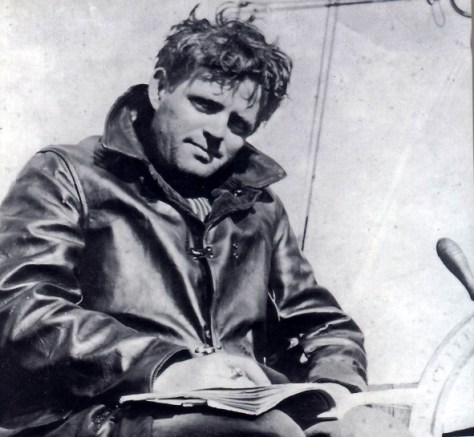
Happy Birthday, Jack London

Jack London

Today is the 145th birthday of writer and adventurer Jack London. Like Robert E. Howard and Ray Bradbury, Jack London was largely self-taught, and his maverick, imaginative style continues to attract and captivate new generations of readers.

If you think London just wrote adventure tales for kids, well, you need to check out my post Jack London: Blood and Redemption at the DMR Books web site.

I’m honored that Deuce Richardson invited me to write this post to kick off the 2021 DMR Guest Bloggerama. And I hope my introduction to Jack London’s life and work will help more readers discover him.

A Good Couple

 A Good Couple
Idle Ink has published my latest flash story, “A Good Couple.” It pays tribute to Flannery O’Connor, one of my favorite authors. Like the Grandmother in “A Good Man Is Hard to Find,” the characters in “A Good Couple” are so busy condemning the sins of others that they cannot see their own.

This is one of my rare literary pieces. I enjoyed writing it, even though I had to chase down the muse to capture the story on paper.

Idle Ink is the perfect home for this story. This lively magazine publishes fiction “too weird to be published anywhere else” as well as “articles that poke fun at modern life.” After you’ve read my story, treat yourself to the book and movie reviews, the challenging opinion pieces, and intriguing artwork.

PS – Fellow Idle Ink and Hexagon contributor Ioanna Papadopoulou has been nominated for a Pushcart Prize for her story “The Drowned King.” Congratulations, Ioanna!

After Dinner Conversations — a review

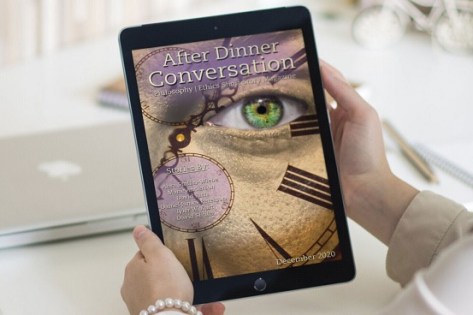
After Dinner Conversations

After Dinner Conversations is “a website of short stories designed to encourage ethical and moral conversations with friends, family, and social groups.” When I read that the featured stories aimed to “create an accessible example of an abstract ethical or philosophical idea,” I was immediately reminded of the novel Sophie’s World by Jostein Gaarder.

Except that After Dinner Conversations (ADC) succeeds much better.

Sophie’s World is an enjoyable and challenging tale that explores the nature of reality. In the story, the protagonist must master philosophical concepts to regain control of her life, which has been taken over and altered by a philosopher.

What I like about ADC is that the philosophy is more deeply embedded in the story. While Sophie’s World throws huge chunks of philosophical exposition at the reader, the stories in ADC craft philosophical problems into plot points.

In Tyler W. Kurt’s “The Shadow of the Thing,” for example, Dakota, the POV character, visits her friends Maeve and Jason, who’ve asked her to join them for the evening. Maeve intends to take a drug that allows one to see the “true world” that’s “layered on top of the world that you see around you.” Later, while waiting for the drug to kick in, Dakota and Maeve sit back and watch the shadows on the wall.

The allusion to Plato’s Cave signals the story’s theme of looking – and seeing – beyond appearances. I thought it amusing that the author foreshadowed (!) the theme at the beginning of the story, when we learn that Maeve and Jason, both unconventional personalities, live in an ordinary tract home in the suburbs. Not exactly the place one would expect to find a wingsuit-diving programmer or a travel blogger who’s visited over 70 countries.

ADC says its goal is to feature stories that spark discussion, and this story clearly succeeds. Jason has already had his eyes opened by the mysterious drug. But the experience seems to have permanently depressed him. Does seeing underlying reality sap one’s enthusiasm? Are our illusions our surest comfort in a bleak world? If so, why would Maeve (and perhaps Dakota) want to follow his example?

And that’s just off the top of my head. Many more fascinating issues lurk beneath the surface here.

I’ll close with a little speculation about the characters’ names. Maeve is an alternate spelling of Queen Medb of Irish mythology, whose name means “she who intoxicates.” In Greek mythology, Jason was married to the sorceress Medea, who ultimately destroy each other. Does this suggest how the Maeve and Jason in “The Shadow of the Thing” end up?

As I said, the possibilities for generating discussion abound.

The Idiot Box vs. Humanity

idiot box

“After forty-odd years, the evidence is everywhere that television, far from proving a great tool of education, is a tool of stupefaction and disintegration.”
Wendell Berry

“So please, oh please, we beg, we pray,
Go throw your TV set away,
And in its place you can install
A lovely bookshelf on the wall.
Then fill the shelves with lots of books.”
Roald Dahl

“Throw out the radio and take down the fiddle from the wall.” Andrew Lytle

Quotes of the day

heinlein and howard
“A dying culture invariably exhibits personal rudeness. Bad manners. Lack of consideration for others in minor matters. A loss of politeness, of gentle manners, is more significant than is a riot.”
Robert A. Heinlein

“Civilized men are more discourteous than savages because they know they can be impolite without having their skulls split, as a general thing.”
Robert E. Howard