Breaking rules

Early in his acting career, Arnold Schwarzenegger established a reputation for being both ambitious and easy to get along with. But he once famously clashed with James Cameron on the set of The Terminator about what would become the most famous line in a groundbreaking movie.

Arnold suggested his killer android character would say “I will be back,” arguing that a machine would not use a contraction. Cameron, who was renowned for his meticulousness, held his ground, finally demanding that Arnold stick to the script. As Arnold recalled, Cameron told him, “I don’t correct your acting, so don’t correct my writing.” Arnold did as he was told, and in the above video, he confesses that Cameron made the right call.

Kudos to Arnold for admitting his mistake.

But the real point is how you can be technically right but artistically wrong. Submissions editors see manuscripts all the time that click on all the technical points, such as tension, characterization, and a good premise, but fail to engage the reader.

The showdown between Arnold and Cameron illustrates that sometimes the logical way isn’t always best. A story develops its own internal logic and dynamic, and it takes years of practice to recognize that fact. James Cameron knew what he was doing.

Another way to put it is that you have to master the rules before you’re good enough to break them. Then you can wield them flexibly and effectively.
Quote of the day

Photo source: Pip R. Lagenta from Creative Commons

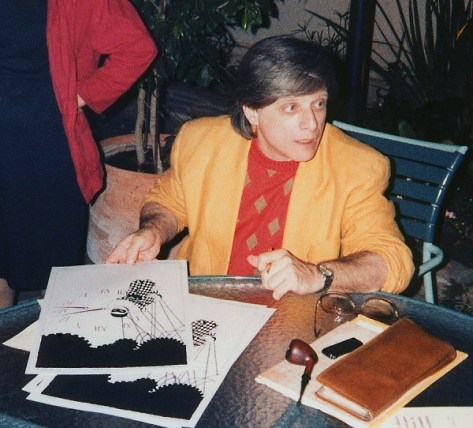
“There is no nobler chore in the universe than holding up the mirror of reality and turning it slightly, so we have a new and different perception of the commonplace, the everyday, the ‘normal’, the obvious. People are reflected in the glass. The fantasy situation into which you thrust them is the mirror itself. And what we are shown should illuminate and alter our perception of the world around us.”

Harlan Ellison

Happy Birthday, Jack London

Jack London

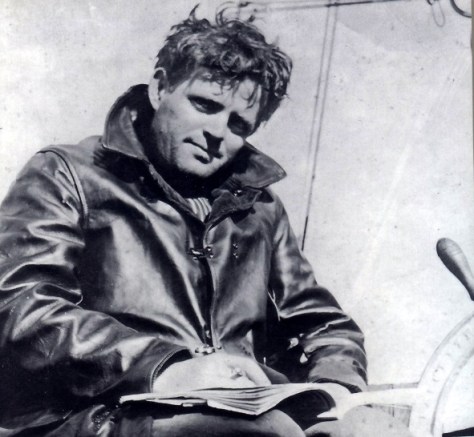
Today is the 145th birthday of writer and adventurer Jack London. Like Robert E. Howard and Ray Bradbury, Jack London was largely self-taught, and his maverick, imaginative style continues to attract and captivate new generations of readers.

If you think London just wrote adventure tales for kids, well, you need to check out my post Jack London: Blood and Redemption at the DMR Books web site.

I’m honored that Deuce Richardson invited me to write this post to kick off the 2021 DMR Guest Bloggerama. And I hope my introduction to Jack London’s life and work will help more readers discover him.

Words – just words

Words just words

One of my coping mechanisms when stuck on a manuscript is to read outstanding posts on writing I’ve saved over the years. This morning, I revisited this advice from K.M. Weiland:

One of the best rules of thumb for showing instead of telling is to never name an emotion. Love, hate, happiness, sadness, frustration, grief—they all might be easily recognizable emotions. They might even all be emotions that will immediately get a point across to a reader. But by themselves the words lack the ability to make a reader feel what we are trying to convey.

This insight shook the mental cobwebs that had been holding me back. Weiland’s right — the most stirring and uplifting prose succeeds obliquely, rousing the reader to silent awe or trembling fear. A few examples:

“Some nights in the midst of this loneliness I swung among the scattered stars at the end of the thin thread of faith alone.”Wendell Berry

“The trees were full of silver-white sunlight and the meanest of them sparkled.”Flannery O’Connor

“I sat up straight and as I did so something inside my head moved like the weights on a doll’s eyes and it hit me inside in back of my eyeballs. My legs felt warm and wet and my shoes were wet and warm inside. I knew that I was hit and leaned over and put my hand on my knee. My knee wasn’t there.”Ernest Hemingway

Not only do these examples evoke intense reactions, they do so indirectly. As Weiland advises, the best writing shows rather than tells. Emily Dickinson was on the same track when she proposed that we tell the truth, but tell it slant.

I believe these passages soar for us because they appeal to more than just our logical selves. The neocortex, that is, the rational brain, processes language, but it connects to other parts of the brain as well. The limbic system interprets facts as emotions, and triggers the reptilian brain, which in turn shoots reactions to the body. So if you read Stephen King alone at midnight, you start peeking outside the window and maybe sweat a little. That’s the three parts working together. And we love it.

Good writing, then, achieves unity of mind and body, a sorely needed experience in an age that fractures and alienates.

Quote of the day

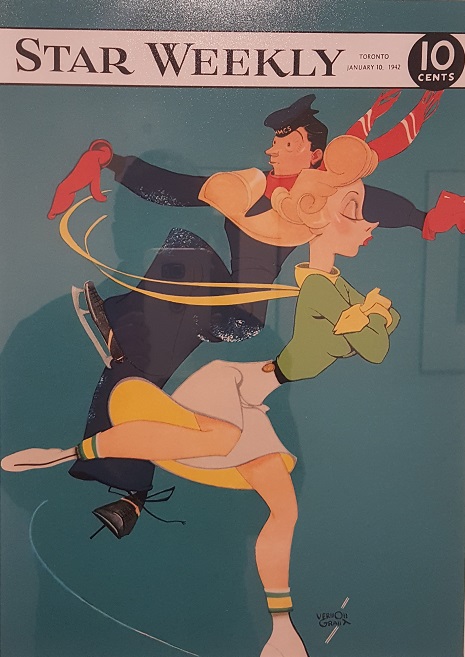
“Ideas come to you with tattered clothes and runny noses, but if you clean them up and present them to the right people, they’ll get adopted.”

Vernon Grant — Rock Hill, South Carolina artist who designed Snap! Crackle! and Pop! for Kellogg’s.

Just like story ideas … rough drafts need a lot of tough love before they can be published.

New reviews

Here’s a roundup of reviews of my latest works. First, here’s award-winning reviewer Kevin Tipple on the June, 2020 issue of Mystery Weekly Magazine:

The story that inspired the cover, “The Calculus of Karma” by M. C. Tuggle, leads off the Mystery Weekly Magazine: June 2020 issue. Deputy Marshal Malcom Lamb has to deal with a body in an alleyway of the asteroid’s main camp. The miner is dead because of the crack in his visor that allowed the vacuum of space to enter his helmet. Whether it was an accident or murder by way of another turf war between groups of miners is up to Deputy Lamb to figure out. He better do it fast as trying to keep the peace on the asteroid near Jupiter is not easy.

Next, S.D. McKinley, the author of How LJ and Rom Saved Heavy Metal, reviews my flash fiction story A Good Couple.

Author Sherrey Meyer posted a 5-star overview of Hexagon at Goodreads.

And author Didi Oviatt posted her reaction to the premiere issue of Hexagon Speculative Fiction Magazine on her author’s blog:

In this 1st edition there are five quick science fiction reads by authors Mike Tuggle, Evan Marcroft, John Grey, Michael M. Jones, and Nicholas C. Smith. I’ve read work by Mike Tuggle before and really enjoyed his style, so I knew going in that this edition had potential.

Many, many thanks for the kind thoughts and gracious reviews.

A Good Couple

 A Good Couple
Idle Ink has published my latest flash story, “A Good Couple.” It pays tribute to Flannery O’Connor, one of my favorite authors. Like the Grandmother in “A Good Man Is Hard to Find,” the characters in “A Good Couple” are so busy condemning the sins of others that they cannot see their own.

This is one of my rare literary pieces. I enjoyed writing it, even though I had to chase down the muse to capture the story on paper.

Idle Ink is the perfect home for this story. This lively magazine publishes fiction “too weird to be published anywhere else” as well as “articles that poke fun at modern life.” After you’ve read my story, treat yourself to the book and movie reviews, the challenging opinion pieces, and intriguing artwork.

PS – Fellow Idle Ink and Hexagon contributor Ioanna Papadopoulou has been nominated for a Pushcart Prize for her story “The Drowned King.” Congratulations, Ioanna!

Writing by hand

write by hand
Image by Colleen O’Dell from Pixabay

We all know it’s a good idea to do something different when you’re stumped on a writing project. When you’re not satisfied with a scene, or just can’t decide what your protagonist should do next, you need to take a walk, chat with a friend, or practice your katas.

But psychologists and neuroscientists suggest an even better strategy is to grab a notepad and ink pen. It seems that the feel and shape of words stimulates your creativity and helps you connect with the narrative you want to capture. As Neil Gaiman once put it, “Writing with a pen is like playing,” and nothing brightens up a manuscript like a sense of playfulness. And this article in Fast Company tells us there’s science to back up what many writers have known for years:

When you write by hand, you write more thoughtfully. Such mindful writing rests the brain, unlocking potential creativity, says neuroscientist Claudia Aguirre. “Recent neuroscientific research has uncovered a distinct neural pathway that is only activated when we physically draw out our letters,” she writes. “And this pathway, etched deep with practice, is linked to our overall success in learning and memory.”

I think there’s something to this. The last time I got stuck in a story, I redeployed to the back porch with pen and pad to chase down my muse. I found her, and we had a very productive writing session, the results of which will be published this Saturday at Idle Ink.

And it’s not just writers who benefit from writing the old-fashioned way. Students who record lectures with a pen relate to the ideas they’re hearing better than those who use laptops, and doctors who take notes by longhand build a better rapport with patients. By slowing down and actively forming words, we stimulate our emotional connection with the stories we’re telling.

Quote of the day

“Finish reading an especially difficult book, and its cover functions more like a trophy awarded for intellectual labor. Carry a book around in public, and its cover can betray you to other people who will make assumptions about you. It feels risky to be so exposed, but at times such assumptions are welcome, as when a book cover, flashed across a crowded subway car, operates like a secret handshake.”

Peter Mendelsund and David J. Alworth

After Dinner Conversations — a review

After Dinner Conversations

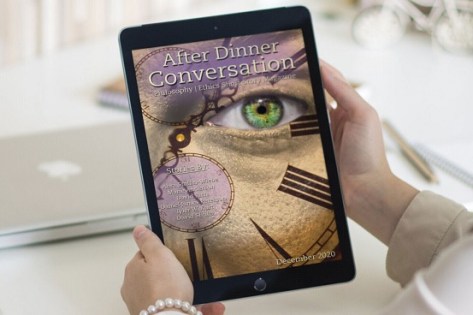
After Dinner Conversations is “a website of short stories designed to encourage ethical and moral conversations with friends, family, and social groups.” When I read that the featured stories aimed to “create an accessible example of an abstract ethical or philosophical idea,” I was immediately reminded of the novel Sophie’s World by Jostein Gaarder.

Except that After Dinner Conversations (ADC) succeeds much better.

Sophie’s World is an enjoyable and challenging tale that explores the nature of reality. In the story, the protagonist must master philosophical concepts to regain control of her life, which has been taken over and altered by a philosopher.

What I like about ADC is that the philosophy is more deeply embedded in the story. While Sophie’s World throws huge chunks of philosophical exposition at the reader, the stories in ADC craft philosophical problems into plot points.

In Tyler W. Kurt’s “The Shadow of the Thing,” for example, Dakota, the POV character, visits her friends Maeve and Jason, who’ve asked her to join them for the evening. Maeve intends to take a drug that allows one to see the “true world” that’s “layered on top of the world that you see around you.” Later, while waiting for the drug to kick in, Dakota and Maeve sit back and watch the shadows on the wall.

The allusion to Plato’s Cave signals the story’s theme of looking – and seeing – beyond appearances. I thought it amusing that the author foreshadowed (!) the theme at the beginning of the story, when we learn that Maeve and Jason, both unconventional personalities, live in an ordinary tract home in the suburbs. Not exactly the place one would expect to find a wingsuit-diving programmer or a travel blogger who’s visited over 70 countries.

ADC says its goal is to feature stories that spark discussion, and this story clearly succeeds. Jason has already had his eyes opened by the mysterious drug. But the experience seems to have permanently depressed him. Does seeing underlying reality sap one’s enthusiasm? Are our illusions our surest comfort in a bleak world? If so, why would Maeve (and perhaps Dakota) want to follow his example?

And that’s just off the top of my head. Many more fascinating issues lurk beneath the surface here.

I’ll close with a little speculation about the characters’ names. Maeve is an alternate spelling of Queen Medb of Irish mythology, whose name means “she who intoxicates.” In Greek mythology, Jason was married to the sorceress Medea, who ultimately destroy each other. Does this suggest how the Maeve and Jason in “The Shadow of the Thing” end up?

As I said, the possibilities for generating discussion abound.

Adventures and mishaps in science fiction, fantasy, and mystery