“As a literary form, then, the uncanny tale can be a means for expressing truths enchantingly. Many are drawn to this literary genre as it affirms what most of us know, and that is the truth that our senses are not capable of apprehending all that was, is, or will be. While the ‘scientists’ or ‘materialists’ will not acknowledge it, ‘nature’ is something more than mere fleshly sensation, and that something may lie above human nature, and something below it—why, the divine and the diabolical rise up again in serious literature.” Russell Kirk on ghost stories
Tag Archives: fantasy fiction
Quote of the Day
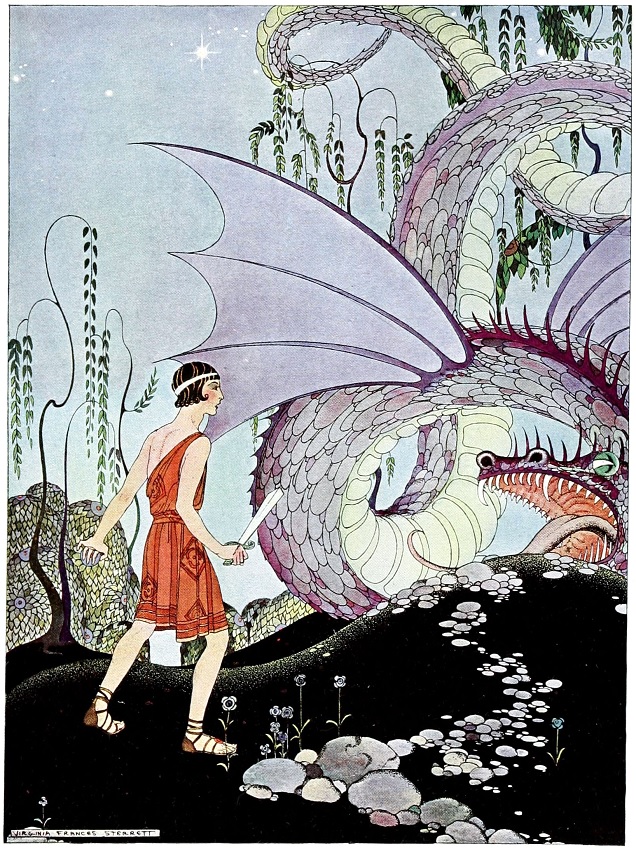
“Just because there’s a dragon in the book doesn’t mean the story isn’t based on reality.” – Jeff VanderMeer
Contagious Magic
While researching Appalachian Folk Magic for my latest wip, I read Sir James Frazer’s The Golden Bough. In his chapter “The Principles of Magic,” I encountered this:
“If we analyze the principles of thought on which magic is based, they will probably be found to resolve themselves into two: first, that like produces like, or that an effect resembles its cause; and, second, that things which have once been in contact with each other continue to act on each other at a distance after the physical contact has been severed.” (p. 12)
Frazer refers to this principle, which he calls “Contagious Magic,” in his discussion of spells around the world that involve the use of hair or nail clippings to exert control over the owner. Even things that were once close, and not necessarily part of the body, can be used because a bond still exists. For example, in Mecklenburg, Germany, practitioners of folk magic believed a coffin nail driven into a footprint would make the person who made the print go lame.
Frazer, with his usual scholarly contempt, dismisses such thinking while painstakingly documenting other examples of it.
But now we have quantum mechanics, which says to folks like Frazer, “Not so fast.” From the Encyclopedia of Science:
“Identical twins, it’s said, can sometimes sense when one of the pair is in danger, even if they’re oceans apart. Tales of telepathy abound. Scientists cast a skeptical eye over such claims, largely because it isn’t clear how these weird connections could possibly work. Yet they’ve had to come to terms with something that’s no less strange in the world of physics: an instantaneous link between particles that remains strong, secure, and undiluted no matter how far apart the particles may be – even if they’re on opposite sides of the universe.”
Erwin Schrödinger, in a letter to Albert Einstein, called this phenomenon “entanglement”:
“When two systems … enter into temporary physical interaction … and when after a time of mutual influence the systems separate again, then they can no longer be described in the same way as before, viz. by endowing each of them with a representative of its own. I would not call that one but rather the characteristic trait of quantum mechanics, the one that enforces its entire departure from classical lines of thought. By the interaction the two representatives [the quantum states] have become entangled.”
Einstein dismissed Schrödinger’s ideas as “spooky action at a distance.” (And isn’t that what magic is all about?) But it’s for real. Today, IT researchers are studying how to create super computers that can exchange data instantaneously through entangled components despite being separated by thousands of miles.
Spooky, indeed.
Like a waterfall
I’m in the Zone, folks. It’s finally come together. I’ve achieved cruising speed on my latest wip, as ideas, dialogue, and action are flowing onto the laptop like a waterfall. My characters and I are finally on speaking terms, even to the point where they nudge me to point out what I need to have them say and do next. Man, what a feeling. This is what writers live for.
Gone are the gruesome hours of agonizing over the major plot points. You know what it’s like: The protag can’t do that. He wouldn’t react that way. And why the hell would our villain do that? She’s not stupid.
And so on. I’m almost in that other-worldly state you see in movies about painters, song-writers, and authors where they’re possessed by their muse, and their wip just flows out of them in a burst of feverish activity. That’s not the way it really works, but you get the idea. Rent Moulin Rouge ( the one with José Ferrer, not Tom Cruise’s first ex) to see what I mean. Great movie. Lousy role model for writers.
Anyway, my latest wip is about Appalachian folk magic in an urban setting. So far, it’s been a blast. Here’s the list of books I’ve read or re-read as background:
Cracker Culture Grady McWhiney
Albion’s Seed: Four British Folkways in America David Hackett Fischer
At Home in Dogwood Mudhole Franklin Sanders
Grammatical Man Jeremy Campbell
The Story of North Carolina Dr. Alex Arnett
The Other Irish Karen F. McCarthy
Our Father’s Fields James Kibler
The Making of a Cop Harvey Rachlin
A History of the South Francis Simkins & Charles Roland
And last but certainly not least:
The Golden Bough Sir James George Frazer
Underlying all this research is a bit of family history you probably wouldn’t believe, but which I’ll discuss fully once the book is out. Then there are my excursions into Charlotte’s extensive creek walks at weird hours. One thing that’s always fascinated me is how familiar things transform come nightfall. More on that later.
Further updates to follow. Right now, it’s time for bed. Yes, it’s been that intense.
Cristian Mihai Reviews Aztec Midnight
From Cristian Mihai: “This novella is one hell of a roller coaster ride. It’s got just the right amount of suspense, well delivered, to make me want to get to the end as soon as possible. The dialogue is excellent, the plot flows in a natural manner. The story works. It just does.”
Read the rest of Aztec Midnight: a novella by M.C. Tuggle at Cristian Mihai’s blog.
Best Fiction and Writing Blogs
The best fiction and writing blog posts from around the ‘net, all guaranteed to make you a literary adventurer. Compiled by ambrose.
Michael Chabon and Neil Gaiman: Video Tribute to Terry Pratchett
P.J. Parrish: What does your character want?
Alice Osborn: 5 Tips on How to Make a Living as an Author
Rod Dreher: First You Change the Language…
James Machin: H. P. Lovecraft’s pivotal moment
Jami Gold: Write what you want to learn about
Stephen Masty: Awareness of the Past Heightens Creativity
Jacqueline Seewald: Overcoming Writer’s Block (Part 2)
7 Languages That Inspire Fantasy Authors
Of the more than 6,500 documented languages, guess which have inspired fantasy authors the most? A very useful introduction from Thoughts On Fantasy.
Robert E. Howard, Southern Writer
The Abbeville Institute, a site dedicated to Southern arts, has published my article on Robert E. Howard. Here’s a sample:
“The novelist with Christian concerns will find in modern life distortions which are repugnant to him, and his problem will be to make these appear as distortions to an audience which is used to seeing them as natural; and he may well be forced to take ever more violent means to get his vision across to this hostile audience. When you can assume that your audience holds the same beliefs you do, you can relax a little and use more normal ways of talking to it; when you have to assume that it does not, then you have to make your vision apparent by shock — to the hard of hearing you shout, and for the almost blind you draw large and startling figures.” Flannery O’Connor
The Southern Gothic tradition, as pioneered by such writers as William Faulkner and Carson McCullers, as well as O’Connor, is noted for its stinging indictment of modern life. Southern Gothic tales feature shocking violence and criminality committed by bizarre, larger-than-life characters clawing for survival in a society that has broken down. Magical and supernatural forces often intervene in unexpected ways.
Read the rest at Abbeville Review, and like it here.
We Are Not The World
Sarah Hoyt reminds us how presumptuous and simply wrong-headed it is to imagine the rest of the world is just like us, only dressed differently. As she puts it, “I don’t think anyone realizes just how different the texture of life is elsewhere.”
She’s right. My wife and I spent three weeks in a village in central Mexico where I researched Aztec Midnight. Though I’d been in the country before, I was not prepared for what I encountered.
The locals we met were extremely hospitable, generous, and eager to talk to us. I admired how social they are — we attended a birthday party for a 75-year-old man we’d just met, and our hosts kept offering us homemade rum and beer, pastries, and enchiladas. They love to fiesta.
But Mexicans are indeed different. There’s a certain Mexican attitude that encompasses both cheerfulness and fatalism, and it’s expressed with a grin and a shrug of the shoulders. Their national character is a striking contrast to American triumphalism.
The more we learn about others, the more we can appreciate who we are.
The Magic of the Everyday
“There is a rule for fantasy writers: the more truth you mix in with a lie, the stronger it gets.” – Diane Duane, via A Writer’s Path
Anne Leonard offers some great advice for fantasy writers in the current io9 that echoes Diane Duane’s invaluable maxim:
I still really like epic fantasy, and especially the world-building part. What I’ve come to realize, though, is that for me world-building is necessary but not sufficient to suck me into the story; for the epic to be epic, it needs to be set against the mundane. By “mundane” I mean “worldly as opposed to spiritual,” rather than the more colloquial usage implying boredom and dullness. The anthropologist Clifford Geertz wrote about “exoticizing the domestic,” and I think that concept is what makes for really good fantasy and speculative fiction. The writer takes the ordinary and twists it, or puts it into a different context.
The term “exoticizing the domestic” brings to mind Rosemary’s Baby by Ira Levin, one of the greatest fantasy stories ever. The movie will rattle you, and the book will make your head explode. What makes it so relentlessly creepy is the way it piles on odd but apparently explainable details that, by themselves, appear ordinary, but add up to a tsunami of horror. In the opening, a helpful elderly man shows Rosemary and her husband Guy around the exclusive Bramford apartment building. He taps the elevator button, and Rosemary notices he’s missing part of his finger. They find a beautiful apartment where they stop and puzzle over a massive dresser blocking the door to a closet. When they manage to move the dresser and open the closet door, they find … nothing out of the ordinary. They take the apartment, and feel lucky to get it. After all, this is Manhattan.
Weeks later, at night, Rosemary hears the neighbors through the walls. She thinks they sound like they’re chanting … but Guy doesn’t believe her. And then … well, you know what happens next: a cultural phenomenon.
I rejected the idea of introducing the magical elements of Aztec Midnight in a prologue for just that reason. Not only would that have made the story less accessible, it would have been overkill. The interior of Mexico is a haunted, brooding place alive with tragic stories and populated by a stoic, courageous people. I wanted to capture the region’s dark magic, and the best way to do that was to show its effects without heavy-handed explanation.
Anne Leonard’s point is that a smart writer positions the ordinary into stories to lure the reader into a recognizable world. Once they’re in, the magic you unveil will be more believable.