All posts by Mike

Adventures and mishaps in science fiction, fantasy, and mystery

My Name is Joe Bob, and I’m an English Major

Reader

Well. Seems Joe Bob Briggs is torn these days. While repeatedly swearing his life long love for literature, he now claims it has no real-world value:

And eventually, if you study the data, which is what the Modern Language Association does, you have to reach the conclusion that studying English is good for…nothing. …

I’m racking my brain. I’m trying to come up with justifications. I’m trying to figure out some way this translates into “Yes, you are now prepared for life.” But alas, these modern students who thumb their noses at English are correct. It’s good for nothing. It has no practical value whatsoever.

Wait — NO practical value? C’mon, Joe!

Briggs laments that many of today’s college students aren’t even considering majoring in English, and are instead flocking to more “practical” courses of study. No doubt a degree in accounting or math is more marketable these days. But to dismiss the study of literature as having no value is wrong, wrong, wrong.

We could argue that learning how to interpret complex texts has significant value in a technological world. We could talk about the crucial role of reading in improving one’s social intelligence, making one more adept at working with others, or how reading helps one form a robust and informed worldview to make sense of one’s place in the world. Or how fiction in general, and science fiction in particular, opens one to spiritual insights that can make you a happier, and therefore more productive person.

But if you insist on focusing only on hard science, we’ve got you covered. Scientists have solid evidence on the link between reading and general problem solving skills. The act of reading itself builds “white matter” in the brain that boosts its ability to recognize patterns and imagine new scenarios. The importance of reading in nurturing general intelligence is beyond dispute:

But in today’s world, fluid intelligence and reading generally go hand in hand. In fact, the increased emphasis on critical reading and writing skills in schools may partly explain why students perform, on average, about 20 points higher on IQ tests than in the early 20th century. The so-called Flynn effect is named after James Flynn, a New Zealand professor who has devoted much of his career to studying the worldwide phenomena of increasing IQ scores.

Knowing technical details is important, but developing the ability to use technical knowledge in new and creative ways is critical.
Nick Offerman: Wendell Berry’s works are a multi-plattered feast

Port William

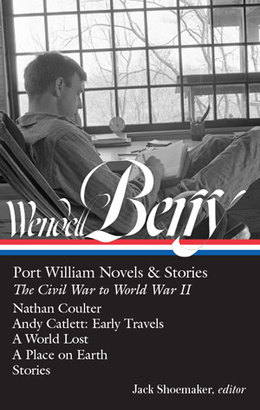
I can’t wait to get my hands on Wendell Berry’s latest book, Wendell Berry: Port William Novels & Stories (The Civil War to World War II). Here’s an introduction to it and Berry’s other works, by none other than Nick Offerman:

He has garnered adoration and accolades for his poetry, his essays and his fiction, but in a general sense no distinction need be drawn between these genres. All of his writing thrives on the ground water of his common sense and his affection for his place on earth and the inhabitants of that place. In the eight decades and counting Mr. Berry has been paying attention, he has witnessed his species genuflecting to the modern fashion of keeping pace with the ever-increasing proliferation of consumer goods and services. By maintaining a lifestyle that eschews that sensibility by simply choosing not to go any faster than necessary, he has maintained a perspective rife with wisdom by which we can all prosper and thrill.

We can’t all be an exemplar of the agrarian lifestyle like Wendell Berry, who produces a staggering volume of literary work while managing his Kentucky farm. But there’s a great deal we can do to restore sanity and meaning in our lives. The disease Berry diagnoses is consumerism, by which he does NOT mean various efforts to ensure the safety and quality of goods, but the modern mindset that helplessness and rootlessness are virtues rather than shortcomings. In Berry’s words, “A mere consumer is by definition a dependent.” Madison Avenue sells pre-packaged identity, esteem, and meaning, and when expensive “stuff” fails to make us happy, the answer is to buy more.

How to be less dependent? Make your own food. Make your own music. Make your own furniture. And think before you buy more plastic yuck you don’t really need. And of course, we can inform ourselves about the condition we’re in, and Berry’s work is a great place to start. I’ve found his writings inspirational.

By the way, I had no idea Offerman was something of a Renaissance man. In addition to acting, he makes boats, furniture, and has written three books. He disdains labels and ideologies, and considers himself “a free-thinking American.” We could use a few more of those.

The Battle of Okinawa

Battle of Okinawa

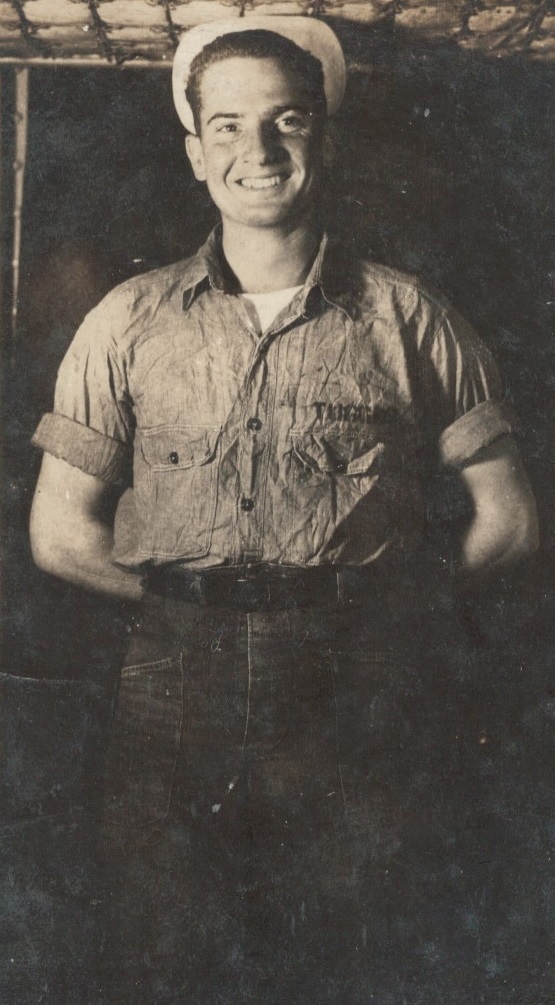
My father, Clayton Tuggle, passed away this Saturday. He was the most decent man I ever met. My brother and I, who knew nothing of war except for what we saw on TV and in the movies, never could figure out why he wouldn’t talk about his experiences in the Navy in WWII. 50 years after he hung up his sailor’s cap, he went on a local talk radio station and took questions for two hours. Then he gave me and my brother a handwritten account of the Battle of Okinawa, which I transcripted. G.P. Cox of Pacific Paratrooper kindly posted my Dad’s story on his excellent WWII blog. Please read this, and remember our WWII veterans. Thank you.

“The Endless” – A Lovecraftian masterpiece

Last night, my wife and I attended the Charlotte Film Society’s screening of “The Endless,” the latest project from indie filmmakers Justin Benson and Aaron Moorhead. When the closing credits rolled, we quickly agreed that in an age of sternum-rattling surround sound and blinding special effects, this film was truly something different: It pulled us in and held us with first-class writing and acting.

Think that filmmaking approach will catch on? We can only hope.

In the movie, brothers Justin and Aaron (yeah, cute!) have hit rock bottom. Years earlier, they’d enjoyed notoriety after they escaped what they described to the news media as a “UFO death cult.” But now, their notoriety has faded, and they’re barely making a living in their cleaning business. Collection agencies hound them, they can’t make friends, and the young ladies they meet aren’t interested in dating ex-death cult members. When younger brother Aaron decides he can’t stomach any more normalcy and wants to visit the old commune, Justin reluctantly agrees.

What could go wrong?

The film opens with this quote from H. P. Lovecraft: “The oldest and strongest emotion of mankind is fear, and the oldest and strongest kind of fear is fear of the unknown.” That quote is a nod to the profound influence Lovecraft has exerted on Benson and Moorhead. (In the closing credits, they pay special tribute to Guillermo Del Toro, another Lovecraftian storyteller.)

What makes “The Endless” stand out is its unforced but relentless buildup of details that lull and mislead. When the seemingly commonplace path you’re following suddenly twists around and scares the daylights out of you, you can only wonder how you could have been so blind. “The Endless” had an effect on me similar to “Rosemary’s Baby,” with its clever presentation of clues that could be dismissed as merely odd that suddenly add up to unspeakable terror.

Now THAT’S entertainment.

Beowulf: The enduring appeal of an Anglo-Saxon ‘superhero story’

Viking

Here’s a great article from the BBC on the enduring influence of the epic poem that defined Western literature and thought:

Some 1,300 years on from when most historians believe it was written, Beowulf continues to be shared, adapted and revised, whether on screen, in print or in song.

JRR Tolkien, who was a noted expert on the poem, is widely thought to have taken inspiration from Beowulf for his Lord of the Rings trilogy.

According to Prof Andrew Burn, from University College London (UCL), the roots of popular medieval-themed video games and TV shows can also be found in this epic saga.

“Look at Lord of the Rings, Dungeons & Dragons, Game of Thrones, any of those big TV franchises, and you realise what the perennial source of interest there is in the same themes: bravery, mortality, power struggles, social hierarchy,” he says.

Beowulf was one of my favorites as a student in high school and college. I now own translations by Kevin Crossley-Holland, Burton Raffel, JRR Tolkien, and Seamus Heaney. Of the four, my favorite is Heaney’s. Its sparkling, dynamic prose best matches the spirit and power of the story and its characters. Here’s a taste from page 51. It’s the scene where Beowulf, who has chosen to fight Grendel bare-handed, first tackles the monster in the mead-hall of King Hrothgar:

And now the timbers trembled and sang,
a hall-session that harrowed every Dane
inside the stockade: stumbling in fury,
the two contenders crashed through the building.
The hall clattered and hammered, but somehow
survived the onslaught and kept standing.

The legacy and importance of Beowulf was not only established by its being a robust and entertaining tale, but because it defined Western civilization itself. The worldview here is one of accommodation and repurposing of pagan traditions. Instead of scouring the old ways it encountered, Christianity adapted pagan values and made them its own. For example, Beowulf is presented as a warrior-savior, a kind of Nordic Jesus. And as James C. Russell argued in The Germanization of Early Medieval Christianity, Christianity in northern Europe was significantly altered to become a “world-embracing” rather than a “world-denying” religion. As Kevin Crossley-Holland concludes in the BBC article, one of Beowulf’s themes is that “On the whole, life’s to be relished, lived to the full, laughed with and at.”

JRR Tolkien certainly concurred with that view, as every page of The Lord of the Ring confirms.

Spooky Wisdom

Earth

Journalist Gracy Olmstead examines modernism’s legacy of sterile efficiency and the anti-human spaces it spawned:

But in modernity … we chose to dispense with precedent and tradition. We decided to distrust the “spooky wisdom” of the past—whether it had to do with old-fashioned agrarianism or dense walkability—and instead start from scratch, inventing our own way of doing things. Thus, freeways cut through the core of our cities, severing neighborhoods and communities. Suburbs sprung up around cosmopolitan centers, fashioning their own car-centric rhythms and culture. Farmers, meanwhile, were told to “get big or get out,” to trade diversity and sustainability for homogeneity and profit. Small to midscale farms steadily lost land and resources to their larger, industrialized counterparts.

The “spooky wisdom” she writes about is a term borrowed from quantum theory. It refers to intuitive insights that work even though we can’t fully explain WHY they work. Olmstead offers examples from ancient cities and rural communities whose designs not only fulfilled profound human needs but have survived and thrived over long centuries. Her great-grandfather, she notes, resisted the efficient yet inhumane practice of “confined animal feeding” on his small farm because providing open pastures “made the animals happy and kept the land pretty.”

I’ve long believed that our longing for beauty rises from our deepest needs and provides crucial guidance in meeting those needs. Our yearning to interact and enjoy nature and other people has been pushed aside in favor of gratifying material wants. In the mad rush to get there faster and consume more and more, we’ve managed to sequester our bodies in polluting cars or in the shadows of towering buildings. And we wonder why we feel so isolated and small.

However, some hopeful currents are stirring, from the return to small, sustainable agriculture to walkable greenways in our cities. Nature tends to be self-correcting, and I believe the pain inflicted by modernism is a signal we as a species are finally responding to.

You, Me, and the Whole Wide World

Whole Wide World

I recently wrote a guest post for Sue Vincent’s wonderful spiritual, art, and folklore site. My post focuses on a topic I find myself thinking about more and more:

Countless online and printed articles have wrestled with what has become the most troubling question of our age: What is happening to us?

The cascade of electrons and ink aimed at this question underscores our growing realization that many of the sources of order we once relied on, from governments to churches, are coming apart. Individuals are coming apart, too. Despite our material opulence and abundance of sexual choices, we’re depressed. People are increasingly alienated from each other, divorcing at record rates, and respond by insulating themselves in electronic diversions and pills. Many commentators have attempted explanations, but I think no one has attacked the question more directly and honestly than anthropologist Helen Fisher in this interview with Krista Tippett:

Ms. Tippett: Right. We don’t have those extended circles of people who know them.
Ms. Fisher: … Serial pair-bonding is probably basic to the human animal, series of partnerships. But what is really unusual, for me, is the loss of local community. We have extended communities — we have our internet friends; we’ve got our work friends; we’ve got our people who we exercise with; we’ve got people who we go to a poetry conference with — whatever it is. But we don’t have local community.

Read the rest at Sue Vincent’s Daily Echo.

Cathedra

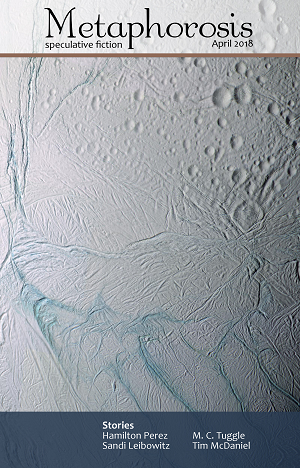
“‘Cathedra’ is beautiful, realistic, fun to read.” Alice Osborn, author of Heroes Without Capes. Metaphorosis April 2018

My story “Cathedra” is featured in the latest issue of Metaphorosis. It’s free online all week.

Ben Kaplan is a loner who considers himself the best astrogeologist in the Asteroid Belt. But when he’s blamed for the deaths of two miners on Enceladus, Saturn’s most mysterious moon, he confronts more than a threat to his reputation. When a previously unknown species that rules the moon’s sub-surface ocean captures Kaplan, the only way to save himself is to stop the creatures from destroying the entire colony.

Cathedra

In a wondrous yet deadly setting of underground oceans, organic atomic reactors, and sunlit geysers shooting into space, “Cathedra” is a tale about the individual’s quest for identity and purpose within society, as well as one’s connection to the universe. The title and theme came from this beautiful anecdote:

A man came upon a construction site where three people were working. He asked the first, “What are you doing?” and the man replied: “I am laying bricks.” He asked the second, “What are you doing?” and the man replied: “I am building a wall.” As he approached the third, he heard him humming a tune as he worked, and asked, “What are you doing?” The man stood, looked up at the sky, and smiled, “I am building a cathedral!”

This is my first appearance in Metaphorosis, which bills itself as “a magazine of science fiction and fantasy. We offer intelligent, beautifully written stories for adults.” “Cathedra” is hard sci-fi inspired by an article in Astronomy magazine about Enceladus, one of the most promising sites for life in our solar system. (That’s a NASA photo of Enceladus on the cover.)

I want to express thanks to my wife Julie and to my comrades-in-critique at the Charlotte Writer’s Club for their invaluable suggestions and insights. I hope you enjoy “Cathedra.”

Patience Is A Virtue

Patience is indeed a mindset you MUST develop if you’re going to write. Love the Rousseau quote, “Patience is bitter, but its fruit is sweet.”

evie gaughan's avatarEvie Gaughan

IMG_20180316_160150

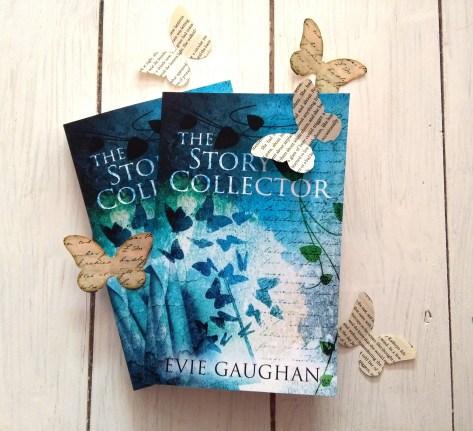
There are many skills that an author needs to learn in this business of pub, patience being the most important.  Patience with yourself, as the magical story in your head makes its way stumbling and lurching onto the page with all the grace and skill of a toddler.  Patience with the world when it doesn’t immediately recognise your brilliance.  Patience with agents and publishers while you await their response to your submission.  And now, for me, a new kind of patience while I wait for my book to be released.

IMG_20180410_093419

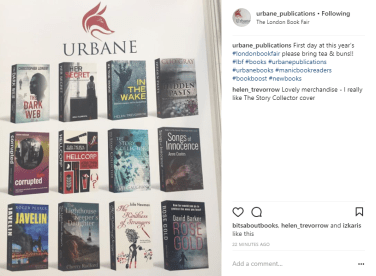
The advance reader copies have been sent out and happily, joyously, wondrously, the feedback is good 🙂  Editors and publications have been contacted, copy sent in.  The blog tour has been arranged.  And as we speak, my book (along with those of my fellow Urbanites) are being showcased at The London Book Fair.  THE LONDON BOOK FAIR!

lbf2lbf

As Jean-Jacques Rousseau…

View original post 261 more words

There’s No Getting Around It: Old Is Old

If you like hard truths expressed with charm and insight, you’ll want to check out Neil’s latest. This message is one I can relate to!

Yeah, Another Blogger's avatarYeah, Another Blogger

Holy crap, or more to the point, holy shit, I’m getting old. Old, as in old. I mean, how is this possible? I used to think that the rules didn’t apply to me. I don’t like this game!

Not until my most recent birthday, though, did I ever feel the least bit depressed about the advancing years. But when I spun the dial six months ago and it landed on the big 7-0, I gulped. Then I gulped again. Then I said to myself, “Neil, you’ve been around a looong time. In your head you might feel no different than you did when you were 45. But times have changed. The wrinkles on your face are multiplying faster than amoebae. Not to mention that your ass is starting to look as grainy as a minute steak. And the hairs on your head? Cowboy, there are fewer of those…

View original post 810 more words