Category Archives: Science fiction

The Magic of Swamps

My wife and I just got back from Carolina Beach. We spent Tuesday hiking through Carolina Beach State Park, a 761-acre wildlife sanctuary in southeastern North Carolina bordered by the Intracoastal Waterway and the mighty Cape Fear River.
We need more places like this. After driving nearly 200 miles from Charlotte down I-74, much of which is garrisoned by countless installations of Burger This and Taco That, we were ready for something that wasn’t standardized and sterile.

The Swamp Trail was alive with surprises. Here’s the Lily Pond, which was overflowing with dark green lily pads and dotted with white blossoms, all floating in unpolluted water. The air around the Lily Pond smelled deliciously earthy and rich.

Not far away, large swaths of the pine forest still showed signs of this summer’s controlled burn. This process helps clear away old and diseased vegetation, thereby freeing up nutrients for the soil and new life, such as this little guy:

If this newborn pine reminds you of the young Groot, you’re not the only one.

Swamps reaffirm the astonishing resilience and adaptability of life. The Wilmington, North Carolina area is the only place in the world where you can find Venus Flytraps. Both Pitcher Plants and Venus Flytraps evolved in an environment lacking the proteins and nitrogen needed to sustain them, so these plants started feeding on meat. We didn’t come across any Venus Flytraps on our hike, but here are some Pitcher Plants we saw waiting for their usual customers, including flies, small frogs, and even birds:

Carnivorous plants. Pretty wild, huh?

Guess you could say swamps are to our everyday environment what science fiction and fantasy are to our routine reading. In the swamp, you’re face-to-face with nature’s more fantastical creatures, creatures whose vitality and outlandish attributes force you to pay attention to them. Swamps are the incubators of wild imaginings and unexpected beauty. My story “Hunting Ground,” which was included in the Unbound II: Changed Worlds anthology, was not only set in a swamp but inspired by my boyhood ramblings in local marshes. Did carnivorous plants get a starring role? Well, their (could be) cousins did …

Getting outdoors, and hiking in particular, help you sharpen your senses. And don’t forget how experiencing nature lets you encounter beauty and rediscover peace of mind, which can lead you to becoming a more balanced person and a better writer.

Happy 230th Birthday, Enceladus, Our Solar System’s Greatest Hope For Life Beyond Earth

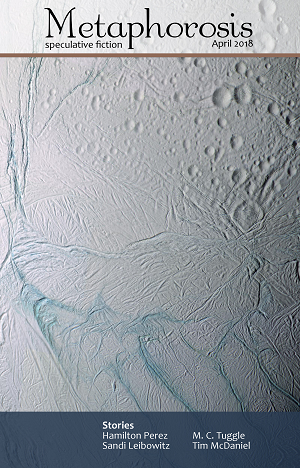
Metaphorosis April 2018 The latest issue of Forbes Magazine features this article commemorating the 230th anniversary of William Herschel’s discovery of Saturn’s most intriguing moon, Enceladus. Astrophysicist Ethan Siegel explains why this mysterious and beautiful body fascinates scientists:

Given that we know of 62 moons around Saturn, and that one of them (Titan) is enormous and has a thick atmosphere with liquid hydrocarbons on its surface, it hardly seems like Enceladus would be the place to look for life. It has no thick atmosphere like Titan; it has no lava-rich volcanoes like Io or cryovolcanoes like Triton. But still, Enceladus might be the most habitable place in our Solar System beyond Earth.

Its ultra-reflective, lifeless surface simply provides cover for a complex, possibly life-rich liquid ocean that begins just ~20 kilometers (12 miles) beneath the icy crust. A series of pale blue stripes cuts across its surface, telling the tale of deep fissures that go down into the interior of the world. But what’s perhaps most remarkable is that we can actually see water-ice being spewed from these fissures into space, extending upwards for hundreds of miles (or kilometers) with every eruption.

With water, energy, and organic molecules, some new, alien form of life could very well be waiting here to be discovered. And just to deepen the allure of this remarkable little moon, Siegel reminds us that we once believed the sunless bottom of our own oceans could not support life, and yet we now know creatures do indeed live around hydrothermal vents. And those vents, with their rich interplay of chemical and thermal processes, may well explain the origin of life itself.

Nature has frequently exploded our notions of the possibilities of life, a truth that inspires both science and science fiction. Enceladus reminds us just how vast, beautiful, and awe-inspiring the universe truly is.

UPDATE: From the comments section:

Great read as usual and one I will look into more. Curious? Is there any works of science-fiction that feature this Moon.

MCT: Oh, here’s one:

https://magazine.metaphorosis.com/story/2018/cathedra-m-c-tuggle/
George RR Martin: ‘Science fiction has conquered the world’

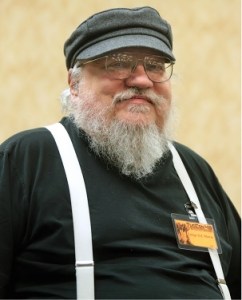
This Irish Times article gives a little background into Martin’s life and what inspired him growing up. Raised in public housing, Martin found escape from his bleak surroundings in the soaring fiction of Robert Heinlein and other science fiction authors.

It would seem Martin’s fortunes have changed.

When asked about the near-fanatical devotion sci-fi readers feel about their favorite authors, Martin replies:

“Science fiction, for much of its history – and this goes back to before I was born – was not considered reputable,” says Martin. “It was seen as cheap gutter entertainment. I was a bright kid, but even I had teachers say to me, ‘Why do you read that science-fiction stuff? Why don’t you read real literature?’ You got that kind of snobbism.”

I remember one of my favorite English lit professors catching heat from his peers because he had us read Kurt Vonnegut’s Slaughterhouse Five, now considered a classic. And Vonnegut himself got zinged a few times in his career for writing sci-fi stories.

But as Martin says, times have changed.

The Internet Speculative Fiction Database

I’ve recently been included in The Internet Speculative Fiction Database.

The ISFDB provides bibliographic information on past and present authors of science fiction, fantasy, and horror. Listings include author pseudonyms, series, awards, and cover art. The publication’s goal is to improve the coverage of speculative fiction to 100%, and they have earned a reputation for being fastidious about nailing down the facts. ISFDB won the 2005 Wooden Rocket Award for the Best Directory Site.

Cory Doctorow wrote in Science Fiction Age: “The best all-round guide to things science-fictional remains the Internet Speculative Fiction Database.”

I’m honored. My thanks to the ISFDB volunteers who included my works.

Editors’ Choices for Bewildering Stories’ Second Quarter

The God Particle

My short story “The God Particle” was selected as one of the Editors’ Choices for Bewildering Stories’ second quarter.

I’ve been pleasantly surprised how readers have reacted to this story. S. J. Higbee, author of the Sunblinded Trilogy, wrote, “Fabulous story – I really enjoyed it.” And I thoroughly enjoyed researching and writing it. If you haven’t read it yet, check it out.

My thanks to managing editor Don Webb and to the review editors at Bewildering Stories.

The God Particle

God Particle The latest issue of Bewildering Stories features my story “The God Particle.”

Though he’s a rookie engineer at the Ising Particle Collider, Larry Bethany knows the facility’s inner workings better than anyone else. When all safeguards mysteriously fail and the system’s super-magnets overheat, Larry descends into the accelerator’s interior to shut down the power and prevent a meltdown. Racing against time, Larry discovers the impending disaster is no accident, and learns more about the collider – and himself – than he thought possible.

Not long ago, I read there are over 30,000 accelerators slamming sub-atomic particles into each other at near-light speed just to see what they’ll do. Science, however, is insatiable, so universities and research facilities around the world are pouring billions into building even bigger, more powerful units.

That got me to thinking — could there be ANY unforeseen consequences of tinkering with the basic building blocks of the universe? Just wondering …

Asimov’s 2019 predictions – fiction or fact?

Another genius of the last century, Yogi Berra, once quipped that “It’s tough to make predictions, especially about the future.” And that’s why we have to admire Isaac Asimov for getting so many things right, as this BBC article argues:

He foresaw the rise of computers, saying the complexity of society would make them “impossible to do without”, disrupting work and penetrating the home.

“To think that computers would take over the world was remarkably insightful at that time,” thinks Calum Chase, who writes both fiction and non-fiction books on the subject of artificial intelligence.

“Most bosses did not use computers in the 80s. It was their secretaries who had them and they would print out emails for the bosses to read. The internet was around but not many people knew about it.”

These days, Asimov’s predictions seem rather tame — well, OF COURSE computers are essential, not just in business, but in education, entertainment, and personal communications. But there was heated opposition to them when they first appeared.

Chase’s comments about the lowly status of computers in the ’80s bring back many memories. I worked for Jefferson-Pilot Corporation back then, a holding company for several life, health, and property insurance companies in Greensboro, North Carolina. My work with computers and a corporate-wide cost reduction program led to my transfer to the Organizational Development department, where we analyzed workflows, proposed more efficient and effective methods, and managed automation projects. That was one cool job.

I quickly learned that many of the managers we worked with wanted nothing to do with personal computers, which they viewed as glorified typewriters. In one of my projects, I mapped out a workflow process that eliminated the need for life insurance underwriters to dictate to a transcriptionist, who would then enter data into the mainframe (you know, a REAL computer). Instead, I proposed the underwriter directly enter the applicant and policy information into a local area network. The underwriting manager complained to my boss that I wanted to turn professional underwriters into secretaries.

After all, computers have a keyboard, and keyboards are for clerical workers!

Yes, times have changed. And Isaac Asimov saw a lot of what was coming. “Genius” is an over-used compliment these days, but I’d say he earned it.

The Pioneers of Pulp

Science Fiction and Fantasy, once despised by the creators of popular entertainment as well as literary scholars, have not only risen in the eyes of serious students of literature but among the general public. What accounts for this sea-change? We could point to the surprising success of both Star Trek (soft sci-fi) or Star Wars (sci-fan), but the origins of the near-dominance of sci-fi/fantasy in popular entertainment today goes back a little further, as this must-read from Open Culture argues:

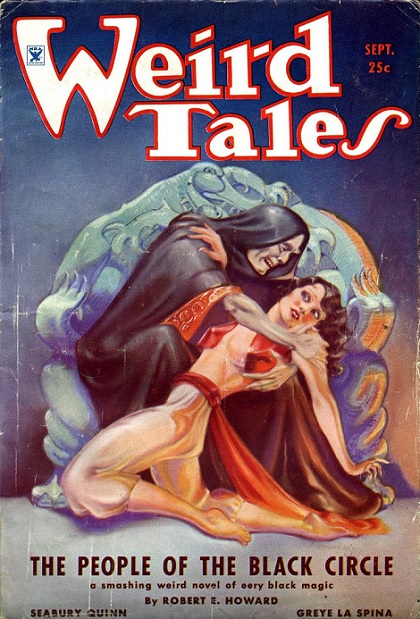
Do we start with The Castle of Otranto, the first Gothic novel, which opened the door for such books as Dracula and Frankenstein? Or do we open with Edgar Allan Poe, whose macabre short stories and poems captivated the public’s imagination and inspired a million imitators? Maybe. But if we really want to know when the most populist, mass-market horror and fantasy began—the kind that inspired television shows from the Twilight Zone to the X-Files to Supernatural to The Walking Dead—we need to start with H.P. Lovecraft, and with the pulpy magazine that published his bizarre stories, Weird Tales.

I have to agree. Lovecraft’s the man!

Don’t miss the article’s treasure trove of links to the letters of H.P. Lovecraft, as well as links to classic editions of Weird Tales featuring stories by Lovecraft, Ray Bradbury, Dorothy Quick, Robert Bloch, and Theodor Sturgeon. What a great way to get ready for Halloween!

A Quiet Place

As my wife and I settled into our dollar-movie-theatre seats, I was pleased to recall that yet another sci-fi film had received glowing audience and critical acclaim. Minutes after it started, I realized the reviews don’t give a clue about how good, how intelligent, and how soul-stirring this movie is.

Yes, it’s entertaining, and yes, it breaks conventions. Some of the breaks worked for me. Making it a (mostly) silent movie transformed it into much more that a “scary” movie. And scary it is, with plenty of white-knuckle scenes as a rural family cowers from a blind but ruthless predator that locates and attacks its victims when they make the faintest sound. The scant dialogue revved up the power of the visual tension to nearly unbearable levels. (At one point, a lady a few seats behind me whispered to her husband that she couldn’t take any more, and scampered out of the theatre.) Some of the conventions it broke left me feeling a bit cheated and shocked. Think a tale about a loving family struggling to survive will end without any casualties? The movie breaks that one in the first scene.

So it’s a hard film to watch at times. But “A Quiet Place” is a masterpiece of cinematic storytelling. Also, it tackles some themes head on in ways I found deeply moving and agreeable. It’s a pro-natalist, pro-sociobiology adventure; both the mother and father courageously do what they must to preserve the family. Despite the danger and the sacrifice, the husband and wife decide to have another baby. (And remember – babies cry!) At one point, the mother asks her husband, “Who are we if we can’t protect our children?”

That’s the key question of our age – just as it is in any age.