Tag Archives: science fiction

Asimov’s 2019 predictions – fiction or fact?

Another genius of the last century, Yogi Berra, once quipped that “It’s tough to make predictions, especially about the future.” And that’s why we have to admire Isaac Asimov for getting so many things right, as this BBC article argues:

He foresaw the rise of computers, saying the complexity of society would make them “impossible to do without”, disrupting work and penetrating the home.

“To think that computers would take over the world was remarkably insightful at that time,” thinks Calum Chase, who writes both fiction and non-fiction books on the subject of artificial intelligence.

“Most bosses did not use computers in the 80s. It was their secretaries who had them and they would print out emails for the bosses to read. The internet was around but not many people knew about it.”

These days, Asimov’s predictions seem rather tame — well, OF COURSE computers are essential, not just in business, but in education, entertainment, and personal communications. But there was heated opposition to them when they first appeared.

Chase’s comments about the lowly status of computers in the ’80s bring back many memories. I worked for Jefferson-Pilot Corporation back then, a holding company for several life, health, and property insurance companies in Greensboro, North Carolina. My work with computers and a corporate-wide cost reduction program led to my transfer to the Organizational Development department, where we analyzed workflows, proposed more efficient and effective methods, and managed automation projects. That was one cool job.

I quickly learned that many of the managers we worked with wanted nothing to do with personal computers, which they viewed as glorified typewriters. In one of my projects, I mapped out a workflow process that eliminated the need for life insurance underwriters to dictate to a transcriptionist, who would then enter data into the mainframe (you know, a REAL computer). Instead, I proposed the underwriter directly enter the applicant and policy information into a local area network. The underwriting manager complained to my boss that I wanted to turn professional underwriters into secretaries.

After all, computers have a keyboard, and keyboards are for clerical workers!

Yes, times have changed. And Isaac Asimov saw a lot of what was coming. “Genius” is an over-used compliment these days, but I’d say he earned it.

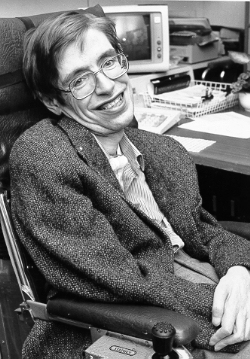
Stephen Hawking predicted race of ‘superhumans’

Here’s a troubling insight from one of history’s great scientists, via The Guardian:

The late physicist and author Prof Stephen Hawking has caused controversy by suggesting a new race of superhumans could develop from wealthy people choosing to edit their and their children’s DNA.

Hawking, the author of A Brief History of Time, who died in March, made the predictions in a collection of articles and essays.

The scientist presented the possibility that genetic engineering could create a new species of superhuman that could destroy the rest of humanity. The essays, published in the Sunday Times, were written in preparation for a book that will be published on Tuesday.

Can’t help but remember this episode from Star Trek TOS:

Who can forget this blistering exchange between Spock and McCoy:

SPOCK: Hull surface is pitted with meteor scars. However, scanners make out a name. SS Botany Bay.
KIRK: Then you can check the registry.
SPOCK: No such vessel listed. Records of that period are fragmentary, however. The mid=1990s was the era of your last so-called World War.
MCCOY: The Eugenics Wars.
SPOCK: Of course. Your attempt to improve the race through selective breeding.
MCCOY: Now, wait a minute. Not our attempt, Mister Spock. A group of ambitious scientists. I’m sure you know the type. Devoted to logic, completely unemotional

The problem with selective breeding, as Spock later points out, is that “superior ability breeds superior ambition.” Instead of Ghandis and Einsteins, you get Hitlers and Napoleons.

Indeed, that’s the problem with all utopian schemes, from eugenics to communism — those pesky unforeseen consequences. Our minds evolved to adapt and survive in small social groups facing a harsh, unforgiving environment. The complex processes underlying the universe are beyond our grasp, just as our muscles are incapable of tossing boulders into orbit. Our muscles and our minds are not only useful, but extraordinary, but each have their limitations. True wisdom is the recognition and acceptance of those limitations.

That’s why we should heed Hawking’s last words.
The Pioneers of Pulp

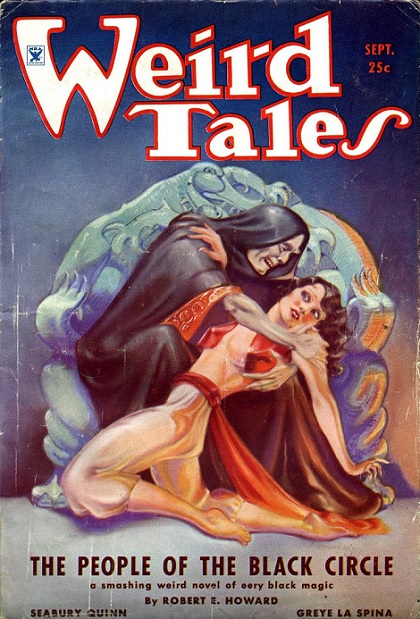
Science Fiction and Fantasy, once despised by the creators of popular entertainment as well as literary scholars, have not only risen in the eyes of serious students of literature but among the general public. What accounts for this sea-change? We could point to the surprising success of both Star Trek (soft sci-fi) or Star Wars (sci-fan), but the origins of the near-dominance of sci-fi/fantasy in popular entertainment today goes back a little further, as this must-read from Open Culture argues:

Do we start with The Castle of Otranto, the first Gothic novel, which opened the door for such books as Dracula and Frankenstein? Or do we open with Edgar Allan Poe, whose macabre short stories and poems captivated the public’s imagination and inspired a million imitators? Maybe. But if we really want to know when the most populist, mass-market horror and fantasy began—the kind that inspired television shows from the Twilight Zone to the X-Files to Supernatural to The Walking Dead—we need to start with H.P. Lovecraft, and with the pulpy magazine that published his bizarre stories, Weird Tales.

I have to agree. Lovecraft’s the man!

Don’t miss the article’s treasure trove of links to the letters of H.P. Lovecraft, as well as links to classic editions of Weird Tales featuring stories by Lovecraft, Ray Bradbury, Dorothy Quick, Robert Bloch, and Theodor Sturgeon. What a great way to get ready for Halloween!

A Quiet Place

As my wife and I settled into our dollar-movie-theatre seats, I was pleased to recall that yet another sci-fi film had received glowing audience and critical acclaim. Minutes after it started, I realized the reviews don’t give a clue about how good, how intelligent, and how soul-stirring this movie is.

Yes, it’s entertaining, and yes, it breaks conventions. Some of the breaks worked for me. Making it a (mostly) silent movie transformed it into much more that a “scary” movie. And scary it is, with plenty of white-knuckle scenes as a rural family cowers from a blind but ruthless predator that locates and attacks its victims when they make the faintest sound. The scant dialogue revved up the power of the visual tension to nearly unbearable levels. (At one point, a lady a few seats behind me whispered to her husband that she couldn’t take any more, and scampered out of the theatre.) Some of the conventions it broke left me feeling a bit cheated and shocked. Think a tale about a loving family struggling to survive will end without any casualties? The movie breaks that one in the first scene.

So it’s a hard film to watch at times. But “A Quiet Place” is a masterpiece of cinematic storytelling. Also, it tackles some themes head on in ways I found deeply moving and agreeable. It’s a pro-natalist, pro-sociobiology adventure; both the mother and father courageously do what they must to preserve the family. Despite the danger and the sacrifice, the husband and wife decide to have another baby. (And remember – babies cry!) At one point, the mother asks her husband, “Who are we if we can’t protect our children?”

That’s the key question of our age – just as it is in any age.

April issue of Metaphorosis on Amazon

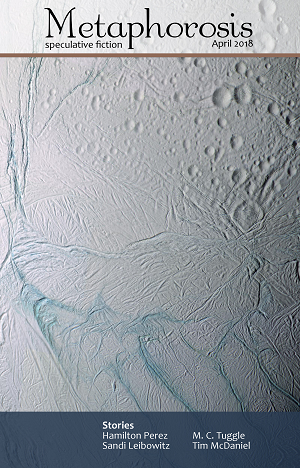
Metaphorosis April 2018

You can now pre-order the April issue of Metaphorosis Magazine in paperback, which will be available on July 1. Here’s what’s included:

Bye Bye Skinny Cow – Hamilton Perez
Cathedra – M. C. Tuggle
The Cypress and the Rose – Sandi Leibowitz
Koehl’s Quality Impressions – Tim McDaniel

I’m honored to be included with such distinguished authors. The cover shows Saturn’s mysterious moon Enceladus, the setting of my contribution, “Cathedra.” And I was particularly excited by the reviews:

“‘Cathedra’ is beautiful, realistic, fun to read.” Alice Osborn, author of Heroes Without Capes

“‘Cathedra’ is a wonderful–and memorable–story.” Susan Shell Winston, author of Singer of Norgondy

Metaphorosis offers “well-written stories with humor, emotion, and wit,” and I think you’ll agree they deliver what they promise. Enjoy!

Quote of the day

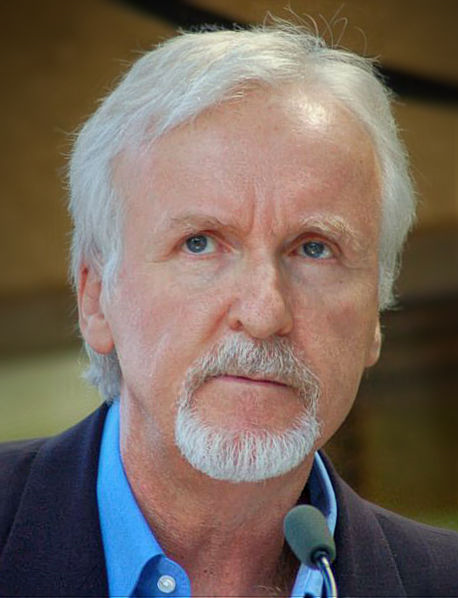
James Cameron
Image by Angela George

“Science fiction is a very good way to talk about politics and human systems, by extrapolating them to another planet or into a future where it doesn’t piss people off to read about them. You talk about people’s politics or religion and they get mad because they feel threatened. But you set it on another planet or in some alternate universe, and they can look at it with a more objective eye and maybe look at the world through another perspective, if only for a short time.” James Cameron, director of Avatar, The Terminator and True Lies

You, Me, and the Whole Wide World

Whole Wide World

I recently wrote a guest post for Sue Vincent’s wonderful spiritual, art, and folklore site. My post focuses on a topic I find myself thinking about more and more:

Countless online and printed articles have wrestled with what has become the most troubling question of our age: What is happening to us?

The cascade of electrons and ink aimed at this question underscores our growing realization that many of the sources of order we once relied on, from governments to churches, are coming apart. Individuals are coming apart, too. Despite our material opulence and abundance of sexual choices, we’re depressed. People are increasingly alienated from each other, divorcing at record rates, and respond by insulating themselves in electronic diversions and pills. Many commentators have attempted explanations, but I think no one has attacked the question more directly and honestly than anthropologist Helen Fisher in this interview with Krista Tippett:

Ms. Tippett: Right. We don’t have those extended circles of people who know them.
Ms. Fisher: … Serial pair-bonding is probably basic to the human animal, series of partnerships. But what is really unusual, for me, is the loss of local community. We have extended communities — we have our internet friends; we’ve got our work friends; we’ve got our people who we exercise with; we’ve got people who we go to a poetry conference with — whatever it is. But we don’t have local community.

Read the rest at Sue Vincent’s Daily Echo.

Cathedra

“‘Cathedra’ is beautiful, realistic, fun to read.” Alice Osborn, author of Heroes Without Capes. Metaphorosis April 2018

My story “Cathedra” is featured in the latest issue of Metaphorosis. It’s free online all week.

Ben Kaplan is a loner who considers himself the best astrogeologist in the Asteroid Belt. But when he’s blamed for the deaths of two miners on Enceladus, Saturn’s most mysterious moon, he confronts more than a threat to his reputation. When a previously unknown species that rules the moon’s sub-surface ocean captures Kaplan, the only way to save himself is to stop the creatures from destroying the entire colony.

Cathedra

In a wondrous yet deadly setting of underground oceans, organic atomic reactors, and sunlit geysers shooting into space, “Cathedra” is a tale about the individual’s quest for identity and purpose within society, as well as one’s connection to the universe. The title and theme came from this beautiful anecdote:

A man came upon a construction site where three people were working. He asked the first, “What are you doing?” and the man replied: “I am laying bricks.” He asked the second, “What are you doing?” and the man replied: “I am building a wall.” As he approached the third, he heard him humming a tune as he worked, and asked, “What are you doing?” The man stood, looked up at the sky, and smiled, “I am building a cathedral!”

This is my first appearance in Metaphorosis, which bills itself as “a magazine of science fiction and fantasy. We offer intelligent, beautifully written stories for adults.” “Cathedra” is hard sci-fi inspired by an article in Astronomy magazine about Enceladus, one of the most promising sites for life in our solar system. (That’s a NASA photo of Enceladus on the cover.)

I want to express thanks to my wife Julie and to my comrades-in-critique at the Charlotte Writer’s Club for their invaluable suggestions and insights. I hope you enjoy “Cathedra.”

Science Fiction as Improvised Religion

Science Fiction

Our need for a new mythos, that is, a narrative that helps us understand our role in society and the universe, has never been more urgent. Declining church membership, the rise of alternate religions, and the increase in visibility and number of those who consider themselves non-deist clearly indicate that the old narratives simply don’t work for us any more.

And the daily news forces us to realize that our institutions no longer inspire confidence, or instill social order. The division and alienation driving people to acts of madness are red flags telling us we’ve lost our way.

Many commentators claim we need a new mythos to unite and inspire — others say we need to stop speeding down the dead-end road we’re on and get back to the basics. How do we reclaim our humanity and sense of purpose? This short essay from Dispatches from the Cusp looks to science fiction as a signpost leading toward that new mythos:

Within the last couple of centuries, science fiction has served humanity as part searchlight, part sentinel, part prophetic voice.

Originally known as “fantastic fiction” and “speculative fiction,” this artistic genre – genre almost seems an understatement in this context – has not simply entertained us for generations or, for that matter, divined our future. In many instances, science fiction has supplied a kind of evolutionary tug. It not only has also pointed the way toward scientific and technological innovation and our role within this expanded conceptual landscape but has also inspired us to reach for this future – not only to reach toward it but also to conceive and to refine the nature and terms of this quest. To put it another way, science fiction now seems to be integrally bound up in scientific and technological progress, an essential facet of the equation. Much of the scientific and technological progress we have achieved arguably would not have been possible without the clarifying effects of science fiction.

I have also been intrigued for a long time with how science fiction has taken on many of properties of religion, not only in terms of helping us divine the future – no pun intended – but also enabling us to identify, improvise and refine the moral and ethical scaffolding to cope within this emerging future.

I think this writer is on to something. We know that fantastic stories engage deeper responses from readers than mundane exposition. And in a world that’s been flattened by globalism and stripped of its mystery by behavioral psychologists, a renewed sense of wonder is a good place to start if we’re to define a mythos that helps us find our way.

Let’s get started …